A Registrar at a private university in Tamil Nadu forwarded us a consultant's proposal last month. Forty pages. Criterion-wise templates. File organization protocols. A twelve-week Self-Study Report timeline. The consultant was thorough. The problem was that the SSR is for a framework NAAC no longer uses.
Her institution's NAAC cycle expires in early 2027. She had one question: "If NAAC has announced a binary framework that measures institutional maturity instead of documentation, why am I paying someone to organise files for the old seven-criteria system?"
She was asking the right question. Most institutions aren't.
The framework has changed. The portal hasn't opened yet.
On February 10, 2025, NAAC announced the most significant reform to Indian higher education quality assurance in three decades. The graded system — A++, A+, A, B++, and the rest — is being replaced with a binary outcome: accredited or not accredited. Institutions demonstrating excellence will be able to opt into Maturity-Based Graded Levels (MBGL), but the foundational decision will be binary.
The new framework, as outlined in the Dr. Radhakrishnan Committee Report and NAAC's subsequent announcements, will evaluate institutions using an Input-Process-Output model — not the peer-review CGPA calculations of the current framework. The exact attributes, metrics, and assessment mechanics are still being finalised. As of April 2026, the binary accreditation portal has not yet opened for applications. Institutions are waiting.
This creates a dangerous gap. The old framework is winding down. The new framework hasn't launched. And consultants are still selling preparation for a system that's either obsolete or not yet operational.
Walk into almost any NAAC consultancy website today. The services on offer are the same ones sold in 2020: SSR preparation, criterion-wise documentation, IQAC setup, peer team visit preparation. Some of these may still apply under the current RAF pipeline. But for institutions whose NAAC cycle expires in 2027 or later, the question isn't how to prepare under the old rules — it's whether you'll be ready when the new rules take effect.
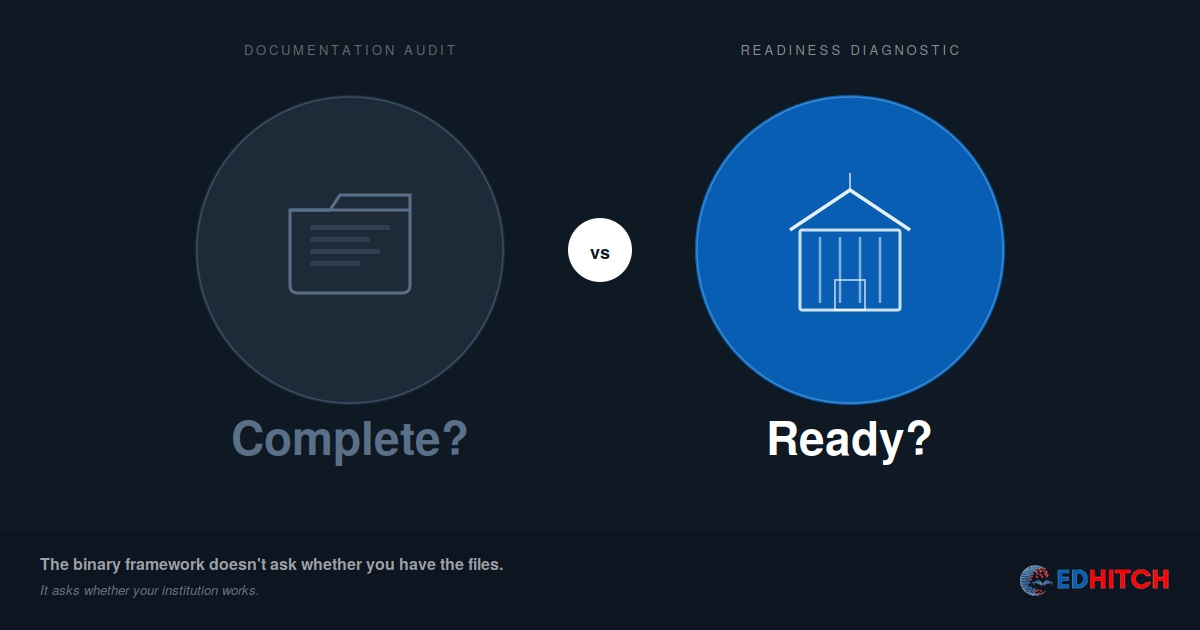
The binary framework doesn't ask whether you have the files. It asks whether your institution works. And the time to assess that is before the portal opens — not after.
Documentation audit vs. institutional diagnostic
A documentation audit answers one question: are your files complete and organised for submission? Useful when the operational house is already in order.
But it cannot tell you whether you'll be accredited under the binary framework. Based on the Radhakrishnan Committee Report and NAAC's stakeholder consultation documents, that decision will hinge on whether your institution demonstrates maturity across a set of attributes assessed through an Input-Process-Output model.
A NAAC Binary Readiness Diagnostic answers a different question: is your institution actually ready — and if not, what specifically needs to change?
The same pattern plays out in NIRF: institutions that are strong but whose data is weak don't need better documentation — they need better data discipline.
Ask your current consultant: "If our files were perfect tomorrow, would we be accredited?" If the answer is yes because they'll make your files perfect, you're buying a documentation audit.
What the diagnostic actually assesses
The NAAC Binary Readiness Diagnostic is built on the 12 Theories of Institutional Performance — the analytical framework Edhitch has developed across twelve years of working with Indian higher education institutions.
1. Attribute-by-attribute readiness
The Radhakrishnan Committee Report identified 8 attributes; NAAC's subsequent stakeholder consultation documents reference up to 10. Regardless of the final count, the diagnostic assesses each expected attribute: does it exist as a lived reality in your institution, is it measurable, and will the measurement hold up under the verification process NAAC is building?
2. Gap prioritisation using the 12 theories
Some gaps are symptoms of a single underlying problem — fix the root cause and multiple attributes improve. The diagnostic distinguishes structural from isolated gaps.
3. Cycle decision framework
For institutions whose NAAC cycle is expiring, the diagnostic addresses a specific strategic question: when the binary portal opens, should you apply under the new framework — or should you pursue accreditation under the RAF while it's still available? This decision has five-year consequences, and institutions that wait until the portal opens to think about it will have already lost months of preparation time.
4. Leadership action plan
A written report and leadership presentation — not a compliance document. Designed for VCs, not IQAC coordinators. The same approach that works in NIRF — strategic clarity, not checklists.
Who should commission one — and why now, before the portal opens
Institutions whose NAAC cycle expires in 2026 or 2027 — you will almost certainly face the binary framework. The diagnostic tells you where you stand before the rules are finalized, giving you maximum preparation time.
Institutions applying for first NAAC accreditation — if you've never been through the NAAC process, waiting for the portal to open and then scrambling to understand a new framework is the worst possible approach.
Institutions already advised to pursue documentation preparation but suspecting it may be solving the wrong problem — the binary framework signals a fundamental shift from documentation to institutional maturity. The diagnostic tells you which preparation actually matters.
Institutions planning multi-year quality investments — not just the spending, but the strategy behind it.
The diagnostic is not for institutions that already have a clear readiness picture and simply need execution support.
What the engagement looks like
Week 1 — data collection and stakeholder interviews. Structured conversations with VC, Registrar, IQAC Director, Deans, and sample faculty.
Week 2 — deep analysis. 12 theories applied to data. Attribute-by-attribute assessment. Off-site, no institutional time required.
Week 3 — gap prioritisation and remediation mapping. Structural gaps distinguished from isolated gaps. Investment-impact analysis for leadership decisions.
Week 4 — report and delivery. Written report plus 90-minute interactive leadership presentation. Designed to ensure leadership understands not just findings, but the decisions they imply.
Programme alumni from Edhitch's 5-Day Integrated NAAC-NBA-NIRF Strategy Programme receive 20% off through April 30, 2026.
Book a NAAC Binary Readiness Diagnostic
A fixed-scope assessment against the expected binary framework attributes, based on the Radhakrishnan Committee Report and NAAC's published reform documents. Written report and leadership presentation included.
Request Engagement Details →A note on guarantees
Edhitch does not guarantee NAAC accreditation outcomes. Be skeptical of any consultant who does.
A documentation audit sells you a deliverable. An institutional diagnostic sells you a clearer view of your own institution — and trusts you to decide what to do about it.
Frequently Asked Questions
What's the difference between a documentation audit and a readiness diagnostic?
A documentation audit checks files. A readiness diagnostic assesses whether your institution is actually ready under the binary framework NAAC has announced. One answers "is your paperwork in order?" The other answers "when the binary portal opens, will your institution be accredited?"
Why doesn't a documentation audit work for binary NAAC?
Based on the Radhakrishnan Committee Report and NAAC's reform announcements, the binary framework will evaluate institutional maturity and outcomes — not file completeness. The shift is from documentation to demonstrated institutional performance.
Who should commission a diagnostic?
VCs, Registrars, and Directors of institutions whose NAAC cycle expires in 2026–27, first-time applicants under the binary framework, and leaders wanting an honest external assessment.
How long does it take?
Four weeks. Week 1: data collection and stakeholder interviews. Week 2: deep analysis using the 12 Theories. Week 3: gap prioritisation and remediation mapping. Week 4: written report and leadership presentation.
What does it cost?
with 50% advance. Programme alumni get 20% off through April 30, 2026.
Does it guarantee accreditation?
No. We provide honest assessment and specific gap identification. Accreditation depends on institutional action. Be skeptical of guarantees.
Related Reading
- Binary NAAC Accreditation – How to Win the Yes/No Game
- Cracking the Binary NAAC Code: A Criterion-Wise Strategy
- NAAC vs NIRF vs NBA: 68% Overlaps — One Strategy, Not Three
- The Institution Was Strong. The Data Was Weak.
- What the DVV Process Actually Checks (And 6 Reasons Clarifications Get Rejected)
- NAAC A+. NIRF Unranked. How Is That Even Possible?

Edhitch
Accreditation & Ranking Intelligence · NAAC · NBA · NIRF · 12 Years · 100+ Institutions