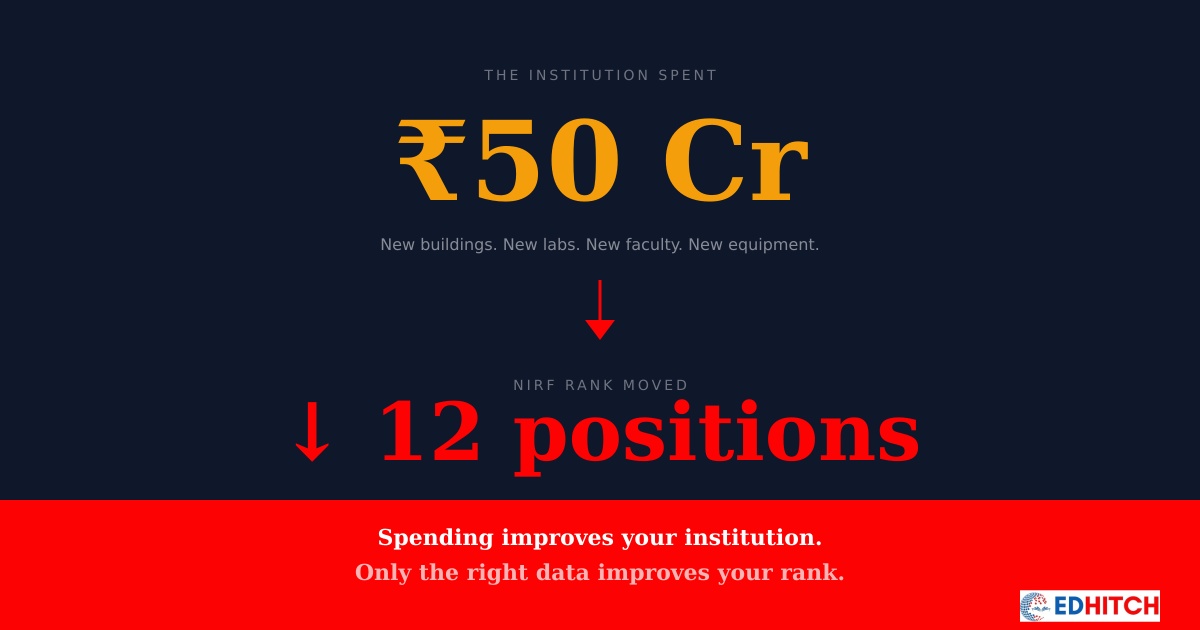
A private university in North India spent ₹48 crore on a new academic block. State-of-the-art classrooms. Modern labs. Conference halls. The management was confident this would reflect in their NIRF ranking the next year.
When the results came, their rank had actually dropped by twelve positions.
The Chancellor called us. "We spent forty-eight crore. How did we go down?"
He wasn't the first. And his frustration is shared by dozens of institutional leaders we've spoken with over the years. They invest — genuinely, heavily — and the ranking doesn't respond.
NIRF doesn't rank investment. It ranks outcomes.
This is the most misunderstood aspect of NIRF. Institutional leaders often assume that spending on quality translates into ranking improvement. It seems logical — better infrastructure means better education means better rank.
But NIRF doesn't measure how much you spent. It measures what the spending produced — and it measures it in very specific ways that don't align with how institutions think about investment.
A new building is an achievement for the institution. For NIRF, it's a line item that may or may not affect the metrics that actually drive the score. Whether it does — and how much — depends on factors that most institutional leaders have never been briefed on.
We've seen institutions that spent crores and dropped in ranking. We've also seen institutions that spent almost nothing and climbed twenty positions. The difference wasn't the money. It was what the data showed.
Spending improves your institution. But only the right data improves your rank. The two are connected — but not in the way most people assume.
The four investment traps
After working with over 100 institutions, we've noticed that misdirected spending falls into four broad patterns. We call them traps because each one feels like progress — but doesn't show up where NIRF looks.
Trap 1: Building more when NIRF measures utilisation. Once infrastructure crosses a certain threshold, additional spending adds diminishing value to the score. NIRF cares about how well resources are used — not how many resources exist. A new building with empty classrooms doesn't move the needle.
Trap 2: Hiring faculty without understanding what NIRF counts. Not every person on your payroll counts the same way in NIRF. Institutions hire aggressively before NIRF submissions, but the way NIRF counts faculty is different from the way HR counts faculty. The investment is real. The rank impact may not be.
Trap 3: Increasing research spending without tracking attribution. Institutions pour money into research — seed grants, conference sponsorship, journal subscriptions. The money is well spent. But whether that research spending translates into NIRF's research score depends on factors that have nothing to do with how much was spent.
Trap 4: Improving placements without changing what NIRF sees. The placement cell works harder, signs more companies, places more students. The institution celebrates. But NIRF measures graduate outcomes in a specific way — and what the placement cell reports to the management is not what NIRF reads from the portal.
In each case, the institution invested in the right direction. The problem was that the investment didn't reach the NIRF scorecard — because there's a gap between what the institution does and what NIRF's algorithm sees.
Why VCs don't get accurate feedback
Here's the uncomfortable truth. Most Vice Chancellors and Principals don't have visibility into how NIRF actually scores their institution. They see the rank. They see the overall score. But they don't see where the marks are being lost — because nobody has decoded it for them at the level of specificity that matters.
The IQAC coordinator fills the portal. The VC sees the rank. If the rank is good, everyone is happy. If the rank is bad, the assumption is "we need to invest more" or "we need to do better."
Neither assumption is usually correct. The problem is rarely about doing more. It's about a disconnect between what the institution is doing and what the NIRF data capture system records.
But diagnosing that disconnect requires reading the institution's data through NIRF's scoring lens — not through the institution's internal reporting lens. And that's a skill set most IQAC teams don't have, because it requires understanding the scoring methodology at a depth that goes far beyond portal filling.
The VC asks "what should we spend on?" The right question is "where are we losing marks?" The answer to the second question often has nothing to do with spending.
The rank is comparative — and that makes it worse
Even when an institution does improve genuinely — better faculty, more research, stronger outcomes — the rank may not move. Because NIRF is a comparative ranking. Your score isn't measured against a benchmark. It's measured against every other institution in your category.
If you improve by 5% but your peer institutions improve by 8%, your rank drops. Not because you got worse — but because others got better faster.
This is why blind investment doesn't work. You can't outspend your way to a better rank. You need to know exactly where your institution loses marks relative to peers — and direct effort precisely there. Anything else is guesswork.
What actually moves ranks
The institutions we've seen make real rank movement didn't necessarily spend more than their peers. They did something different: they understood exactly where their marks were leaking before deciding where to invest.
That understanding comes from a diagnostic — not a budget meeting. It comes from someone reading the institution's data the way NIRF reads it, identifying the specific areas where the score is suppressed, and mapping those areas to institutional decisions.
Sometimes the fix requires investment. Sometimes it requires changing how data is collected. Sometimes it requires restructuring how departments report information. And sometimes it requires nothing more than ensuring that what the institution already does is accurately captured in the portal.
But you can't know which of these applies until you've looked at the data through the right lens. And that lens is institution-specific — because every institution's rank gap has a different root cause.
The question isn't "how much should we spend." The question is "do we know where our marks are going?" Most institutions don't. That's why the rank doesn't move.
Before You Spend, Know Where Your Marks Are Going
Our NIRF Diagnostic identifies exactly where your score is suppressed — so your next investment goes where it actually moves the rank, not where it feels like progress.
We also cover NIRF strategy in our 5-Day programme: April 6-10, 2026 · 7-9 PM · Online
Register Now — ₹2,499 →Frequently Asked Questions
Why didn't my NIRF rank improve after spending on infrastructure?
NIRF doesn't rank based on spending. It measures how resources translate into outcomes. Spending more on buildings or equipment doesn't automatically improve the metrics NIRF uses.
Does spending more money improve NIRF rank?
Not necessarily. An institution that spends less but aligns its data with NIRF's framework can outrank one that spends ten times more.
What does NIRF actually reward?
Measurable outcomes — research output, graduate outcomes, resource utilisation, and perception. Internal progress doesn't become rank movement unless the data reflects it in the way NIRF measures.
Why is my rank stuck despite genuine improvements?
Three common reasons: improvements are in areas NIRF doesn't weight, improvements aren't reflected in the submitted data, or peer institutions improved at the same rate.
What should a VC focus on for NIRF improvement?
Before deciding where to invest, understand where marks are being lost. Most rank gaps come from how data is reported rather than from institutional weakness.

Edhitch
Accreditation & Ranking Intelligence · NAAC · NBA · NIRF · 12 Years · 100+ Institutions