The Director of a private engineering college in Chhattisgarh called us four months before his planned IIQA submission. His institution was eight years old, had graduated four batches, and had never applied for NAAC. He had one question: "We've hired a consultant who says we can get A grade in our first cycle. Is that realistic?"
It wasn't. His institution had no IQAC minutes older than six months. His AISHE data hadn't been uploaded for two years. His placement records used a different counting methodology than NAAC requires. And his consultant had given him a template SSR from another institution with instructions to "adapt it."
He wasn't doing anything wrong. He was doing what most first-cycle institutions do: approaching NAAC as a documentation project rather than an evidence-building process. And that approach produces the same result almost every time — a grade lower than the institution deserves, or worse, a DVV failure that sends the application back.
First-cycle accreditation is not a simpler version of re-accreditation
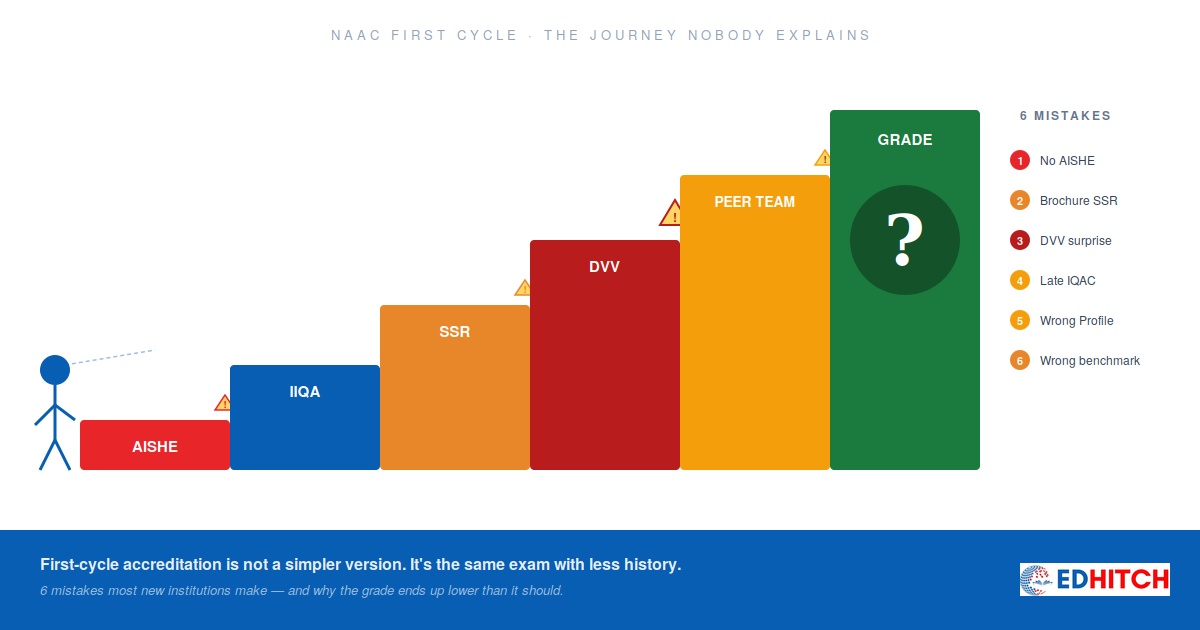
There is no first-timer discount. The process is identical: IIQA submission, SSR preparation, DVV verification, Peer Team Visit, NAAC decision. The same seven criteria. The same quantitative-qualitative split (~70% QnM, ~30% QlM). The same DVV scrutiny. The same peer team expectations.
The difference is that first-cycle institutions have less institutional history to draw from. Re-accreditation institutions can show five years of IQAC functioning, five years of quality improvement data, five years of AISHE submissions. First-cycle institutions have to demonstrate quality with whatever history they have — and most of that history was never documented with NAAC in mind.
The institutions that get the best first-cycle grades are not the ones that prepared the best SSR. They're the ones that started building evidence two years before they applied — not because they were planning for NAAC, but because they were running a quality institution and happened to document it.
Mistake 1: Not registering on AISHE before applying
NAAC requires AISHE registration as a prerequisite for IIQA submission. The AISHE code is mandatory. Yet we regularly encounter institutions that haven't uploaded AISHE data for one or more years — and discover this only when they try to submit IIQA.
The problem isn't just the missing registration. It's the missing data trail. AISHE returns for the last three years establish your institutional baseline — student numbers, faculty count, programmes offered. DVV cross-references your SSR data against AISHE. If your AISHE data is missing or inconsistent with your SSR, DVV flags it immediately.
First-cycle institutions that haven't been filing AISHE regularly arrive at the SSR stage with a fundamental problem: the external data trail that NAAC uses for verification either doesn't exist or contradicts what they're about to submit.
Mistake 2: Treating the SSR as a marketing brochure
The most common first-cycle mistake — and the most expensive. New institutions approach the SSR as an opportunity to showcase their achievements. They write aspirational narratives. They highlight awards, events, and infrastructure. They use the language of a college prospectus.
The SSR is not a prospectus. It is an evidence document. Every quantitative claim will be verified by DVV. Every qualitative claim will be checked by the Peer Team. The SSR doesn't need to be impressive. It needs to be accurate and defensible.
An institution that claims 85% placement in the SSR but can offer letters for only 68% of graduates will have its placement metric recalculated at 68% by DVV. An institution that describes "state-of-the-art labs" but has equipment from 2018 will have the Peer Team note the gap. The Peer Team came to verify, not to be impressed.
The institutions that score best in their first cycle write SSRs that are slightly conservative — claims they can defend with evidence, not claims they hope nobody will check.
Mistake 3: Not understanding how DVV works
DVV is where most first-cycle applications stumble. Institutions that have been through re-accreditation understand DVV — they've been burned by it before. First-cycle institutions encounter it for the first time and are often shocked by its rigour.
DVV checks your quantitative metrics — roughly 70% of your CGPA — against your supporting documents. It doesn't take your word for anything. If you claim 92 faculty with PhDs, you need 92 PhD certificates, appointment orders, and AISHE-consistent records. If DVV finds evidence for only 78, your metric is recalculated with 78.
The 25% QnM pre-qualifier is particularly dangerous for first-cycle institutions. If DVV deviations are severe enough that your quantitative score falls below 25% of the maximum, the accreditation process terminates. You reapply after one year. Fees are forfeited. For an institution applying for the first time, this is devastating — not just financially, but reputationally.
Mistake 4: Building IQAC only for accreditation
NAAC's guidelines state that IQAC should be established from the institution's inception — not when accreditation is being pursued. The Peer Team checks IQAC meeting minutes, ATRs, and quality improvement evidence going back as far as the institution's history allows.
First-cycle institutions that establish IQAC six months before IIQA submission have six months of minutes. Institutions that established IQAC at founding have years of documented quality improvement. The difference is visible in the Criterion 6 score — and it's not something that can be manufactured retroactively.
The harder truth: most first-cycle institutions that establish IQAC late fill the first few meetings with administrative agenda items — examination schedules, event planning, admission updates. These don't score. The Peer Team reads your IQAC minutes for evidence of quality assurance, not administration. Six months of administrative minutes is worse than useless — it's evidence that your IQAC doesn't understand its own role.
Mistake 5: Ignoring the Extended Profile
First-cycle institutions focus almost entirely on the SSR's qualitative narratives. They spend weeks writing criterion-wise responses. They barely glance at the Extended Profile.
This is backwards. The Extended Profile contains the denominators for every quantitative metric in the SSR. Faculty count, student count, programme count, expenditure — these numbers feed into the formulas that generate roughly 70% of your CGPA. Get one Extended Profile number wrong and every metric that uses it as a denominator is wrong.
First-cycle institutions are especially vulnerable because they often don't have established data governance. The faculty count in HR's records differs from the count in the AISHE return. The student count uses a different definition than NAAC's. The expenditure figures mix academic years with financial years. These inconsistencies — harmless in daily operations — become score-reducing errors in the Extended Profile.
Mistake 6: Benchmarking against A++ institutions
The Director in Chhattisgarh had printed the SSRs of three A++ institutions and was using them as templates. His consultant encouraged this. "See how IIT Madras writes their Criterion 3. Write yours like that."
This is terrible advice. An A++ institution has 30 years of research output, international collaborations, and faculty who publish in Nature. A first-cycle institution has four batches of graduates and a faculty that's still building its research profile. Writing your SSR like an A++ institution doesn't make you look like an A++ institution. It makes you look like an institution that doesn't understand its own position.
First-cycle institutions should benchmark against similar first-cycle institutions that received B+ or A grades — institutions of comparable size, age, and type. That's the realistic peer group. The goal isn't to write like IIT Madras. The goal is to write an honest, evidence-backed SSR that accurately represents where your institution is — and the CGPA calculation will place you where you belong.
The best first-cycle grade isn't the highest grade. It's the grade that accurately reflects your institution — because that grade becomes the baseline from which you improve in Cycle 2. An inflated Cycle 1 grade creates a Cycle 2 grade drop. An honest Cycle 1 grade creates a Cycle 2 grade improvement.
What first-cycle institutions actually need
Not a template SSR from another institution. Not a consultant who promises A grade. Not a crash course in NAAC documentation.
What they need is an honest assessment of where they stand — before they submit IIQA. Which criteria are genuinely strong? Where are the evidence gaps? Is the AISHE data consistent with what the SSR will claim? Does the Extended Profile reflect reality? Will the DVV process confirm or contradict the SSR's numbers?
These questions are institution-specific. The answers depend on your data, your history, your governance, and your faculty. A generic preparation checklist can't answer them. An institution-specific diagnostic can.
Applying for NAAC for the first time?
Our NAAC Readiness Diagnostic evaluates your institution's actual readiness for first-cycle accreditation. We audit your AISHE consistency, Extended Profile accuracy, IQAC documentation depth, DVV risk areas, and criterion-wise evidence gaps — and deliver a written report telling you exactly where you stand before you submit IIQA.
Learn About the Diagnostic →Frequently Asked Questions
Who is eligible for first-time NAAC accreditation?
Institutions with at least two graduated batches or six years of existence (whichever is earlier), UGC recognition, university affiliation (for colleges), and AISHE registration.
What is the process?
Five stages: IIQA submission, SSR preparation, DVV verification, Peer Team Visit, NAAC decision. Typically 12-18 months from IIQA to grade. No simplified first-timer track — same process as re-accreditation.
What grade do first-cycle institutions typically get?
Most receive B or B+. A grades in the first cycle require genuinely strong performance across all seven criteria with documented evidence — inherently harder with limited institutional history.
What are the most common first-cycle mistakes?
Missing AISHE registration, treating SSR as a brochure, not understanding DVV, late IQAC establishment, ignoring Extended Profile denominators, and benchmarking against A++ institutions instead of realistic first-cycle peers.
How long should preparation take?
At least 18 months before IIQA submission. The SSR itself takes 3-6 months, but the evidence it draws from — IQAC minutes, AISHE data, quality improvement records — needs to exist well before SSR writing begins.
Related Reading

Edhitch
Accreditation & Ranking Intelligence · NAAC · NBA · NIRF · 12 Years · 100+ Institutions