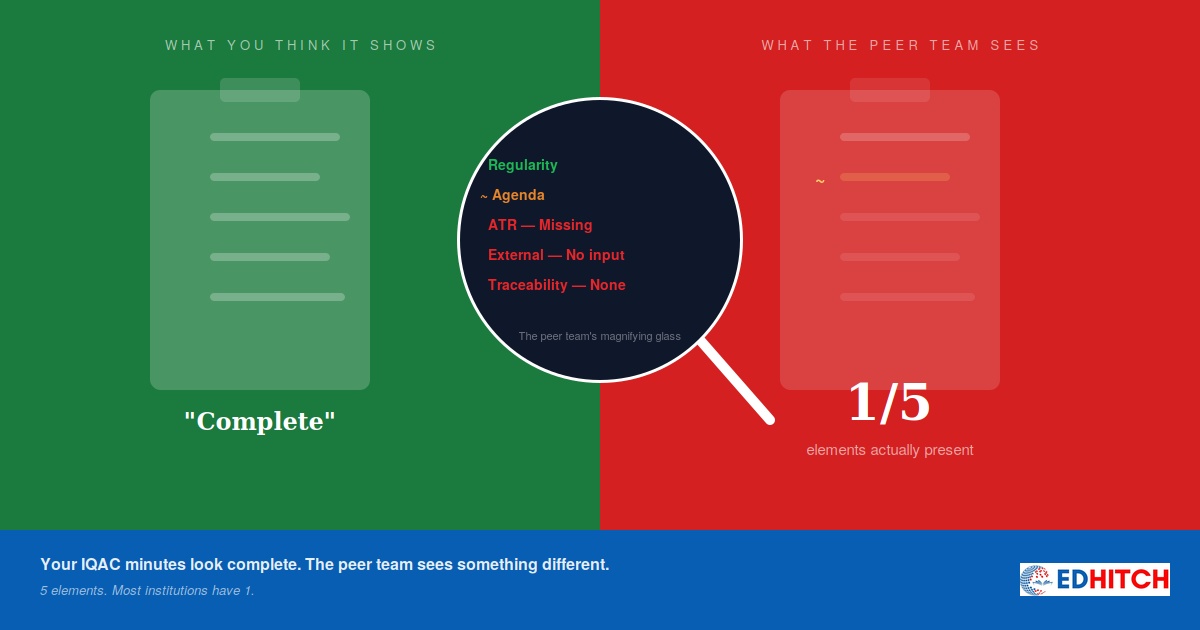
Every institution we work with has IQAC meeting minutes. Neatly bound. Properly dated. Signed by the chairperson. Filed in the IQAC room, ready for the peer team.
And almost every set of minutes we review has the same problem: they document what was discussed, but not what happened next.
A peer team member at a university in Karnataka told us something that changed how we think about IQAC documentation: "I can tell within five minutes of reading the minutes whether the IQAC is a functioning quality body or a compliance exercise. The minutes tell the story. Most institutions don't realise what story they're telling."
The peer team doesn't read your minutes for completeness. They read them for evidence.
IQAC meeting minutes are not administrative records. Under NAAC's current RAF, they are evidence for Criterion 6 (Governance, Leadership and Management) — specifically, evidence that the institution has a functioning quality assurance mechanism that drives continuous improvement.
The peer team is checking five things. Not whether the meetings happened — that's table stakes. They're checking whether the meetings produced outcomes.
Element 1: Regularity — did you meet consistently or just before the deadline?
NAAC expects a minimum of two IQAC meetings per semester — roughly four per year. But regularity isn't just about count. It's about distribution.
An institution that held one meeting in July and three in February (right before the SSR submission) signals panic, not process. Four meetings spread across July, October, January, and April signal a quality cycle that runs continuously.
The peer team checks the dates. If your four annual meetings cluster in the last quarter of the accreditation cycle, the minutes undermine the very claim they're supposed to support: that quality assurance is an ongoing institutional practice.
Element 2: Agenda quality — did you discuss quality or administration?
The single most common pattern in weak IQAC minutes: the agenda reads like a department meeting. "Discussion on examination schedule." "Review of admission numbers." "Planning for college day celebrations."
These are administrative activities. They belong in faculty meetings, departmental meetings, or committee meetings — not in the IQAC. The IQAC's mandate is quality assurance: curriculum review, teaching-learning improvement, research facilitation, student support enhancement, feedback analysis, and institutional development planning.
Strong IQAC minutes have agenda items like: "Review of student feedback analysis for Semester 1 — identification of three teaching-learning gaps and proposed interventions." "Analysis of Criterion 3 research output data — comparison with previous cycle and gap identification." "Review of Extended Profile data accuracy — cross-check against AISHE and NIRF submissions."
The peer team reads your IQAC agenda to understand whether your IQAC thinks about quality or thinks about events. Most IQAC agendas are event calendars, not quality agendas.
Element 3: Action Taken Reports — the gap between decisions and evidence
This is where most institutions fail. The minutes record a decision: "It was resolved that faculty development programmes would be conducted quarterly." The next set of minutes says: "It was noted that two FDPs were conducted."
What's missing is the Action Taken Report (ATR) — the documented chain from decision to action to outcome. Not "two FDPs were conducted" but "two FDPs were conducted (Evidence: Attendance registers, feedback forms, certificates — annexed). Faculty feedback showed 78% rated the sessions 'useful' or 'very useful.' Three specific teaching-learning changes were adopted as a result (listed in Annexure B)."
ATRs turn minutes from a record of intentions into evidence of institutional improvement. The peer team doesn't check whether you decided to do things. They check whether you did them, documented the doing, and measured whether it worked.
An institution with four meetings and four ATRs scores better under Criterion 6 than an institution with twelve meetings and zero ATRs. The grade doesn't reward activity. It rewards documented improvement.
Element 4: External member participation — not just attendance, but contribution
NAAC's IQAC guidelines specify that the IQAC should include external members — from industry, alumni networks, or neighbouring institutions. Most institutions comply by listing external names on the IQAC composition document.
The peer team checks whether external members were actually present (attendance register) and whether their contributions are reflected in the minutes. An attendance sheet showing an industry representative's signature but no recorded input from them in the minutes is suspicious. It suggests the external member signed in and left — or worse, that the signature was collected separately.
Strong minutes attribute specific observations or suggestions to external members by name: "Mr. Suresh Reddy (Industry representative, Infosys) suggested that the curriculum review include current industry certification requirements. IQAC resolved to form a sub-committee to map industry certifications against existing course outcomes." This is evidence. An unnamed "discussion was held with industry representatives" is not.
Element 5: Traceability — can the peer team follow the thread?
The most sophisticated thing a peer team does with your minutes is trace a thread across multiple meetings. Meeting 1: a gap is identified. Meeting 2: an intervention is decided. Meeting 3: the intervention's impact is reviewed. Meeting 4: the next improvement action is planned based on the review.
This is the continuous improvement loop that NAAC values most highly. It's the same loop NBA demands under Criterion 8 (Continuous Improvement). Institutions that can show this loop — gap → action → measurement → next action — across four consecutive meetings demonstrate a quality culture. Institutions whose minutes read as four disconnected meetings demonstrate a filing system.
The peer team can tell the difference between an institution that holds meetings and an institution that uses meetings. The minutes are the proof.
The uncomfortable question
Pull out your last four IQAC meeting minutes. Read them as if you were a peer team member seeing them for the first time. Ask five questions: Are the meetings spread across the year or clustered before the deadline? Does the agenda read like a quality body or a department meeting? Is there an ATR for every decision — with evidence and outcomes? Are external members contributing or just signing the register? Can you trace a single quality improvement thread across all four meetings?
If you answered "no" to even two of those, your IQAC minutes are documentation, not evidence. And the peer team will know the difference within five minutes of opening the file.
The gap between what your minutes currently show and what the peer team expects to see is institution-specific — it depends on your IQAC's history, your criterion-wise strengths, and how your governance actually functions. That gap is exactly what our diagnostic identifies.
Want your IQAC documentation peer-team-ready?
Our NAAC Readiness Diagnostic includes IQAC documentation review, Criterion 6 gap analysis, and a written report identifying exactly what peer teams will flag. Not a generic checklist — an institution-specific assessment.
Learn About the Diagnostic →Frequently Asked Questions
What do peer teams check in IQAC minutes?
Five things: regularity of meetings, quality-linked agenda items, Action Taken Reports with outcomes, external member participation with attributed contributions, and traceability of improvement threads across meetings.
How many IQAC meetings does NAAC expect?
Minimum two per semester — roughly four per year. Distribution matters as much as count. Meetings clustered before SSR deadlines undermine the claim of continuous quality assurance.
What is an ATR?
An Action Taken Report documents what happened after a decision — who did it, when, what evidence exists, and what changed. Minutes without ATRs are discussions without follow-through evidence.
Should IQAC minutes include external members?
Yes. NAAC expects external representation. Peer teams check attendance AND recorded contributions. External names on the list with no attributed input in the minutes is a red flag.
What are common IQAC minutes mistakes?
Generic agendas, no ATRs, clustered meeting dates, absent external member input, and decisions that never trace to measurable outcomes.
Related Reading

Edhitch
Accreditation & Ranking Intelligence · NAAC · NBA · NIRF · 12 Years · 100+ Institutions