An IQAC coordinator at a deemed university in Karnataka spent four weeks filling the SSR. Every metric was documented. Every criterion had evidence. The submission looked complete.
Then NAAC's DVV flagged fourteen metrics in a single pass.
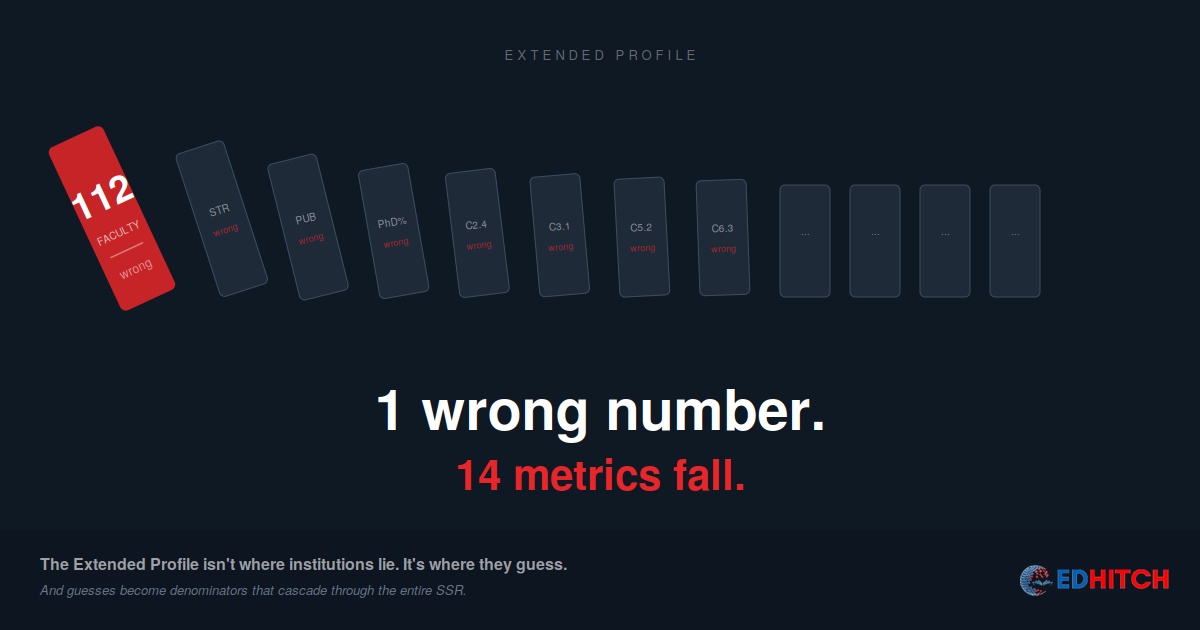
The problem wasn't the SSR. It was the Extended Profile. She had entered 112 faculty in the profile. HR's records showed 98 full-time faculty and 14 visiting faculty. NAAC counts only full-time. Every metric that divides by faculty count — publications per faculty, student-faculty ratio, PhD-qualified percentage — was wrong. Not because the numerators were wrong. Because the denominator was wrong from the start.
Fourteen flags. One root cause. A single number in the Extended Profile.
What the Extended Profile actually is
Most IQAC coordinators treat the Extended Profile as a preliminary form — something to fill quickly before getting to the "real" SSR. This is the most expensive misunderstanding in the entire NAAC process.
The Extended Profile is not a form. It is the mathematical foundation of your entire SSR. Every number you enter here becomes a denominator in NAAC's metric calculations. Total students, total faculty, total programmes, total expenditure — these are the divisors that turn your raw institutional data into the ratios NAAC actually scores.
Get the SSR numerators wrong, and one metric is off. Get the Extended Profile denominators wrong, and every metric that uses that denominator is off. The cascade is real: a single wrong faculty count can affect 8–12 metrics across Criteria 2, 3, 5, and 6.
The Extended Profile is not a warm-up for the SSR. It's the foundation the SSR stands on. Crack the foundation and the whole building tilts.
The 5 mistakes institutions keep making
1. Counting faculty who don't qualify
NAAC's definition of "full-time faculty" is specific: regular, full-time, on the institution's payroll. Visiting faculty, adjunct faculty, contractual faculty, guest lecturers — none of these count. Most institutions know this in theory. In practice, the IQAC coordinator pulls the faculty list from HR, which includes everyone. The number goes into the Extended Profile unchecked.
The consequence compounds. A higher faculty count makes your student-faculty ratio look better — but it also dilutes your publications-per-faculty, your PhD-qualified-percentage, and your faculty-with-awards metric. You look weaker on research and qualifications because you inflated the denominator.
2. Using headcount instead of the right student metric
NAAC asks for student numbers in specific categories — total enrolled, year-wise, programme-wise. The definitions matter. Is a student enrolled in a certificate programme counted the same as a degree student? Are lateral-entry students counted from the year they joined or the year the programme began? Are students who registered but never attended included?
Most IQAC coordinators use the admissions register or the examination roll. Neither is exactly what NAAC's template asks for. The discrepancy is usually 5–15%, which is enough to shift every student-dependent metric by a meaningful margin.
3. Misclassifying programmes
NAAC categorises programmes as UG, PG, diploma, and research. An integrated dual-degree programme — is that one programme or two? A PG diploma — is that PG or diploma? The Extended Profile template asks you to count them. Your answer determines the denominator for "courses offered across programmes" and several Criteria 1 metrics.
The classification is not intuitive. It depends on how the affiliating university recognises the programme, not on what the institution calls it internally.
4. Financial year vs. academic year confusion
The Extended Profile asks for expenditure data. Your accounts department works in financial years (April–March). The SSR assessment period works in academic years (June–May or July–June, depending on the university). When the IQAC coordinator asks accounts for "last year's expenditure," accounts sends the financial year figure. The Extended Profile expects the academic year figure.
The gap is usually one quarter of data — either included twice or missing entirely. On a ₹50 crore annual expenditure, that's ₹12–15 crore of misalignment. Enough to distort every financial ratio in the SSR.
5. Numbers that contradict AISHE and NIRF
This is the mistake that triggers DVV rejections most reliably. Your Extended Profile says 3,200 students. Your AISHE return says 2,800. Your NIRF submission says 3,050. Three portals, three numbers, one institution.
Nobody lied. Different people filled different portals at different times using different source data and different definitions. NAAC's DVV now cross-references all three. The inconsistency doesn't just flag the student count — it raises questions about every number your institution has submitted anywhere.
The Extended Profile isn't where institutions lie. It's where they guess. And guesses become denominators that cascade through the entire SSR.
How to get the Extended Profile right
Start with the Extended Profile, not the SSR. Most institutions fill the SSR first and the Extended Profile as an afterthought. Reverse the order. Fill the Extended Profile, verify every number, and then build the SSR on top of verified denominators.
Cross-reference every number against AISHE and NIRF. Before submitting, place your Extended Profile, AISHE return, and NIRF submission side by side. Any number that differs across sources needs reconciliation — not explanation, reconciliation. Fix the source, don't explain the discrepancy.
Use NAAC's definitions, not your institution's. "Faculty" means what NAAC says it means, not what HR says. "Programme" means what NAAC classifies it as, not what the prospectus says. Read the NAAC manual's definitions for every Extended Profile field before filling it.
Trace every number forward. After filling the Extended Profile, identify every SSR metric that uses each Extended Profile number as a denominator. Check whether the resulting ratio is accurate and defensible. If your faculty count is 85, and you claimed 120 publications, your publications-per-faculty is 1.41. Is that accurate? Can you defend it with evidence?
Have someone other than the filler verify. The person who filled the Extended Profile is the worst person to check it — they've already convinced themselves the numbers are right. Have a second person verify every field against source documents.
Not sure your Extended Profile is right?
Our NAAC Binary Readiness Diagnostic is a four-week, fixed-scope assessment that includes Extended Profile verification, cross-framework data reconciliation, and SSR denominator audit. Written report and leadership presentation included.
Learn About the Diagnostic →Frequently Asked Questions
What is the NAAC Extended Profile?
A set of institutional baseline numbers — student count, faculty count, programmes offered, financial data — that serve as denominators in NAAC's metric calculations across all seven SSR criteria. It is the mathematical foundation the entire SSR relies on.
What's the difference between Extended Profile and SSR?
The SSR contains your claims. The Extended Profile contains the baseline numbers NAAC uses to calculate ratios from those claims. The SSR says "we published 120 papers." The Extended Profile says "we have 85 faculty." NAAC divides 120 by 85. If the Extended Profile says 95 instead, every ratio shifts.
Why do Extended Profile errors cascade across the SSR?
Because the same number — say, total students — is used as a denominator in metrics across Criteria 2, 4, and 5. One wrong number in the Extended Profile affects 8–12 metric calculations.
What are the most common Extended Profile mistakes?
Five patterns: counting non-qualifying faculty, using headcount instead of the right student metric, misclassifying programmes, financial year vs academic year confusion, and numbers contradicting AISHE or NIRF data.
How should institutions verify the Extended Profile?
Cross-check against AISHE and NIRF submissions, use NAAC's definitions (not internal ones), trace every number forward into dependent SSR metrics, and have a second person verify against source documents.
Related Reading
- What the DVV Process Actually Checks (And 6 Reasons Clarifications Get Rejected)
- Key Areas Where Institutions Struggle in SSR Drafting
- One Nation, One Data — Why NAAC, NBA and NIRF Will Soon Cross-Check Everything
- The Institution Was Strong. The Data Was Weak.
- What a NAAC Binary Readiness Diagnostic Actually Tells You
- A Comprehensive Guide to NAAC Accreditation

Edhitch
Accreditation & Ranking Intelligence · NAAC · NBA · NIRF · 12 Years · 100+ Institutions