A Vice Chancellor asked us a question that we now hear at least once a week: "Should we prepare for RAF or wait for Binary?"
It's the wrong question. Not because the answer is obvious — it isn't — but because the question assumes that the framework is the hard part. It isn't. The hard part is the evidence. And the evidence problems institutions face are the same under RAF, Binary, and MBGL.
We've worked with institutions preparing for every NAAC cycle since the introduction of DVV. The ones that struggled didn't struggle because the framework was unfamiliar. They struggled because their evidence wasn't ready — and it wasn't ready for reasons that had nothing to do with which framework was in play.
The framework is the question. The evidence is the answer.
Under RAF, NAAC evaluates institutions through a 7-criteria SSR verified by DVV and assessed by a peer team. Under the proposed Binary framework, NAAC plans to evaluate institutions through 10 attributes using AI-based assessment and standardised Data Capture Formats. Under MBGL, maturity-level assessment adds a progression dimension.
The frameworks differ in structure, process, and outcome format. But the underlying evidence is the same: faculty qualifications and workload, student outcomes and progression, research output and impact, financial health and resource utilisation, governance decisions and their follow-through, and quality improvement over time.
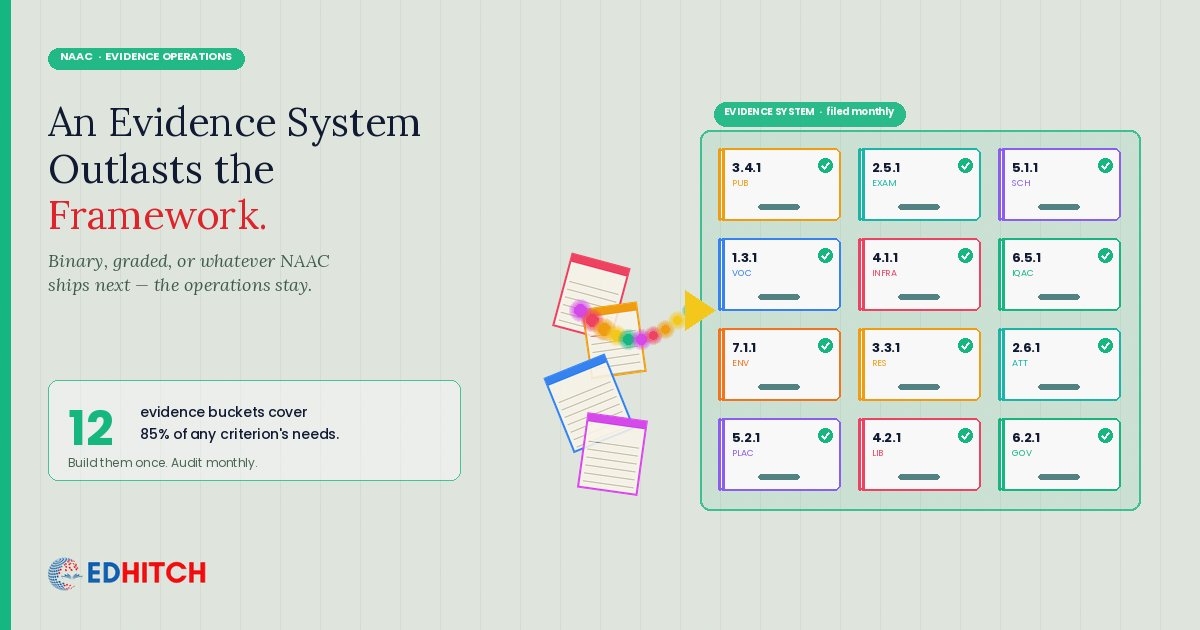
An institution that can produce verified evidence for these areas will perform well under any framework. An institution that cannot will struggle under every framework. The framework determines how the evidence is packaged and evaluated. The evidence system determines whether the evidence exists at all.
Problem 1: Evidence exists in memory, not in documents
The Dean knows that three faculty members completed FDPs last semester. The IQAC coordinator remembers that the feedback scores improved. The placement officer has the numbers in his head. But when the SSR asks for evidence, none of these exist as verifiable documents.
This is the most fundamental evidence gap: institutional activity happens without producing a documentary trail. Not because people are careless, but because Indian higher education institutions were not historically built to document activity in real time. They were built to teach, administer, and report when asked.
Under RAF, this gap shows up during DVV when clarification requests come back for metrics the institution knows are true but cannot prove. Under Binary, where AI-based assessment verifies data against external databases, the gap will be even more visible — because there will be no peer team visit where the coordinator can verbally explain what the document doesn't show.
Problem 2: Evidence is assembled at the deadline, not at the activity
The most common evidence workflow in Indian institutions: an activity happens (a workshop, a placement, a publication), months pass, accreditation preparation begins, someone is asked to "collect the evidence," and they reconstruct it from memory, email threads, and WhatsApp messages.
Reconstructed evidence is fragile. Dates don't match. Attendance registers are recreated. Certificates are back-dated. Photographs are gathered after the fact. The institution isn't being dishonest — it's filling genuine gaps in a documentation process that wasn't designed to capture evidence at the point of activity.
The distinction matters because peer teams can tell when evidence was assembled retrospectively. Dates cluster suspiciously. Formatting is inconsistent. Cross-references don't align. Under Binary, where AI systems may timestamp-check uploaded documents against reported activity dates, retrospective assembly becomes even riskier.
The difference between an institution with an evidence system and an institution without one is not the quality of their evidence. It's the timing. Evidence captured at the moment of activity is credible. Evidence assembled before a deadline is suspect.
Problem 3: Departments count differently
How many faculty does your institution have? The answer depends on who you ask. HR counts sanctioned positions. The academic office counts those currently teaching. The AISHE return uses UGC's definition. The Extended Profile uses NAAC's definition. The NIRF DCS uses yet another counting methodology.
This isn't a data problem — it's a definition problem. Different departments in the same institution use different definitions for the same data point, and nobody has reconciled them. The institution submits 112 faculty to AISHE, 98 to NAAC, and 105 to NIRF — all in good faith, all using internally consistent logic, and all creating a cross-portal inconsistency that the One Nation One Data platform is being built to catch.
This problem doesn't go away when the framework changes. If anything, it gets worse under Binary, because AI-based cross-validation against AISHE and NIRF databases will flag definition mismatches automatically — without the human judgment a peer team member might apply when hearing the explanation.
Problem 4: Evidence is paper-first in a digital-first world
Most Indian institutions maintain their primary evidence in physical form: bound registers, printed certificates, signed minutes, stamped attendance sheets. Digital versions, where they exist, are often scans of these physical documents — not born-digital records.
Under RAF, this works. DVV accepts scanned documents. The peer team visits the campus and can inspect physical files. Under Binary, where the entire assessment is expected to be digital, paper-first evidence creates a bottleneck. Documents need to be scanned, organised into the correct Data Capture Format categories, uploaded within file size limits, and made machine-readable for AI verification.
Institutions that start digitising only when the Binary portal launches will face a massive backlog. Institutions that have been maintaining born-digital evidence — generating documents in digital format from the start, tagging them by criterion and metric, storing them in organised repositories — will upload in days rather than months.
Problem 5: Evidence for one framework contradicts another
An institution's NAAC SSR reports 82% placement. Its NIRF DCS, submitted six months earlier, reports 71% placement. The institution isn't lying in either submission — it's using different denominators, different definitions of "placed," and different time windows.
This is a problem today, and it will be a bigger problem under Binary. The Radhakrishnan Committee explicitly proposed cross-validation against AISHE, NIRF, and other government databases. An AI system that sees 82% in one submission and 71% in another will flag it as an inconsistency — and unlike a peer team, it won't ask for an explanation before marking it.
The fix isn't to make the numbers match artificially. It's to use the same definitions and the same source data for all submissions. That requires a single institutional data source for each key metric — maintained by one department, using one counting methodology, producing outputs formatted for each framework's requirements.
Problem 6: Quality improvement evidence has an expiry date
The most telling evidence gap: institutions generate quality improvement evidence during accreditation cycles and stop generating it between cycles. IQAC meeting frequency drops. Feedback analysis stops. ATRs aren't produced. The quality improvement loop — gap identification → action → measurement → next cycle — pauses until the next accreditation deadline approaches.
Under RAF with 5-year cycles, institutions had time to restart the loop before the next assessment. Under Binary with expected 3-year validity, the gap between cycles shrinks. And under MBGL, where progression from one level to the next requires demonstrating sustained improvement, an institution that stops generating evidence between cycles has nothing to show for the inter-cycle period.
The institutions that will progress from Level 1 to Level 3 under MBGL are the ones that never stopped generating evidence — because their evidence system runs as part of normal operations, not as a pre-accreditation project.
The question to ask now
Not "which framework should we prepare for?" but "does our institution generate verifiable evidence of quality as a byproduct of its daily operations?"
If the answer is yes, the framework is a formatting exercise. If the answer is no, no framework will produce the grade the institution wants — because the grade reflects the evidence, and the evidence reflects the system that produces it.
Where your institution's evidence system breaks down — which of the six problems apply, how deep they go, and what it would take to fix them — is institution-specific. It depends on your department structure, your data governance, your IQAC's operating rhythm, and your digital infrastructure. A generic checklist can name the problems. Only an institution-specific diagnostic can tell you which ones are yours.
Where does your evidence system break down?
Our NAAC Readiness Diagnostic audits your evidence generation process, data consistency across portals, digital readiness, and IQAC functioning. Framework-agnostic: the findings apply whether you next submit under RAF, Binary, or MBGL.
Learn About the Diagnostic →Frequently Asked Questions
What is a NAAC evidence system?
The institutional process that generates, organises, and maintains documentation for accreditation — operating year-round as a byproduct of normal operations, not assembled before deadlines.
Will Binary require the same evidence as RAF?
The format changes (Data Capture Formats instead of SSR narrative), but the underlying evidence is the same: faculty, outcomes, research, finances, governance, quality improvement. Evidence gaps are institutional, not framework-specific.
How should we prepare when the framework is uncertain?
Focus on framework-agnostic fundamentals: data accuracy, year-round evidence capture, digital-first documentation, IQAC functioning, and cross-portal consistency.
What are the most common evidence problems?
Six patterns: evidence in memory not documents, evidence assembled at deadlines not activities, departments counting differently, paper-first evidence, cross-portal contradictions, and quality evidence stopping between cycles.
Is digital evidence mandatory under Binary?
Binary is explicitly digital-first. AI-based assessment uses digitally submitted evidence cross-validated against government databases. Paper-based evidence repositories will need to be digitised.
Related Reading

Edhitch
Accreditation & Ranking Intelligence · NAAC · NBA · NIRF · 12 Years · 100+ Institutions