For the past decade, Indian higher education institutions have maintained a quiet arrangement with reality. They submit one set of numbers to NAAC. A different set to NIRF. A third to AISHE. A fourth to NBA. Sometimes to UGC, AICTE, or state regulators as well.
Same institution. Same year. Different stories.
Nobody checked. Each framework operated independently. Each had its own portal, its own format, its own timeline. As long as each submission looked internally consistent, the numbers were accepted.
That's about to change.
What's happening
The government has been signalling a shift towards unified institutional data for several years now. The phrase "One Nation One Data" has appeared in policy discussions, UGC communications, and accreditation reform proposals. The intent is clear: institutions should report their data once, and all quality frameworks should draw from the same source.
NAAC has announced plans for AI-based assessment that will automatically pull data from NIRF, AISHE, and other government databases. The days of a peer team relying solely on what the institution presents in its SSR are evolving into a system where claims are cross-verified against independently submitted data.
NIRF already operates this way for research — pulling publication data directly from Scopus rather than accepting what institutions report. The model of independent data extraction is expanding to other parameters.
AISHE — the All India Survey on Higher Education — has always collected institutional data annually. But until recently, AISHE data and NAAC data and NIRF data existed in parallel universes. That's changing. The infrastructure to link them is being built.
The question is no longer "will frameworks cross-check data." The question is "how soon and how thoroughly."
Why this matters more than most institutions realise
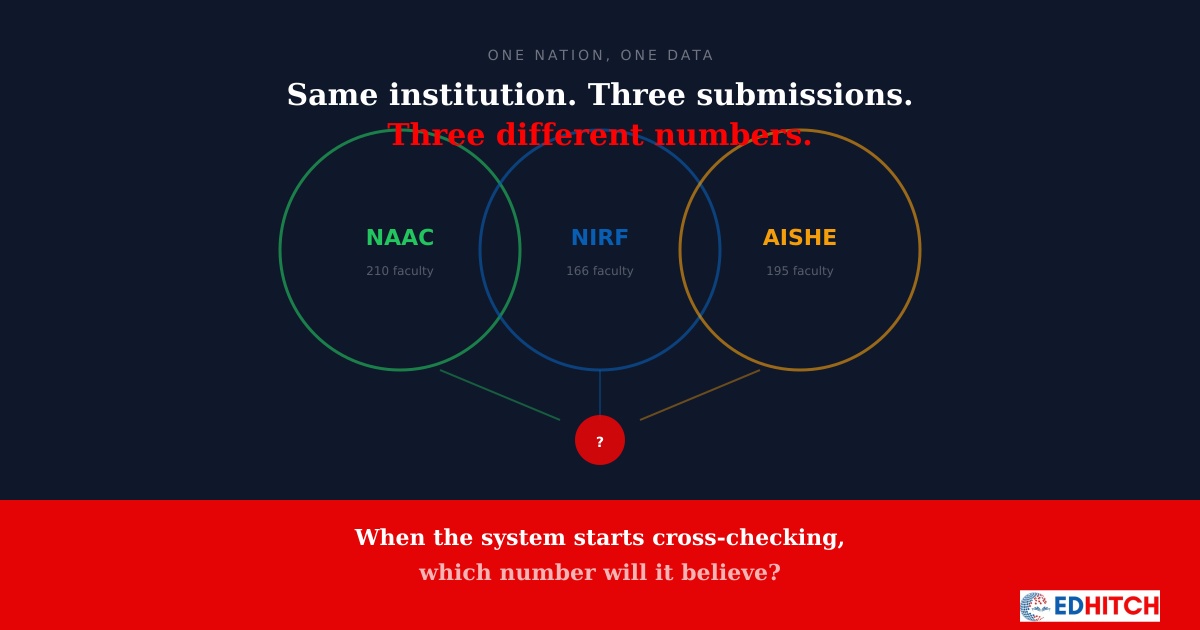
Consider what happens when an institution's NAAC SSR says 210 faculty, its NIRF submission says 166, and its AISHE return says 195.
Today, each number exists in its own silo. Nobody compares them. The institution isn't even aware that three different numbers have been submitted for the same fact.
Tomorrow — when these databases talk to each other — that inconsistency becomes a red flag. Not because the institution was dishonest. But because three different people filled three different forms and counted differently.
The problem isn't fabrication. It's fragmentation. Different departments, different teams, different counting methodologies — all producing different versions of the same institutional truth. And when the system starts comparing, every fragmented number becomes a question mark.
The three phases institutions should worry about
Phase 1 is already happening. NAAC's DVV process now cross-references claims against NIRF and AISHE data. Institutions that recently went through DVV have experienced this — queries arising not from what they submitted to NAAC, but from discrepancies with what they submitted elsewhere. This isn't future speculation. It's current practice.
Phase 2 is in progress. NIRF's data verification is tightening. Publication data is already pulled independently. Financial data verification is becoming more rigorous. The trend is towards more automated verification and less reliance on self-reported numbers.
Phase 3 is on the horizon. A unified data repository where institutions submit once and all frameworks draw from the same source. When this arrives — and it will — the ability to maintain different narratives for different audiences disappears entirely.
Institutions that prepare for Phase 3 by cleaning up their data now will transition smoothly. Institutions that wait will face a reckoning — years of inconsistent submissions suddenly becoming visible all at once.
What most institutions are doing wrong right now
The typical institution has no institutional data governance framework. What does that mean in practice?
It means the IQAC coordinator fills the NAAC SSR using one set of numbers. The NIRF in-charge fills the NIRF portal using a slightly different set. The Registrar files the AISHE return using yet another set. The NBA coordinator prepares the SAR using programme-level data that may or may not reconcile with the institution-level numbers already submitted.
Nobody is lying. Everyone is pulling from the sources they have access to, in the format they need, under the time pressure they face. But the result is an institution that tells a slightly different story to every agency it reports to.
Until now, that hasn't mattered. Tomorrow, it will.
Data governance sounds like a corporate buzzword. In higher education, it's about to become a survival requirement.
The institutions that will be fine
Every institution that comes through this well will have one thing in common: they unified their data before they were forced to.
They mapped what they report to NAAC against what they report to NIRF against what they report to AISHE. Where the numbers diverged, they understood why — and documented the reason. Where the divergence was due to counting errors or different definitions, they standardised.
They didn't wait for the government to build the unified portal. They built their own internal consistency — so that when the portal arrives, their data is already clean.
These institutions aren't doing anything extraordinary. They're just doing something that most institutions haven't started yet — and they're doing it before it becomes urgent.
The window is closing
Right now, inconsistencies are still largely invisible. NAAC, NIRF, and AISHE don't yet have a common dashboard that shows your data side by side. The cross-referencing that happens today is manual and limited.
But the infrastructure is being built. The policy direction is clear. And once the switch is flipped, there's no retroactive fix. Your historical submissions — to every framework, for every year — become part of a single picture.
Institutions that act now have time to audit, reconcile, and standardise. Institutions that wait will be explaining discrepancies instead of preparing for assessments.
The question every Principal, VC, and IQAC coordinator should be asking today: "If someone put all our submissions side by side right now — NAAC, NIRF, AISHE, NBA — would the numbers tell the same story?"
At most institutions we work with, the answer is no. Not because anyone intended it. But because nobody ever checked.
One Nation, One Data isn't a slogan. It's a direction. The institutions that align with it proactively will lead. The ones that discover the problem after the system goes live will scramble.
Is Your Data Consistent Across Frameworks?
Our integrated diagnostic reads your institutional data across NAAC, NBA, NIRF, and AISHE — identifying inconsistencies before automated cross-checking makes them visible.
We also cover integrated data strategy in our 5-Day programme: April 6-10, 2026 · 7-9 PM · Online
Register Now — ₹2,499 →Frequently Asked Questions
What is One Nation One Data in higher education?
The government's push towards unified institutional data reporting — institutions submit once and all quality frameworks draw from the same source.
Will NAAC and NIRF cross-check data?
This is already happening. NAAC's DVV process cross-references NIRF and AISHE data. As systems become more integrated, automated cross-checking will increase.
How does this affect institutions?
Institutions maintaining different data for different frameworks will face scrutiny when those numbers are compared. Inconsistencies that were invisible will become visible.
Is NAAC moving to AI-based assessment?
NAAC has announced plans to incorporate AI and data analytics, including automated cross-referencing of institutional data across multiple sources.
How should institutions prepare?
By ensuring data consistency across all frameworks now — before automated cross-checking makes inconsistencies visible. This requires an institution-specific audit.

Edhitch
Accreditation & Ranking Intelligence · NAAC · NBA · NIRF · 12 Years · 100+ Institutions