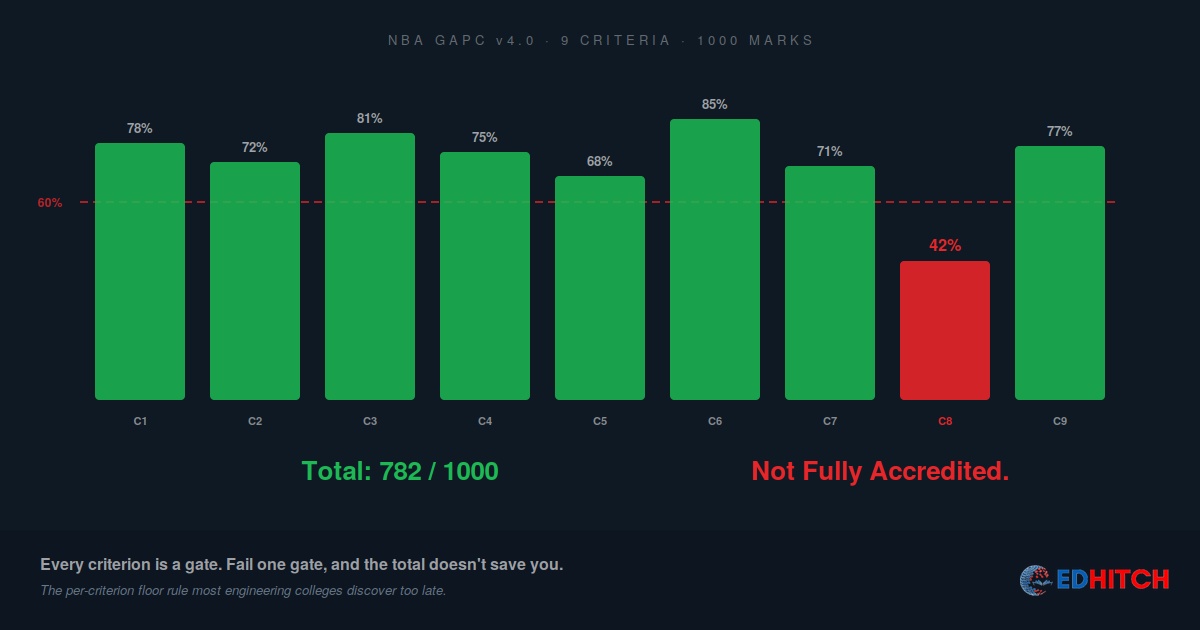
An NBA coordinator at an engineering college in Andhra Pradesh shared his SAR scores with us after the visiting team's evaluation. Total: 782 out of 1000. By any reasonable standard, that's a strong result.
He didn't get full accreditation.
The visiting team's criterion-wise breakdown showed eight criteria scoring between 65% and 85%. One criterion — Continuous Improvement (C8, worth 80 marks) — scored 34 out of 80. That's 42.5%.
42.5% is below the 60% per-criterion floor required for full accreditation. It doesn't matter that eight other criteria were strong. It doesn't matter that the total was 782. One criterion below the floor changed the outcome.
The rule nobody reads until it's too late
NBA's accreditation outcome is determined by two conditions, not one. Most programmes focus on the total score. The total score is necessary — but it's not sufficient.
The two conditions under GAPC v4.0 are: your total score across all 9 criteria must meet the threshold (≥750 for full accreditation of 6 years, or ≥600 for accreditation of 3 years), and each individual criterion must independently meet a minimum percentage of its maximum marks (60% for full, 45% for accreditation).
A programme scoring 850 total but 55% on one criterion gets 3-year accreditation, not full. A programme scoring 780 total but 40% on one criterion risks "Not Accredited" — because 40% is below even the 45% accreditation floor.
NBA doesn't average your weaknesses away. Every criterion is a gate. Pass all gates, you're accredited. Fail one gate, and the total doesn't save you.
Why this catches engineering colleges off guard
Engineering colleges prepare for NBA the way they prepare for exams — focus on the areas worth the most marks and accept some weakness elsewhere. This is rational exam strategy. It is fatal NBA strategy.
Under GAPC v4.0, the 9 criteria and their marks are: C1 Outcome-Based Curriculum (120), C2 Outcome-Based Teaching Learning (120), C3 Outcome-Based Assessment (120), C4 Students' Performance (120), C5 Faculty Information (100), C6 Faculty Contributions (120), C7 Facilities and Technical Support (100), C8 Continuous Improvement (80), and C9 Student Support and Governance (120).
Colleges naturally concentrate on the high-mark criteria — C1, C2, C3, C4, C6, C9 (each 120 marks). They invest less in C5 (100), C7 (100), and especially C8 (80) — because C8 carries the fewest marks and feels like "just documentation."
C8 is where the floor rule bites hardest. 60% of 80 marks is 48. A programme needs to score at least 48 on Continuous Improvement for full accreditation. That requires not just documenting outcomes, but documenting the feedback loop: measure attainment → identify gaps → take corrective action → verify improvement. Most programmes can show the first two steps. They fall apart on the last two.
The three criteria that most commonly fall below the floor
C8 — Continuous Improvement (80 marks)
The floor: 48 marks (60%) for full, 36 marks (45%) for accreditation (3 years). C8 asks for evidence that the programme uses its own outcome assessment data to drive specific changes — and that those changes produced measurable improvement. Documenting "we conducted workshops" doesn't score. Documenting "CO attainment for CO3 was 58% in 2023, we changed the lab component, and CO3 attainment rose to 71% in 2024" does.
C5 — Faculty Information (100 marks)
The floor: 60 marks (60%) for full, 45 marks (45%) for accreditation (3 years). C5 evaluates faculty qualifications, cadre ratio (Professor : Associate Professor : Assistant Professor), PhD percentage, and retention. Programmes with high faculty turnover, low PhD percentage, or inverted cadre ratios (too many assistant professors, too few senior faculty) fall below the floor on C5 even when they're strong everywhere else.
C7 — Facilities and Technical Support (100 marks)
The floor: 60 marks (60%) for full, 45 marks (45%) for accreditation (3 years). C7 covers labs, computing facilities, library resources, and technical support staff. Programmes in institutions that share facilities across departments often score low here because the facilities aren't dedicated to the specific programme being evaluated — and NBA evaluates at the programme level, not the institution level.
What the pre-qualifiers don't catch
Many NBA coordinators confuse the pre-qualifier check with the per-criterion floor. They're different stages with different consequences.
Pre-qualifiers are checked before the SAR is evaluated. They cover minimum student-faculty ratio, faculty cadre proportion, PhD-qualified faculty count, and infrastructure norms. If pre-qualifiers fail, the SAR is returned without evaluation. The 10% application fee is forfeited.
The per-criterion floor is applied after the visiting team completes their evaluation. It determines whether the evaluated scores qualify for full accreditation (6 years), accreditation (3 years), or not accredited. You can pass all pre-qualifiers and still fail on the per-criterion floor — because pre-qualifiers check minimum inputs while the floor checks evaluated performance.
The coordinator in Andhra Pradesh passed every pre-qualifier. His programme had adequate faculty, labs, and infrastructure. The pre-qualifier stage didn't flag anything. The per-criterion floor caught C8 — because the pre-qualifier doesn't check whether your continuous improvement loop is documented. It only checks whether you have the minimum resources. Having the resources and using them effectively are two different assessments.
What programmes should do before the visiting team arrives
Calculate your per-criterion percentage for every criterion — not just the total. After completing the SAR internally, compute each criterion's score as a percentage of its maximum marks. Any criterion below 60% is a risk for full accreditation. Any below 45% is a risk for any accreditation at all.
Treat C8 as a criterion, not an afterthought. Continuous Improvement requires 2+ years of attainment data, gap analysis, specific corrective actions, and evidence that the actions worked. This cannot be manufactured in the last month. Start the feedback loop now — even if your NBA visit is 18 months away.
Audit C5 faculty data against NBA's definitions. Faculty who are "regular" in your institution may not qualify as "regular" under NBA's rules. Contract faculty who taught in both semesters count. Faculty on sabbatical may not. Check the GAPC v4.0 definitions before assuming your faculty count is what you think it is.
Don't compensate — remediate. The instinct is to invest effort in strong criteria to pull the total higher. The per-criterion floor makes this strategy useless. One criterion at 40% isn't fixed by another criterion at 90%. Fix the 40% criterion. That's the only path to full accreditation.
Not sure if your programme has a floor risk?
Our accreditation diagnostic is a four-week, criterion-by-criterion assessment of your NBA readiness, identifying per-criterion floor risks before the visiting team arrives. Written report and leadership presentation included.
Learn About the Diagnostic →Frequently Asked Questions
What is the NBA per-criterion floor rule?
Each criterion must independently score at least 60% for full accreditation (6 years) or 45% for accreditation (3 years). Falling below 45% in any criterion can result in "Not Accredited" regardless of total score.
Can a high total score still result in failure?
Yes. 780/1000 overall but 42% on one criterion means no full accreditation. The total is necessary but not sufficient — every criterion is a gate.
How many criteria does GAPC v4.0 have?
9 criteria (C1-C9), totalling 1000 marks. C1-C4 at 120 each, C5 at 100, C6 at 120, C7 at 100, C8 at 80, C9 at 120.
Which criteria most commonly fall below the floor?
C8 Continuous Improvement (80 marks), C5 Faculty Information (100 marks), and C7 Facilities (100 marks). C8 is most dangerous because it carries the fewest marks and requires the most systematic documentation.
What's the difference between pre-qualifiers and the floor?
Pre-qualifiers are checked before evaluation (minimum inputs). The floor is applied after evaluation (minimum per-criterion performance). You can pass pre-qualifiers and still fail on the floor.
Related Reading

Edhitch
Accreditation & Ranking Intelligence · NAAC · NBA · NIRF · 12 Years · 100+ Institutions