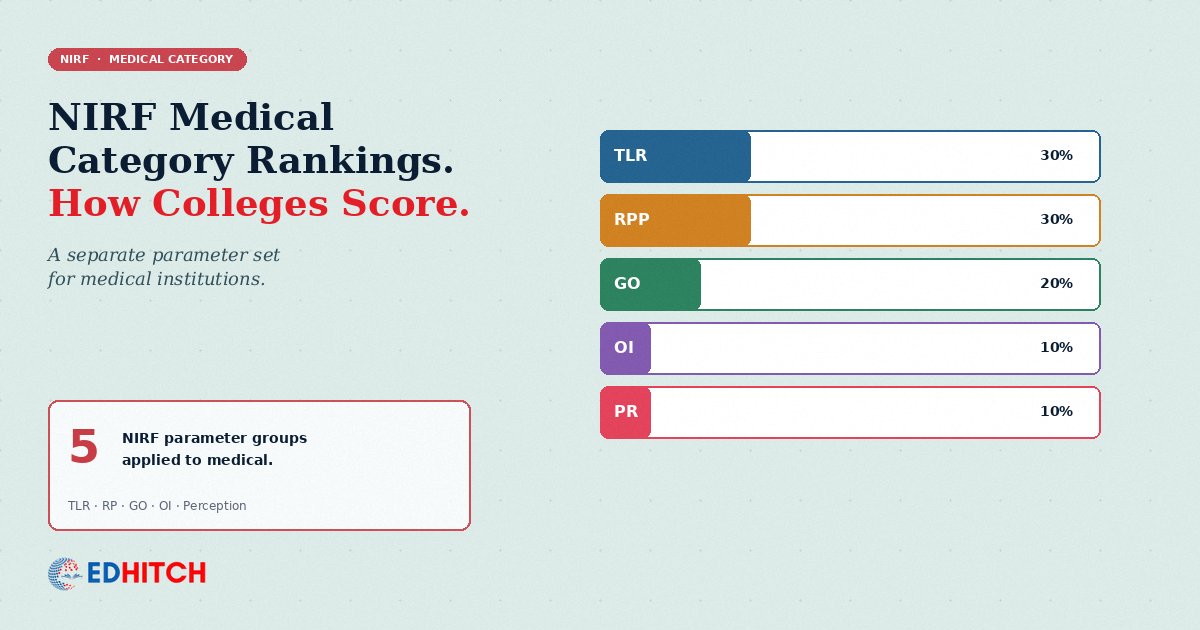
NIRF Medical is the Medical category of the National Institutional Ranking Framework, launched by the Ministry of Education on 29 September 2015. It is a dedicated public ranking for medical colleges in India, scored against the same five NIRF parameters used across categories — TLR, RP, GO, OI, PR — with weightages of 30:30:20:10:10 totaling 100. Participation is voluntary but is widely considered essential for institutional reputation in Indian medical education.
In short: NIRF Medical ranks Indian medical colleges using five parameter groups: Teaching, Learning & Resources (TLR, 30%); Research and Professional Practice (RP, 30%); Graduation Outcomes (GO, 20%); Outreach and Inclusivity (OI, 10%); and Perception (PR, 10%). In NIRF 2025 (released 4 September 2025), AIIMS Delhi, PGIMER Chandigarh, and CMC Vellore retained the top three positions unchanged. NIRF 2025 introduced negative marking for retracted research papers and penalties for self-citations under the RP parameter — a meaningful operational change for medical institutions where research weight is high. Data submitted to NIRF must now be hosted on the institution’s website for three years.
Why NIRF Medical matters for Indian medical colleges
Unlike NMC accreditation (mandatory regulatory) and NAAC (institutional quality assessment), NIRF Medical is the public-facing reputational framework. It is the framework MBBS aspirants, parents, employers, and peer academic communities actually consult when forming opinions about Indian medical institutions. A medical college can hold NMC recognition and NAAC accreditation and still be poorly known publicly; NIRF Medical is the rank that shows up in news coverage, school counselling, and prospectus comparisons.
For Edhitch’s medical college clients, NIRF Medical operates as the third leg of an integrated quality strategy: NMC compliance secures the right to operate, NAAC accreditation validates institutional quality, and NIRF Medical ranking earns reputational standing. The data underlying all three has substantial overlap — which is why running them as integrated workstreams outperforms parallel siloed projects.
The five NIRF parameters — applied to medical colleges
The five NIRF parameter groups apply across all 17 categories, but each parameter’s sub-indicators are calibrated by category. For medical colleges, the operational meaning of each parameter is slightly different from how it applies to engineering or general-college rankings.
Teaching, Learning & Resources
Faculty quality, FSR, doctoral capacity, financial resources
Research & Professional Practice
Publications, citations, IPR, projects — with new retraction penalty
Graduation Outcomes
Exam performance, PhD output, median salary, progression
Outreach & Inclusivity
Region diversity, women, ESCS, PCS facilities
Perception
Academic peer and employer perception
For deeper coverage of the framework as it applies across all categories, see Edhitch’s general guide: NIRF Ranking Criteria 2026: All 5 Parameters & Weightages Explained →. The sections below focus specifically on the medical-category application.
Sub-parameters within each NIRF parameter (medical application)
The five parameter groups break down into 15+ specific sub-parameters. For medical colleges, the sub-parameter mix reflects the realities of medical education — faculty-student ratios calibrated to clinical attachment requirements, research weighted toward indexed health-sciences publications, graduation outcomes including PhD/DM/MCh progression alongside MBBS exam performance, and perception drawn substantially from the medical academic community.
| Parameter | Sub-indicators | Medical-college application notes |
|---|---|---|
| TLR (30%) |
SS — Student Strength incl. Doctoral Students FSR — Faculty-Student Ratio with permanent faculty emphasis FQE — Faculty PhD/equivalent + Experience FRU — Financial Resources & Utilisation |
Permanent full-time faculty is heavily weighted — visiting/contractual faculty does not carry the same score. Medical college FSR must reflect clinical attachment ratios per NMC norms. FQE recognizes MD/MS/DM/MCh as terminal qualifications equivalent to PhD. |
| RP (30%) |
PU — Combined Publications metric QP — Quality of Publications IPR — Patents Published & Granted FPPP — Footprint of Projects & Professional Practice |
Highest-leverage parameter for medical colleges. Scopus and Web of Science indexed publications carry weight. NIRF 2025 negative marking for retracted papers applies here. Self-citation penalty reduces citation-count score. Funded clinical trials and ICMR/DBT projects count under FPPP. |
| GO (20%) |
GUE — University Examination performance GPHD — PhD Students Graduated GMS — Median Salary (introduced 2018) |
MBBS exam performance, FMGE/NExT pass rates, PG progression rates feed here. Median salary for medical colleges reflects starting compensation of graduating MBBS in private practice, government posting, or higher specialization stipends. |
| OI (10%) |
RD — Region Diversity (Other States/Countries) WD — Women Diversity ESCS — Economically & Socially Challenged Students PCS — Facilities for Physically Challenged Students |
Often the lowest-effort improvement area for medical colleges with high inbound demand. Inter-state student admission patterns drive RD. SC/ST/OBC representation drives ESCS. Physical infrastructure for PwD students is binary (present/absent). |
| PR (10%) |
Academic Peers — perception survey of medical educators Employers — perception survey of healthcare institutions, hospitals, recruiters |
Hardest parameter to influence in single cycle. Built through sustained academic visibility — conferences, publications, alumni in leadership roles, hospital partnerships. KPMG’s analysis of NIRF 2025 noted PR scores declined across most categories. |
NIRF Medical 2025: top rankings and observations
NIRF 2025 was released on 4 September 2025 by the Ministry of Education at Bharat Mandapam, Delhi — the 10th edition of the framework. The Medical category top order was largely stable, with AIIMS Delhi, PGIMER Chandigarh, and CMC Vellore retaining the top three positions unchanged from previous cycles.
| Institution | NIRF Medical 2025 Rank | Notes |
|---|---|---|
| AIIMS Delhi | 1 | Retained top position; also high in NIRF Overall |
| PGIMER Chandigarh | 2 | Postgraduate Institute of Medical Education and Research |
| CMC Vellore | 3 | Christian Medical College; long-standing top-3 institution |
| SGPGIMS Lucknow | Top 10 | Sanjay Gandhi Postgraduate Institute of Medical Sciences |
| KGMU Lucknow | Top 10 | King George’s Medical University |
| IMS-BHU Varanasi | Top 10 | Institute of Medical Sciences, Banaras Hindu University |
| AIIMS Bhopal | 25 (up from 31) | Score 60.15 — reflecting research and infrastructure gains |
| Aligarh Muslim University | 29 (dropped) | Score 58.82 — attributed to weaker research and inclusivity scores |
| AIIMS Raipur | 31 (new entrant) | Score 58.44 — growing presence in national rankings |
Source: NIRF India 2025 official rankings, with media analysis from leading Indian education publications. Full ranking list available on nirfindia.org.
What changed in NIRF 2025 — and what it means for medical colleges
NIRF 2025 introduced structural changes that have measurable operational impact on medical colleges. These are the changes medical institutions should specifically operationalize for the upcoming cycle:
3. New SDG category — doesn't directly affect Medical, but signals direction
NIRF 2025 added the Sustainable Development Goals (SDG) category, bringing total categories to 17. This is a separate category, not a parameter within Medical — but it indicates the direction of NIRF’s evolution. Future Medical-category cycles are likely to weight SDG-aligned activities (community health outreach, public health research, equity in healthcare access) more heavily under OI and possibly RP.
4. Mandatory 3-year website hosting of submitted data
NIRF 2025 requires institutions to host their submitted data on their official website for three years for public scrutiny. This is a transparency requirement, but it has compliance implications: any data submitted to NIRF must be (a) defensible if publicly questioned and (b) consistent with what the institution discloses to NMC (Annual Disclosure Report) and NAAC (SSR). Inconsistencies become publicly auditable.
5. Madras High Court interim stay (March 2025) — dismissed, no permanent effect
On 21 March 2025, the Madras High Court issued an interim stay on NIRF 2025 release pending writ petition. The stay was subsequently dismissed and NIRF 2025 was released as scheduled on 4 September 2025. The episode is worth noting historically but has no permanent effect on the framework.
The data overlap: NIRF Medical, NMC ADR, and NAAC SSR
The operational case for Edhitch’s integrated approach to medical college quality is most visible in NIRF Medical, because the same underlying institutional data feeds three submissions — with three different templates and three different deadlines.
- Faculty data. Same faculty profile (qualification, experience, role, NMC registration) feeds NIRF TLR (FSR, FQE), NMC ADR (faculty compliance with NMC Faculty Regulations 2025), and NAAC SSR Criterion 2 (Teacher Quality).
- Student enrolment. Same enrolment data feeds NIRF TLR (Student Strength) and OI (region/women/ESCS diversity), NMC ADR (admissions disclosure), and NAAC SSR Criterion 1 (Student Diversity).
- Research output. Same publication portfolio feeds NIRF RP (PU, QP, IPR), NMC ADR (research disclosure), and NAAC SSR Criterion 3 (Research, Innovations, Extension).
- Infrastructure inventory. Same physical infrastructure feeds NIRF TLR (FRU) and OI (PCS facilities), NMC ADR (infrastructure verification with AEBAS), and NAAC SSR Criterion 4 (Infrastructure & Learning Resources).
- Graduation outcomes. Same exam performance, PhD/MD/MS progression, median salary data feeds NIRF GO (GUE, GPHD, GMS) and NAAC SSR Criterion 2 (Outcome attainment).
When this data is maintained in one institutional source with three output templates, two operational benefits compound: (1) the institution’s data tells a consistent story to all three frameworks, which is critical given that NIRF 2025’s 3-year public hosting requirement now makes data inconsistencies publicly auditable; (2) the documentation effort for each subsequent submission is incremental, not duplicative.
This is the integrated approach Edhitch builds for medical college clients including ASRAM. See the NMC compliance side → | See the NAAC + CBME integration side →
Common NIRF Medical score-leakage patterns — and how to fix them
From Edhitch’s 7-year proprietary NIRF dataset covering 5,076 institution-year records across 13 disciplines, several patterns of NIRF score leakage recur for medical colleges:
- Visiting/contractual faculty diluting FSR. NIRF weights permanent full-time faculty distinctly. Medical colleges with high visiting-faculty ratios for clinical specialties take an FSR hit. Restructuring some visiting roles into permanent attachments is a single-cycle improvement opportunity.
- Publication portfolio includes retraction-risk papers. Especially relevant post-NIRF-2025 negative marking. A pre-submission audit of the last 3 years of publications against Retraction Watch and journal flag-lists surfaces risks before they hit the RP score.
- Self-citation rate above peer norms. Medical research groups that cite each other heavily get penalized. Comparing citation patterns against peer-cluster norms surfaces the issue.
- Median salary (GMS) under-reported. Many medical colleges report only MBBS first-year salaries, ignoring the post-internship and PG-progression compensation. Comprehensive GMS reporting based on alumni tracking improves the score meaningfully.
- Region Diversity (RD) lazy reporting. Medical colleges with strong inter-state admissions sometimes don’t document them rigorously enough for NIRF. The data exists; the reporting discipline doesn’t.
- FRU calculation missing capital expenditure. Financial Resources & Utilisation often under-reports capital spending on hospital infrastructure, simulation labs, equipment — all of which are legitimate NIRF FRU inputs.
- Perception (PR) flatness. Hardest parameter to move but addressable through sustained academic visibility — conference participation, faculty editorial roles, alumni positioning. A 3–5 year strategy, not a one-cycle fix.
- NIRF data inconsistent with NMC ADR or NAAC SSR. The 3-year public hosting requirement now makes inconsistencies auditable. Cross-validation before submission is non-negotiable.
Master Data Map for medical colleges
Your NMC data, your NAAC submission and your NIRF return all draw on the same faculty, student and infrastructure records. Master Data Map keeps them on one institutional record, and our advisory team runs NMC compliance alongside it. See how it works for medical colleges →
Frequently asked questions
What is the NIRF Medical category ranking?
NIRF Medical is one of 17 categories under the National Institutional Ranking Framework, launched by the Ministry of Education on 29 September 2015. It is a dedicated ranking for medical colleges in India, scored against the same five NIRF parameters used across categories — Teaching Learning and Resources (TLR), Research and Professional Practice (RP), Graduation Outcomes (GO), Outreach and Inclusivity (OI), and Perception (PR) — with weightages of 30:30:20:10:10. Participation is voluntary, but is now widely considered essential for reputation building among Indian medical institutions.
Who topped the NIRF Medical 2025 rankings?
In NIRF 2025 (released 4 September 2025), AIIMS Delhi retained the top position, followed by PGIMER Chandigarh at second and Christian Medical College (CMC) Vellore at third — unchanged from previous cycles. The top 10 included SGPGIMS Lucknow, KGMU Lucknow, and IMS-BHU. Notable movement included AIIMS Bhopal climbing from 31st to 25th, AIIMS Raipur entering at 31st, and Aligarh Muslim University dropping to 29th.
What changed in NIRF 2025?
NIRF 2025 introduced two structural changes that directly affect medical colleges: (1) negative marking for retracted research papers and penalties for self-citations under the RP parameter — a meaningful change for medical institutions where research output is heavily weighted; (2) a new Sustainable Development Goals (SDG) category, bringing total NIRF categories to 17. NIRF 2025 also mandated that institutions host their submitted data on their official website for three years for public scrutiny. NIRF 2025 release was briefly delayed by a Madras High Court interim stay on 21 March 2025, which was subsequently dismissed.
How are the 5 NIRF parameters applied to medical colleges?
Teaching Learning and Resources (TLR, 30%) covers student strength, faculty-student ratio with permanent faculty emphasis, faculty PhD and experience metric, and financial resources utilisation. Research and Professional Practice (RP, 30%) covers publications, quality of publications, IPR and patents, and footprint of projects — with the new NIRF 2025 retraction penalty. Graduation Outcomes (GO, 20%) covers University Examination performance, PhD students graduated, and median salary. Outreach and Inclusivity (OI, 10%) covers region diversity, women diversity, economically and socially challenged students, and facilities for physically challenged students. Perception (PR, 10%) covers academic peer and employer perception.
How does NIRF Medical data overlap with NMC and NAAC submissions?
Substantial overlap. Faculty profiles, student enrolment, research publications, infrastructure inventory, and graduation outcomes data appear in NMC Annual Disclosure Reports, NAAC SSR (Unified Manual for Health Sciences Colleges), and NIRF Medical category submission. A medical college that maintains one institutional data source can populate all three submissions without duplication — and avoids the data inconsistencies that surface during DVV and that hurt all three frameworks simultaneously. Edhitch’s integrated approach builds this single data architecture for medical college clients.
What is the retraction penalty introduced in NIRF 2025?
NIRF 2025 introduced negative marking for research papers retracted from journals, and additional penalties for excessive self-citations, under the Research and Professional Practice (RP) parameter. This means a paper that was originally counted in Publications (PU) and Quality of Publications (QP) is not only removed from the count when retracted — it carries a negative score impact. For medical institutions, where research integrity is closely scrutinized, this raises the operational stakes for tracking publication health, monitoring journal retractions, and managing self-citation rates.
When are NIRF rankings released each year?
NIRF rankings are released annually by the Ministry of Education. NIRF 2025 was released on 4 September 2025. Earlier editions were typically released in June, but recent cycles have shifted to September. NIRF 2026 (the 11th edition) is expected later in 2026 — the exact date will be confirmed by the Ministry of Education when the next data submission cycle closes.
How does Edhitch help medical colleges improve NIRF Medical ranking?
Edhitch helps medical colleges — including ASRAM — diagnose where score is leaking across the five NIRF parameters, prioritize improvements with predicted rank impact, and manage NIRF Medical data submission alongside NMC compliance and NAAC SSR. Specifically: faculty data structuring for FSR/FQE metrics, publication portfolio analysis with retraction-risk flagging, graduation outcomes documentation including median salary tracking, Outreach and Inclusivity benchmarking, and integrated data architecture so the same evidence base feeds all three frameworks. 12 years of accreditation advisory experience, 7-year proprietary NIRF dataset of 5,076 institution-year records.
For NIRF’s official methodology and current rankings, visit the NIRF India portal or the Ministry of Education.
Discuss NIRF Medical Strategy for Your Institution
Fill in your details. Our medical-vertical team will review your NIRF Medical readiness against the five parameters and share next steps within 24 hours.
Enquiry Received!
Our medical-vertical team will respond within 24 hours.
For immediate help: WhatsApp +91-92051 19385