NAAC for medical colleges is governed by NAAC’s dedicated Unified Manual for Health Sciences Colleges, applicable to medical, dental, nursing, physiotherapy and allied health, Ayurveda, yoga and naturopathy, Unani, Siddha, and homeopathy institutions. The manual is structured in two parts: Part A (900 weightage points) covers seven generic criteria common to all health colleges, and Part B (100 weightage points) covers discipline-specific metrics for medical institutions. Part A SSR contains 109 metrics across the seven criteria.
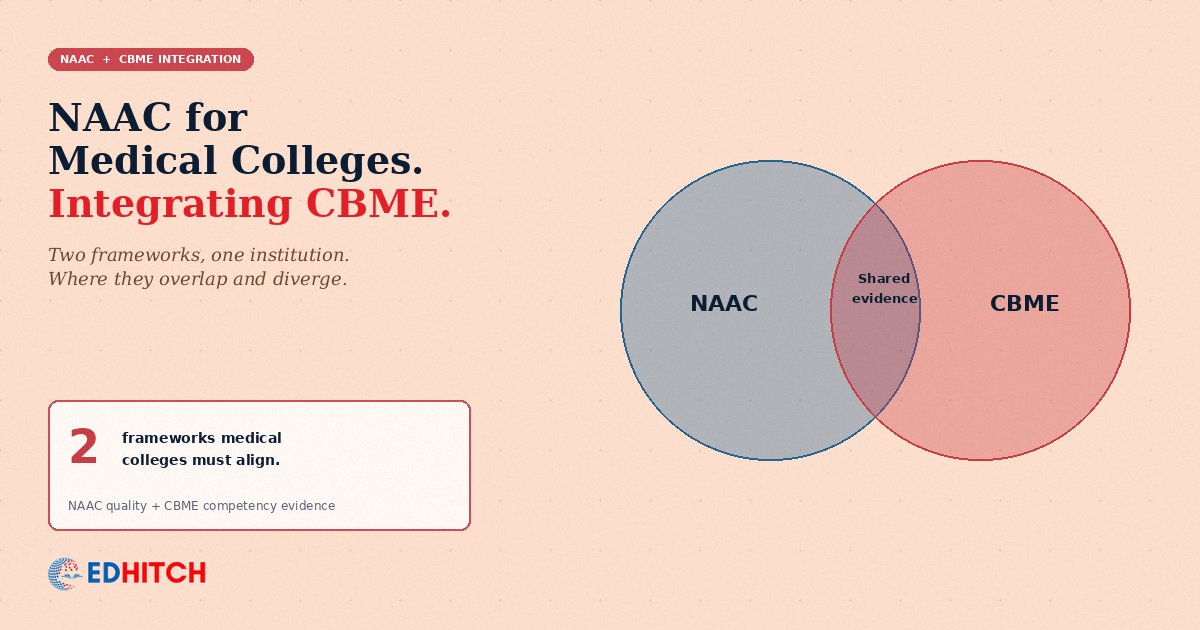
In short: A medical college pursuing NAAC accreditation in India submits a Self-Study Report under the Unified Manual for Health Sciences Colleges — Part A (900 points, 7 criteria, 109 metrics) plus Part B (100 points, discipline-specific). The same college is simultaneously implementing NMC’s CBME Curriculum 2024 — Foundation Course, AETCOM module, Early Clinical Exposure, Family Adoption Programme, Learner-Doctor Method, Alignment & Integration teaching, Pandemic Module. The evidence base for CBME compliance is also the evidence base for NAAC SSR Criterion 2 (Teaching, Learning and Evaluation), Criterion 3 (Research), and Criterion 5 (Student Support). Building this evidence once and using it across both frameworks is the integrated approach.
Why most medical colleges run NAAC and NMC in parallel — and why that's expensive
For a medical college, NMC compliance is mandatory and NAAC accreditation is institutionally critical. Most colleges treat them as two separate projects: a CBME implementation team handles NMC, a separate IQAC handles NAAC, and the data flows from departments are duplicated.
The result is predictable: the AETCOM coordinator submits one report for NMC’s ADR (Annual Disclosure Report) and a different summary to IQAC for NAAC SSR. The Family Adoption Programme registers attendance for NMC compliance, but doesn’t feed into NAAC’s Extension Activities metric. Faculty CBME training data sits in one drive, Faculty Development Programme records for NAAC sit in another. Same activity, two parallel evidence trails, two opportunities for inconsistency.
This page is about doing the work once.
NAAC's Unified Manual for Health Sciences Colleges: structure
Unlike NAAC’s general affiliated-college manual, the Health Sciences manual is unified across all medical-stream disciplines but split into two parts to handle discipline-specific differences:
Part A — Generic Health Sciences
Common to all health sciences colleges: medical, dental, nursing, physiotherapy, allied health, AYUSH disciplines.
- Seven NAAC criteria, applied to health-sciences context
- 109 metrics in the SSR
- Stakeholder participation: management, faculty, staff, students, parents, employers, alumni, community
- Quality Indicator Framework (QIF) governs data templates
Part B — Discipline-Specific
Discipline-specific metrics: medical, dental, nursing, etc. each have unique parameters reflecting their regulatory contexts.
- For medical colleges: NMC-aligned discipline parameters
- For dental colleges: DCI-aligned parameters
- For nursing: INC-aligned parameters
- Captures regulator-specific quality dimensions NAAC's generic Part A cannot
The five-stage NAAC A&A process for health sciences colleges
| Stage | What it is | What you submit / receive |
|---|---|---|
| 1. IIQA | Institutional Information for Quality Assessment | Eligibility and basic institutional data registered with NAAC |
| 2. SSR | Self-Study Report submission | Part A (109 metrics, 900 pts) + Part B (medical-specific, 100 pts) along with evidence uploads |
| 3. DVV | Data Validation and Verification | NAAC validates submitted data through clarifications and document audits |
| 4. PTV | Peer Team Visit | On-site assessment by NAAC peer team including stakeholder interactions |
| 5. Result | Accreditation decision | Under Binary framework: Accredited / Not Accredited; optionally MBGL Level for those pursuing graded recognition |
CBME 2024: what NMC mandates for MBBS
CBME — Competency-Based Medical Education — is the NMC-mandated curriculum framework for MBBS, defining what an Indian Medical Graduate must be able to do at graduation. The CBME Curriculum 2024 was notified by NMC’s Undergraduate Medical Education Board on 12 September 2024, with additional clarification on 10 October 2024.
The five global competencies of an Indian Medical Graduate
CBME defines what a graduating Indian Medical Graduate (IMG) must demonstrate, framed as five global roles:
Clinician
Recognizes, diagnoses, and manages common health problems
Communicator
Communicates effectively with patients, families, communities, colleagues
Leader & Team Member
Functions effectively as both leader and team member in healthcare delivery
Professional
Demonstrates ethical practice, professionalism, and accountability
Lifelong Learner
Committed to continuous learning and professional development
The 4.5-year MBBS structure under CBME 2024
| Phase | Duration | Key components |
|---|---|---|
| Phase I (First Professional) | 12 months (including 2-week Foundation Course and university exams) | Foundation Course, Anatomy, Physiology, Biochemistry; introduction to AETCOM; Early Clinical Exposure; alignment & integration; pandemic module |
| Phase II (Second Professional) | 12 months | Pathology, Pharmacology, Microbiology, Forensic Medicine, Community Medicine (with family visits), introduction to clinical subjects (Gen Surg, Gen Med, OBG); continued AETCOM |
| Phase III Part I | 12 months | Clinical specialties begin in earnest; AETCOM, electives, Family Adoption Programme continues |
| Phase III Part II | 18 months | Clinical Clerkship (Learner-Doctor Method), advanced clinical postings, final professional exams |
| Total | 54 months (4.5 years) before internship | |
The key CBME 2024 implementation components
Foundation Course
Two-week orientation at the start of Phase I, designed to ease the transition from school to medical college, introduce learning skills, and build community-engagement readiness.
Phase I 2 weeksAETCOM Module
Attitude, Ethics and Communication — a longitudinal programme across all phases. Develops professionalism, ethics, communication skills, and patient-centeredness.
All phases LongitudinalEarly Clinical Exposure (ECE)
Introduced in 2019, retained in CBME 2024. Brings clinical context into preclinical phases through patient interaction, hospital visits, and case-based learning from Phase I onwards.
From Phase IFamily Adoption Programme (FAP)
Each student adopts minimum 3 (preferably 5) families in nearby villages. Continues across phases — longitudinal community engagement aligned with India’s primary-care priorities.
Phase I onwards 3–5 familiesLearner-Doctor Method (Clinical Clerkship)
Phase III Part II hands-on clinical training where students function as learner-doctors under supervision — the operational core of competency-based assessment.
Phase III Part IIAlignment & Integration (AIT) Teaching
Horizontal (across same-phase subjects) and vertical (across phases) integration of teaching, replacing siloed subject-wise delivery. Required across all phases.
All phasesPandemic Module
Added in CBME 2024 (post-COVID learning). Integrated into curriculum across phases to prepare graduates for future public health emergencies.
All phases New in 2024Simulation-Based Learning
Mandatory simulation-lab learning for procedural skills, emergency response, and decision-making under stress. Required from Phase I.
All phasesThe CBME ↔ NAAC mapping: where the same evidence feeds both
This is where integrated documentation becomes operationally valuable. Each CBME component generates evidence that maps directly to specific NAAC SSR metrics. A medical college that documents CBME implementation rigorously is, in effect, building most of its NAAC SSR evidence base at the same time.
| CBME Component (NMC) | NAAC SSR Criterion | What evidence it provides |
|---|---|---|
| Foundation Course | Criterion 1 (Curricular Aspects), Criterion 5 (Student Support) | Student induction, orientation programmes, learning-skills development |
| AETCOM Module | Criterion 1 (Value-added courses), Criterion 2 (Teaching innovations), Criterion 5 (Soft-skills, ethics), Criterion 6 (Institutional ethics) | Longitudinal evidence of professionalism, ethics, communication training — one of the highest-leverage evidence sources in the entire SSR |
| Early Clinical Exposure (ECE) | Criterion 2 (Teaching-Learning Process), Criterion 3 (Industry/community linkages) | Experiential learning, integration of theory and practice, clinical contact hours from Phase I |
| Family Adoption Programme | Criterion 3 (Extension Activities), Criterion 7 (Institutional Distinctiveness, Best Practices) | Community engagement, longitudinal community service, primary-care focus — strong qualitative evidence for Criterion 7 Best Practices |
| Learner-Doctor Method | Criterion 2 (Outcome-Based Education, Teaching-Learning Process) | Competency-based assessment, hands-on skill development, attainment evidence aligned with the 5 IMG competencies |
| Alignment & Integration teaching | Criterion 1 (Curricular Aspects, Interdisciplinary), Criterion 2 (Teaching innovations) | Curricular integration, interdisciplinary teaching evidence |
| Simulation-based learning | Criterion 2 (Teaching-Learning), Criterion 4 (Infrastructure) | Modern pedagogical tools, simulation lab infrastructure |
| Pandemic Module | Criterion 1 (Curricular Aspects — emerging areas) | Curriculum responsiveness to public-health emergencies, new addition in CBME 2024 |
| BCME / ACME / rBCW / CISP faculty training | Criterion 6 (Faculty Development), Criterion 2 (Teacher quality) | Faculty development programme attendance, training in CBME pedagogy, AETCOM facilitation |
| 5 IMG roles assessment (Clinician, Communicator, etc.) | Criterion 2 (Programme Outcomes, Course Outcomes) | Outcome-based education evidence, mapping of course outcomes to graduate competencies — the medical-college equivalent of CO-PO mapping in engineering |
A medical college that documents these CBME components properly has, by simple by-product, already prepared 60–70% of the qualitative narrative for its NAAC SSR Criteria 1, 2, 3, 5, 6, and 7. The remaining work is mostly quantitative metric population (faculty numbers, enrolment, expenditure, etc.) which is the IQAC’s ongoing job anyway.
The integrated documentation approach — how to actually do this
Mapping CBME to NAAC on paper is one thing. Operationalizing it — so that the medical college’s real data flows naturally to both NMC ADR and NAAC SSR — is the practical work. Five disciplines that make the difference:
- One institutional data source, two output templates. Faculty profiles, student attainment data, infrastructure, research output should live in one place. The NMC ADR template and NAAC SSR template both draw from that source. No "AETCOM report for NMC" and "AETCOM summary for NAAC" as separate documents.
- AETCOM as the cross-criterion anchor. AETCOM evidence touches Criteria 1, 2, 5, and 6 of NAAC SSR. Document AETCOM sessions, participation, outcomes, faculty preparation, and student feedback once — thoroughly — and reuse across all four NAAC criteria. This is the single highest-leverage documentation move.
- Family Adoption Programme as Criterion 7 Best Practice. NAAC’s Best Practices metric under Criterion 7 (Institutional Values, Best Practices) accepts maximum two practices per cycle. FAP, properly documented as a longitudinal community engagement programme aligned with India’s primary-care priorities and contributing to graduate competencies, is a high-quality Best Practice submission.
- 5 IMG roles as the medical college’s PO-equivalent. Engineering colleges have 11 Program Outcomes mapped to Course Outcomes for NBA. Medical colleges have the 5 IMG global competencies. Map your subject-wise competencies (already required by CBME) to the 5 IMG roles for NAAC Criterion 2 outcome-based evidence.
- Cross-validate with NMC ADR before NAAC submission. A common failure mode is reporting different infrastructure or faculty numbers to NMC’s Annual Disclosure Report and to NAAC. These cross-checks happen during DVV. Run an internal cross-validation before formal submission.
This is exactly the approach Edhitch takes with medical college clients, including ASRAM. See the NMC compliance side → | See the MARB framework →
Common gaps in medical college NAAC SSRs — and the CBME fix
Across NAAC SSR submissions from medical colleges, several gap patterns recur. Most can be closed by leveraging CBME evidence already collected for NMC compliance:
- Weak Outcome-Based Education narrative under Criterion 2. Medical college SSRs often describe traditional teaching methods because authors are unfamiliar with the OBE language NAAC expects. Fix: explicitly map subject-wise CBME competencies to the 5 IMG roles, structurally identical to how engineering colleges do CO-PO mapping for NBA.
- Generic Extension Activities for Criterion 3. Medical colleges have a goldmine in FAP, ECE community visits, rural postings, vaccination drives — but report them in generic NAAC-template language instead of as longitudinal programmes with measurable outcomes. Fix: present FAP and Community Medicine activities as structured longitudinal programmes with student-level data.
- AETCOM under-documented. Most medical colleges have AETCOM running, but treat it as an NMC compliance item rather than an SSR asset. AETCOM is one of the strongest cross-criterion evidence sources available to a medical college; SSRs should highlight it explicitly under Criteria 1, 2, 5, 6.
- Faculty development reported but not structured. Faculty attendance at BCME, ACME, rBCW, AETCOM training is routine in medical colleges but is reported as a list rather than a competency-mapped FDP under Criterion 6. Fix: link FDP attendance to specific teaching-quality improvements.
- Best Practices under Criterion 7 weak or generic. Many medical college SSRs submit "blood donation drives" or similar one-off events as Best Practices, missing the opportunity to present FAP, structured AETCOM, or signature institutional CBME implementation as longitudinal Best Practices with documented impact.
- Cross-framework data inconsistencies surfaced during DVV. Faculty count reported to NAAC differs from NMC ADR submission; bed strength differs between NMC, NAAC, and NIRF Medical submissions. These inconsistencies are caught and they hurt accreditation outcomes.
Master Data Map for medical colleges
Your NMC data, your NAAC submission and your NIRF return all draw on the same faculty, student and infrastructure records. Master Data Map keeps them on one institutional record, and our advisory team runs NMC compliance alongside it. See how it works for medical colleges →
Frequently asked questions
Does NAAC apply to medical colleges in India?
Yes. NAAC has a dedicated Unified Manual for Health Sciences Colleges that applies to Medical, Dental, Nursing, Physiotherapy and Allied Health Sciences, Ayurveda, Yoga and Naturopathy, Unani, Siddha, and Homeopathy. Most leading Indian medical colleges hold both NMC recognition (regulatory) and NAAC accreditation (quality assurance), and the data overlap between the two frameworks is substantial.
What is the NAAC Unified Manual for Health Sciences Colleges?
It is NAAC’s dedicated assessment manual for health sciences institutions. The manual has two parts: Part A contains 900 weightage points of generic metrics covering NAAC’s seven criteria applicable to all health colleges; Part B contains 100 weightage points of discipline-specific metrics covering medical, dental, nursing and other streams. For health sciences colleges, the SSR has 109 metrics in Part A across the seven criteria, with discipline-specific Part B metrics added on top.
How does CBME fit into NAAC SSR for a medical college?
CBME (Competency-Based Medical Education) is the NMC-mandated curriculum for MBBS, and CBME implementation evidence feeds directly into NAAC SSR Criterion 2 (Teaching, Learning and Evaluation). Components like the Foundation Course, AETCOM module, Early Clinical Exposure, Family Adoption Programme, Learner-Doctor Method, Alignment and Integration teaching, and the Pandemic Module — all NMC-mandated under CBME 2024 — serve as evidence for NAAC metrics on outcome-based curriculum, teaching innovation, and student engagement. Building this once and using it twice is the integrated approach Edhitch recommends.
What are the five competencies of an Indian Medical Graduate under CBME?
Per NMC’s CBME framework, the Indian Medical Graduate (IMG) must demonstrate five global roles at graduation: (1) Clinician — able to recognize, diagnose, and manage common health problems; (2) Communicator — communicates effectively with patients, families, communities, and colleagues; (3) Leader and Member of the Health Care Team — functions effectively as both leader and team member; (4) Professional — demonstrates ethical practice, professionalism, and accountability; (5) Lifelong Learner — committed to continuous learning and professional development. The CBME Curriculum 2024 (NMC notification 12 September 2024) operationalizes these competencies.
What is AETCOM and why does it matter for NAAC?
AETCOM is the Attitude, Ethics and Communication module — a longitudinal programme NMC mandates as part of CBME, running across all phases of the MBBS curriculum. AETCOM evidence is high-value for NAAC SSR because it speaks directly to multiple NAAC metrics: outcome-based learning under Criterion 2, value-based education under Criterion 5 (Student Support), and institutional ethics under Criterion 6 (Governance). A well-documented AETCOM programme is one of the strongest single sources of cross-criterion evidence for a medical college NAAC SSR.
Has NAAC moved to Binary Accreditation and MBGL for medical colleges?
NAAC announced the Binary Accreditation Framework and Maturity-Based Graded Levels (MBGL) on 10 February 2025, replacing the legacy CGPA grading. The Binary framework applies in principle to all NAAC-accredited institutions, including health sciences. Implementation specifics for the Health Sciences manual continue to be detailed by NAAC. Medical colleges in Cycle 2 and above under the Revised Accreditation Framework retain their existing grades during transition. Track NAAC’s official notifications for the latest framework-applicability guidance.
How long does a NAAC SSR take for a medical college?
Manual NAAC SSR preparation for a medical college typically takes 9 to 12 months because of the volume of data required across 109 Part A metrics, the additional Part B health-sciences-specific metrics, and the documentation overhead of CBME implementation evidence. With integrated documentation that draws CBME evidence already collected for NMC compliance, the additional NAAC-specific work can be reduced to 4 to 6 months for institutions with reasonably maintained data. Institutions with significant data gaps require longer.
How does Edhitch help medical colleges with NAAC and CBME integration?
Edhitch helps medical colleges — including ASRAM — manage NMC compliance, NAAC accreditation, and NIRF Medical ranking as one integrated quality system. CBME evidence collected for NMC documentation is mapped to NAAC SSR Criterion 2 (and other criteria where applicable). AETCOM, Family Adoption Programme, Foundation Course, and Early Clinical Exposure documentation is structured once and reused for SSR submission, NMC ADR (Annual Disclosure Report), and NIRF Medical category data submission. 12 years of accreditation advisory experience, 9,000 plus faculty trained.
For NAAC’s official Health Sciences Manual, visit the NAAC Health Science Manual page. For CBME 2024 official document, see NMC Rules & Regulations.
Discuss NAAC + CBME Integration for Your Medical College
Fill in your details. Our medical-vertical team will review your CBME evidence base and map it against the NAAC Unified Manual within 24 hours.
Enquiry Received!
Our medical-vertical team will respond within 24 hours.
For immediate help: WhatsApp +91-92051 19385