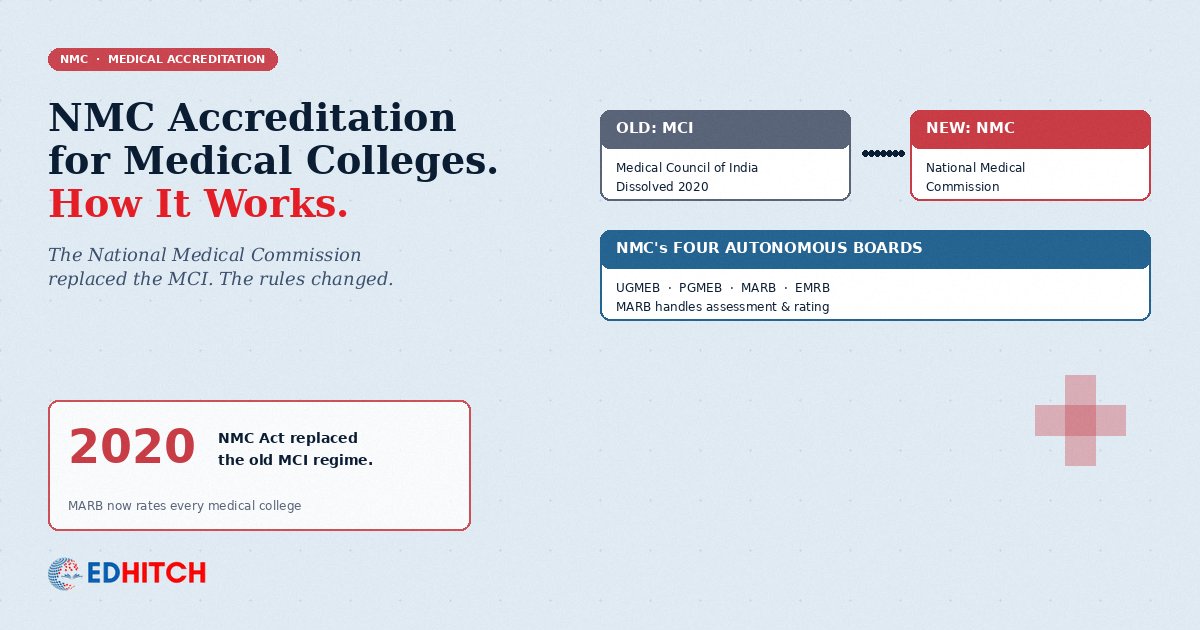
NMC accreditation is the recognition and assessment process governed by the National Medical Commission for medical colleges in India. It includes the Letter of Permission (LOP) for new or expanded MBBS and PG courses, periodic continuance of recognition under the Establishment of Medical Institutions, Assessment and Rating Regulations 2023, and the emerging accreditation and rating framework under the Medical Assessment and Rating Board (MARB). Every recognized medical college must also comply with UGMSR 2023 for undergraduate courses, PGMSR 2023 for postgraduate, and submit an Annual Disclosure Report (ADR).
In short: NMC accreditation in India is governed by the NMC Act 2019 and delivered through four autonomous boards — UGMEB, PGMEB, MARB, and EMRB. MARB issues the Letter of Permission (LOP) or Letter of Disapproval (LOD) based on UGMSR 2023, PGMSR 2023, and the 2023 Establishment Regulations. As of May 10, 2025, MARB has additionally drafted a separate 11-criteria, 78-parameter, 1000-point accreditation and rating framework — currently under stakeholder consultation. For most medical colleges, NMC compliance runs in parallel with NAAC accreditation and NIRF Medical category ranking, which is why a unified quality strategy outperforms three separate compliance projects.
The NMC Act 2019: what changed when MCI was replaced
The National Medical Commission Act, 2019 replaced the Medical Council of India (MCI) and restructured medical regulation in India. The reform was driven by long-standing concerns over governance, transparency, and uneven enforcement under the MCI model. NMC operates as a four-board federation, with each board owning a distinct part of the regulatory lifecycle.
UGMEB — Undergraduate Medical Education Board
Sets standards for MBBS and other undergraduate medical education, including curriculum (CBME), admission criteria, and examinations. Issues UGMSR — the Minimum Standard Requirement for undergraduate courses.
PGMEB — Postgraduate Medical Education Board
Regulates MD, MS, and super-specialty courses. Issues PGMSR for postgraduate standards. Also responsible for the NMC Faculty Regulations 2025 dated 30 June 2025, governing faculty qualification.
MARB — Medical Assessment and Rating Board
Assesses medical institutions and issues LOP (Letter of Permission) or LOD (Letter of Disapproval). Has drafted (May 2025) a separate accreditation and rating framework currently under consultation.
EMRB — Ethics and Medical Registration Board
Maintains the national medical register, regulates professional conduct, and handles disciplinary matters for medical practitioners across India.
For medical colleges, the most operationally significant board is MARB — it controls whether you can start a new MBBS programme, increase seats, launch a PG course, or maintain continuance of recognition. UGMEB and PGMEB set the standards MARB enforces.
The medical college recognition lifecycle
Unlike NAAC, which operates in fixed multi-year cycles, NMC recognition is a continuous, layered process. Most medical colleges find themselves managing several NMC interactions in parallel: course-level permissions, seat increases, annual reporting, and 5-yearly continuance assessments.
| Stage | What it is | Governing regulation |
|---|---|---|
| Establishment | Permission to start a new medical college, with first-year LOP and subsequent annual permissions until first batch passes out | Establishment Regulations 2023 |
| Recognition | Granted after the first batch of MBBS students complete the course and the college is assessed by MARB | Establishment Regulations 2023 |
| Continuance | Periodic reassessment to maintain recognition — statutorily every 5 years | Establishment Regulations 2023 |
| UG Seat increase | Application for additional MBBS seats — subject to UGMSR 2023 compliance | UGMSR 2023 (amended 2025, 2026) |
| PG Course start / Seat increase | Permission to launch MD/MS programmes or expand existing PG seats | PGMSR 2023 |
| Annual disclosure | ADR (Annual Disclosure Report) mandated by MSMER 2023 — submitted yearly | MSMER 2023 |
| MARB accreditation & rating | Emerging: a separate framework drafted May 2025, under consultation | NMC Act 2019, Section 26(1)(d) |
Every stage has its own evidence requirements, AEBAS (Aadhaar Enabled Biometric Attendance System) verification, Hospital Management Information System (HMIS) data checks, and on-site or virtual assessment provisions. Compliance gaps at any stage can result in stoppage of admissions, reduction in seats, monetary penalty, or recommendation for withdrawal of recognition.
LOP vs LOD: how the Letter of Permission process works
Every year, NMC invites online applications from medical colleges and institutions for: (a) establishment of new medical colleges, (b) increase of UG (MBBS) seats, (c) starting new PG courses, and (d) increase of PG seats. For the academic year 2025–26, the Central government approved 11,682 MBBS seats and 8,967 PG seats across 43 newly established medical colleges, taking national totals to 818 medical colleges, 1,28,976 MBBS seats, and 85,020 PG seats.
After due scrutiny and assessment, MARB issues either:
- LOP (Letter of Permission) — the application is approved. The college may proceed with admissions for the cycle covered by the LOP. LOPs are typically annual until full recognition is granted.
- LOD (Letter of Disapproval) — the application is rejected due to non-compliance with one or more of: Establishment Regulations 2023, UGMSR 2023, PGMSR 2023, or other relevant norms. The college may rectify and reapply in a subsequent cycle.
The assessment itself, as defined in the MARB Guidelines, may include verification of documents in digital form, Aadhaar-based attendance register, live video feed verification, photographs, HMIS data, or physical/virtual assessment on any day. Assessors examine infrastructure, quality of medical education, faculty, clinical material, financial status, and may conduct interviews with staff and students. Fake patient practice, when detected, is treated as a serious violation under Chapter 5 (Sanctions and Penalty) of the 2023 Establishment Regulations.
MARB's new accreditation framework: 11 criteria, 78 parameters, 1000 points
On 10 May 2025, the Medical Assessment and Rating Board released a draft framework for separate accreditation and rating of medical colleges — over and above the existing LOP-based recognition system. The framework, exercising powers under Section 26(1)(d) of the NMC Act 2019, proposes assessment of all NMC-regulated medical colleges through an independent third-party agency. MARB has been working with the Quality Council of India (QCI) on assessment delivery since 2023.
The draft framework is constructed on 11 key criteria, totaling 78 evaluation parameters, with 1000 total points distributed across qualitative and quantitative measures:
| Domain | Examples | Indicative weight |
|---|---|---|
| Governance & Leadership | Mission alignment, strategic planning | Significant |
| Curriculum & CBME Implementation | How well CBME is integrated | Significant |
| Clinical Training & Patient Care | Real clinical material, AEBAS-verified clinical exposure | Significant |
| Teaching-Learning Environment | Faculty engagement, learning resources | Significant |
| Student Admission & Welfare | NEET-based admissions, student support services | Moderate |
| Research & Innovation | Faculty research output, student research opportunities | Moderate |
| Faculty & Staff | Compliance with NMC Faculty Regulations 2025 | Significant |
| Infrastructure & Resources | Hospital beds, departments, library, simulation labs | Significant |
| Community Outreach Programmes | Public health engagement, rural exposure | 40 points |
| Quality Assurance System | Internal QA mechanisms, continuous improvement | 30 points |
| Feedback & Perception of Stakeholders | Student, faculty, patient, community feedback | 40 points |
| Total | 26 qualitative + 52 quantitative = 78 parameters | 1000 points |
The MARB framework is consciously aligned with WFME (World Federation for Medical Education) standards, which cover 9 major domains and are adopted by over 100 countries. By 2024, more than 75% of medical schools worldwide operated under WFME-aligned accreditation. India's MARB framework, once finalized, is expected to bring Indian medical education into that global mainstream.
Important — the framework is currently in stakeholder consultation. Final criteria weightages, rating bands, and rollout timelines are subject to change. Medical colleges should not yet pursue formal MARB ratings; they should, however, begin internal readiness on the 11 criteria so that the gap is closed when the framework is finalized.
CBME: the curriculum NMC mandates
Competency-Based Medical Education (CBME) is the NMC-mandated curriculum framework for MBBS. It is, in effect, OBE (Outcome-Based Education) for medical education — the medical equivalent of the CO-PO framework engineering colleges operate under for NBA.
CBME defines the competencies an Indian Medical Graduate (IMG) must demonstrate at graduation. Per NMC, the IMG is expected to be competent across five roles:
- Clinician — able to recognize, diagnose, and manage common health problems
- Leader and Member of the Health Care Team — functions effectively as a leader and team member in healthcare delivery
- Communicator — communicates effectively with patients, families, communities, and colleagues
- Lifelong Learner — committed to continuous learning and professional development
- Professional — demonstrates ethical practice, professionalism, and accountability
The CBME Curriculum 2024 was notified on 12 September 2024 with additional clarification on 10 October 2024. Key implementation features include early clinical exposure from year 1, simulation-based skill-building, integrated ethics modules, and a shift from purely theory-based assessment to skill-and-competency demonstration.
CBME implementation is evaluated as part of NMC compliance — and curriculum integration also features prominently in the MARB draft framework. Critically, CBME is also evaluated under NAAC Criterion 2 (Teaching, Learning and Evaluation) for the same medical college. This is why integrated CBME-NAAC documentation, with one source-of-truth for both frameworks, is operationally important.
The reality: NMC + NAAC + NIRF in parallel
Most Indian medical colleges discover, painfully, that NMC accreditation is not the only quality framework they answer to. NAAC and NIRF Medical category operate in parallel, on different cycles, with different submission requirements — but drawing from substantially the same underlying institutional data.
NMC
Regulator — mandatory
- UGMSR 2023 + PGMSR 2023 compliance
- Annual LOP cycles
- 5-yearly continuance assessment
- Annual Disclosure Report (ADR)
- CBME implementation
- Faculty Regulations 2025
- (Future) MARB rating
NAAC
Quality assessment — not legally mandatory, institutionally critical
- Binary Accreditation + MBGL framework (Feb 2025)
- SSR across 7 criteria
- AQAR annually (by 31 December)
- IQAC functioning
- CBME evaluated under Criterion 2
- Clinical infrastructure under Criterion 4
NIRF Medical
Public ranking — reputational
- Medical category (separate from general categories)
- 5 parameter groups: TLR, RP, GO, OI, PR
- Faculty data, research output (Scopus-indexed)
- Graduation outcomes including FMGE pass rates
- Perception of academic peers, employers
- Annual data submission cycle
For an MBBS Programme Coordinator or IQAC head at a medical college, the practical question becomes: "do we run three parallel data exercises and accept the cost, or do we build one institutional data source that serves all three?" The data overlap is substantial — faculty profiles, student outcomes, infrastructure, research publications, financial data feed all three frameworks.
This is exactly the approach Edhitch takes with medical college clients, including ASRAM: one institutional data source, framework-specific outputs on demand, integrated CBME-NAAC documentation, and MARB-readiness mapping as the framework finalizes.
Common NMC compliance gaps in Indian medical colleges
Across NMC assessments, MARB inspections, and informal post-mortems of recognition issues, several gap patterns recur. These are not exotic problems; they are predictable and preventable with systematic preparation.
- Faculty deficiency relative to UGMSR 2023 requirements — especially in non-clinical departments, and post-amendment recalibrations needed after 02.07.2025 and 23.04.2026
- AEBAS attendance gaps — biometric data not matching declared faculty strength, which is automatically detected during assessment
- Clinical material shortfall — insufficient bed occupancy, low patient inflow, or HMIS data inconsistencies that suggest "fake patient practice"
- CBME implementation surface-only — curriculum maps exist on paper but actual skill stations, simulation labs, or competency-based assessment not operationalized
- Infrastructure declared vs verified — library holdings, lab equipment, demonstration rooms not matching documented claims
- ADR submission gaps — Annual Disclosure Report not filed, or filed with internal inconsistencies vs prior submissions
- NAAC-NMC documentation conflicts — same data point reported differently to NAAC SSR and NMC ADR, surfaced during cross-validation
The diagnostic question for medical college leadership is not "are we compliant" — it is "would our compliance survive an assessor's verification methodology against our actual operational data?"
Master Data Map for medical colleges
Your NMC data, your NAAC submission and your NIRF return all draw on the same faculty, student and infrastructure records. Master Data Map keeps them on one institutional record, and our advisory team runs NMC compliance alongside it. See how it works for medical colleges →
Frequently asked questions
What is NMC accreditation?
NMC accreditation is the recognition and assessment process governed by the National Medical Commission for medical colleges in India. It includes the Letter of Permission (LOP) for starting or expanding MBBS and PG courses, periodic continuance of recognition under the Establishment of Medical Institutions, Assessment and Rating Regulations 2023, and the emerging accreditation and rating framework under the Medical Assessment and Rating Board (MARB). All recognized medical colleges in India must comply with UGMSR 2023 for undergraduate courses and PGMSR 2023 for postgraduate courses.
What is MARB and how does it differ from existing NMC inspections?
MARB is the Medical Assessment and Rating Board, one of the four autonomous boards under the National Medical Commission. While the existing NMC inspection regime focuses on minimum compliance for LOP issuance, MARB has drafted (10 May 2025) a separate accreditation and rating framework that evaluates medical colleges on 11 criteria across 78 parameters totaling 1000 points. The framework is currently under stakeholder consultation and is expected to introduce performance-based ratings, going beyond binary recognition into a graded quality assessment.
What is the difference between LOP and LOD?
LOP (Letter of Permission) is issued by NMC granting permission to establish a new medical college, start a new course, or increase MBBS or PG seats — after due scrutiny and assessment. LOD (Letter of Disapproval) is issued when an application is rejected due to non-compliance with the Establishment of Medical Institutions, Assessment and Rating Regulations 2023, UGMSR 2023, or PGMSR 2023. Both letters are issued under the authority of MARB on behalf of NMC.
How often must a medical college renew NMC recognition?
Under existing regulations, medical colleges must obtain continuance of recognition every 5 years through NMC assessment. In addition, the Maintenance of Standards of Medical Education Regulations, 2023 (MSMER 2023) requires every recognized medical college to submit an Annual Disclosure Report (ADR) to the concerned NMC board (UGMEB or PGMEB), confirming compliance with prescribed standards every year.
Does NMC accreditation replace NAAC for medical colleges?
No. NMC accreditation is a regulatory requirement specific to medical education, governed by the NMC Act 2019 and its associated regulations. NAAC (National Assessment and Accreditation Council) is a separate quality assessment framework that applies to higher education institutions generally, including medical colleges. Most Indian medical colleges hold both — NMC for medical education compliance and NAAC for general institutional quality assurance. NIRF Medical category ranking is also separate. Edhitch helps medical colleges manage NMC, NAAC, and NIRF as one integrated quality system.
What are the four autonomous boards under NMC?
The four autonomous boards under the National Medical Commission are: (1) Undergraduate Medical Education Board (UGMEB) — sets standards for MBBS and other undergraduate medical education; (2) Postgraduate Medical Education Board (PGMEB) — regulates MD, MS, and super-specialty courses; (3) Medical Assessment and Rating Board (MARB) — assesses and permits medical colleges, issues LOP/LOD, and is developing the new accreditation and rating framework; (4) Ethics and Medical Registration Board (EMRB) — maintains the national medical register and enforces ethical conduct.
How is CBME related to NMC accreditation?
CBME (Competency-Based Medical Education) is the NMC-mandated curriculum framework for MBBS, defining the competencies an Indian Medical Graduate (IMG) must demonstrate — Clinician, Leader, Communicator, Lifelong learner, and Professional. The CBME Curriculum 2024 was notified on 12 September 2024 with additional clarification dated 10 October 2024. CBME implementation is assessed as part of NMC compliance, and curriculum integration also features prominently in the MARB draft accreditation framework. CBME is also evaluated under NAAC Criterion 2 (Teaching, Learning and Evaluation) for the same medical college, making integrated CBME-NAAC documentation important.
How does Edhitch help medical colleges with NMC accreditation?
Edhitch helps Indian medical colleges manage NMC compliance, NAAC accreditation, and NIRF ranking as one integrated quality system — not three parallel projects. Engagements include UGMSR 2023 gap audits, CBME integration documentation for NAAC SSR, MARB readiness preparation as the framework finalizes, NIRF Medical category data preparation, and faculty regulations compliance under the NMC Faculty Regulations 2025. Edhitch has supported medical institutions including ASRAM and brings 12 years of accreditation advisory experience across NAAC, NBA, and NIRF frameworks.
For NMC's official notifications, visit NMC Rules & Regulations. For MARB updates, see the Medical Assessment and Rating Board page.
Discuss NMC + NAAC + NIRF Readiness for Your Medical College
Fill in your details. Our medical-vertical team will review your readiness across NMC, NAAC, and NIRF and share next steps within 24 hours.
Enquiry Received!
Our medical-vertical team will respond within 24 hours.
For immediate help: WhatsApp +91-92051 19385