Of NIRF's five parameter groups, four can be moved by institutional action. TLR can improve when you hire faculty. RP can climb when your researchers publish more. GO can rise when your placement cell runs better. OI can grow when you expand outreach.
One parameter doesn't behave like that.
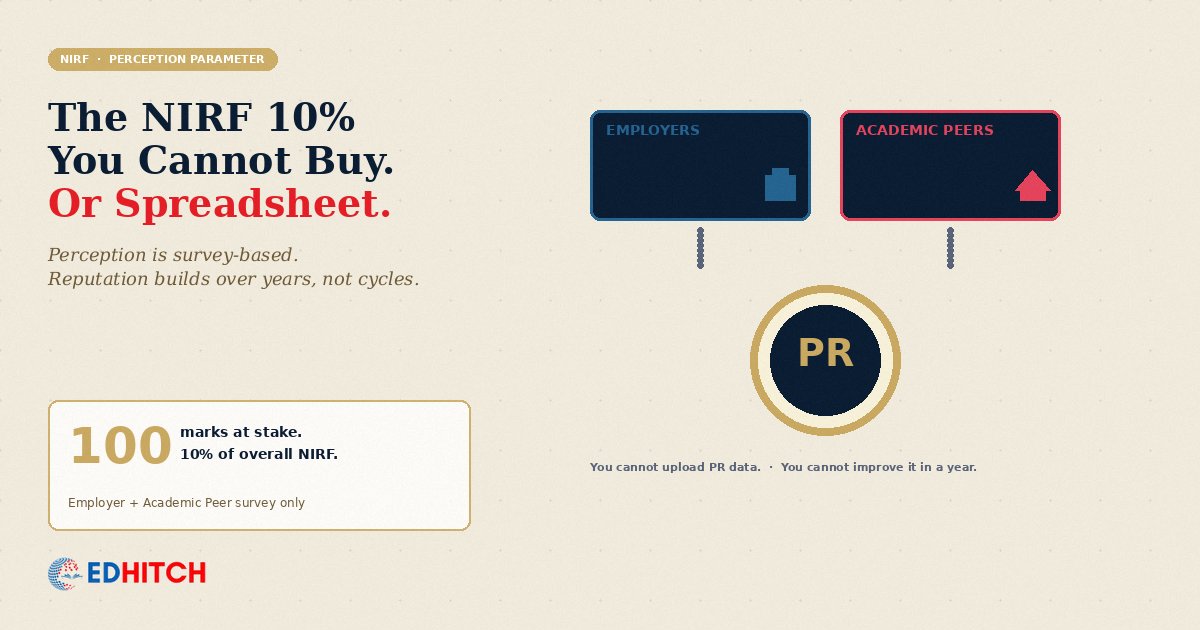
The fifth — Perception (PR) — carries 100 marks and accounts for 10% of the overall weighted NIRF score for engineering and most categories. It is built entirely from surveys. Employers and academic peers tell NIRF, in confidential responses, which institutions they prefer when hiring graduates or when recommending colleagues. That signal becomes your PR score. No upload, no improvement project, no diagnostic can change it directly. It moves only when reputation moves — and reputation moves slowly.
What PR actually measures
Per NIRF's published 2025 framework (nirfindia.org), the Perception parameter is defined as:
"Peer Perception: Employers & Academic Peer (PR): 100 marks. This is to be done through a survey conducted over a large category of Employers, Professionals from Reputed Organizations and a large category of academics to ascertain their preference for graduates of different institutions."
Two source groups:
- Employers and professionals from reputed organisations. Asked which institutions they prefer hiring graduates from, across sectors and regions.
- Academic peers. Senior faculty, deans, researchers at other institutions — asked which institutions they recognise and respect in the field.
NIRF constructs a comprehensive list of respondents taking into account sectoral and regional spread, sends out the survey, and aggregates the responses to produce the PR score. The methodology is intentionally insulated from institutional gaming — there's no list to be on, no submission to file, no way to upload more "perception" to improve your score.
Why this parameter exists
The first four NIRF parameters are operational. They measure what an institution has and does. PR is intentionally different — it asks what the world outside the institution thinks of it. The reasoning is that an institution can perform well operationally and still produce graduates the market doesn't value, or can perform modestly operationally and still produce graduates with strong reputational pull. PR adds the missing dimension.
In ranking terms, PR is the dimension where heritage IITs and IIMs hold structural advantages that no operational improvement can match in the short term. It's why a relatively-young IIT campus often ranks below an older IIT despite similar TLR and RP scores. The PR signal is sticky.
What this means for institutions in the dense rank band
For institutions in the top 20 of any NIRF category, PR is a stabiliser — established reputation produces consistent scores, and small operational gains compound. For institutions in the 50-150 dense band, PR is often the parameter where the largest score gap to higher ranks sits, and the one institutions feel least able to improve.
This produces a predictable strategic mistake. Institutions in the dense band see their PR score is the lowest of their five parameters and conclude they should focus on it. They commission "branding initiatives," media campaigns, "outreach to industry." Most of these initiatives don't move PR meaningfully because PR isn't driven by visibility — it's driven by experienced quality of graduates.
The institutions whose PR actually rises across years aren't the ones with the largest marketing budgets. They're the ones whose graduates, over a decade, have steadily entered the workforce and performed in ways that employers remember. PR rises slowly because the inputs to PR — what employers and academic peers have experienced of your institution — accumulate slowly.
What can be done — and what can't
This is the honest answer about Perception:
What cannot be done: You cannot upload PR data. You cannot improve PR in one year through any focused operational programme. You cannot game the survey because the respondent list isn't public and the methodology is insulated. Marketing campaigns aimed at survey respondents don't shift PR meaningfully.
What can be done over years: Improve placement quality — not placement numbers, but the quality of roles your graduates land. Strengthen the academic visibility of your faculty through conferences, journal involvement, peer review work. Build relationships with the industry sectors that hire from your category, not for press releases but for sustained engagement. Ensure your graduates entering the workforce represent the institution well.
These don't move PR immediately. They move PR five to ten years from now, as the cohort of graduates who experienced your improved operations becomes the cohort of professionals being surveyed about which institutions they trust.
The structural insight
PR is unusual among ranking parameters because it's a lagging indicator. Most NIRF parameters reflect current state. PR reflects accumulated past state. An institution that has improved dramatically in the last three years will see TLR, RP, GO, OI all reflect the improvement — but its PR will still reflect the institution it was five and ten years ago, because the employers and academic peers being surveyed remember the older institution.
This is also why PR moves slowly even when institutions decline. An institution that has decayed operationally over the last five years often retains a strong PR score for years afterward, before the market catches up. The lag works in both directions.
For institutions building a ten-year strategy, this matters: invest in operational quality now, and PR will follow — eventually. For institutions chasing rank improvement in a single cycle, PR is the parameter to accept rather than fight. The other four are where the leverage actually sits.
Want a diagnostic read of where you stand?
Edhitch runs an Accreditation Diagnostic across NIRF, NAAC, and NBA — surfacing the gaps that don't show up on your dashboard.
See the Diagnostics Catalogue →The bottom line on Perception
The institutions that rank well on PR earned it. Not in the last year. Not with a campaign. They earned it by producing graduates the market has experienced and remembered well, across decades. There's no shortcut, and the institutions that try to engineer one tend to discover they've spent budget without moving the number.
The honest strategic posture toward PR is: stop trying to move it in the short term. Focus on the four parameters that respond to operational work. Build the institutional quality that will, over years, become the perception your future PR scores reflect. The institutions that ignore the temptation to chase PR with marketing tend to outperform the institutions that don't.
About Edhitch
Edhitch is an independent accreditation and ranking diagnostics firm working with Indian higher education institutions. Twelve years in the sector. 100+ institutions served. A seven-year NIRF dataset spanning 5,076+ institution-year records across 13 disciplines. Founder-led advisory combining proprietary diagnostic software with strategic engagement. Read more about us →