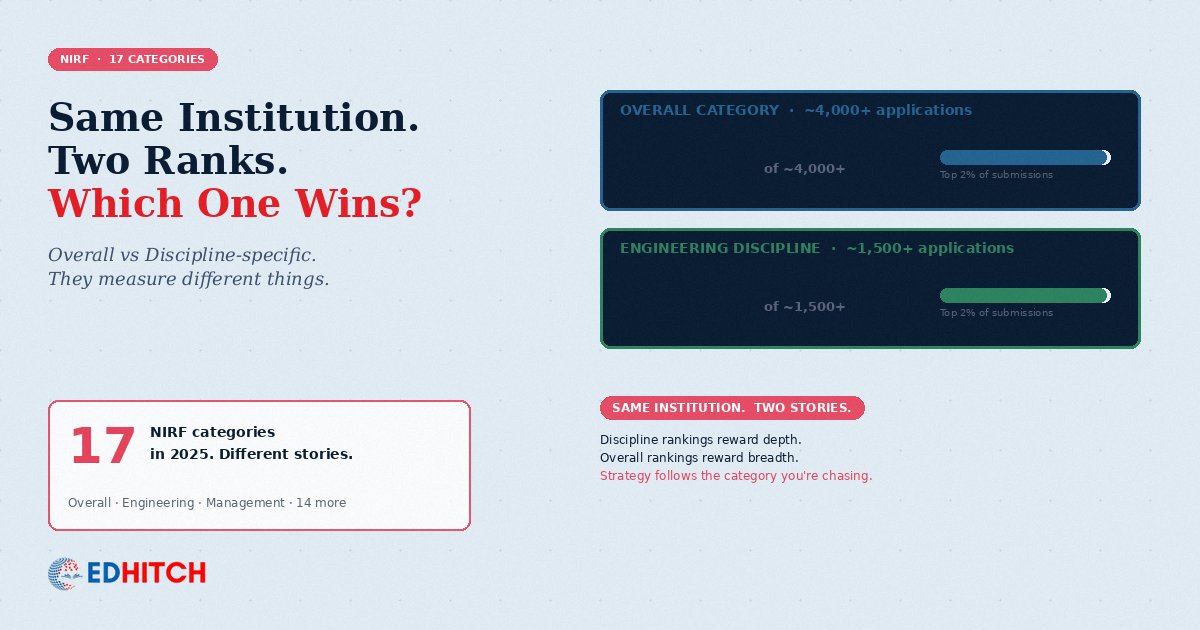
NIRF 2025, released by the Ministry of Education on September 4, 2025, ran across 17 categories — Overall, Universities, Engineering, Management, Medical, Pharmacy, Law, Dental, Architecture and Planning, Agriculture and Allied Sectors, Colleges, Research Institutions, Innovation, State Public Universities, Skill Universities, Open Universities, and a new Sustainable Development Goals (SDG) category.
Across these categories, NIRF 2025 received 14,163 applications from 7,692 unique institutions — the highest participation in the framework's ten-year history. Many institutions submit to multiple categories (an engineering institution may submit to both Engineering and Overall, for example), which is why applications substantially exceed unique institutions. Of the unique participating institutions, the College category alone saw fourfold growth since 2016.
The mistake most institutions make when they look at their NIRF results is treating these as different views of the same competition. They aren't. Each category has its own competitive landscape, its own scoring emphasis, and its own strategic implications. An institution ranking 78 in Overall and 32 in Engineering is telling you something specific about itself — and the strategic response to those two numbers is very different.
What "Overall" actually rewards
The Overall NIRF category accepts multi-disciplinary institutions — those that offer programmes across multiple disciplines and want to be evaluated as composite entities. The competitive set is therefore weighted toward large institutions with broad coverage: universities with engineering, management, sciences, humanities under one umbrella; large multi-campus institutions; multi-disciplinary autonomous institutions.
The scoring rewards breadth alongside depth. An institution that's excellent in engineering but doesn't offer much else will rank lower in Overall than a multi-disciplinary institution that's only good in several disciplines. The Overall category effectively measures composite institutional strength — not focused excellence.
This is why IIT Madras has topped Overall for ten consecutive years (NIRF 2025). It's not just that IIT Madras has strong engineering programmes — it's that as a multi-disciplinary IIT, it competes well across the Overall rubric's full scoring breadth.
What discipline-specific rankings reward
Engineering, Management, Medical, Law, and similar discipline-specific categories evaluate institutions within their discipline only. The competitive set narrows substantially — Engineering received approximately 1,500+ applications, evaluated against engineering-specific peer institutions, not against multi-disciplinary universities competing in Overall.
The scoring within discipline rankings rewards focused excellence. An institution that does engineering deeply and well — strong CO-PO attainment, focused research in engineering domains, employer recognition specifically for engineering graduates — will rank higher in Engineering than its Overall rank suggests, often substantially.
This is why a focused engineering institution can rank in the top 50 in Engineering while ranking 80+ in Overall: it doesn't have the multi-disciplinary breadth that Overall rewards, but it has the focused depth that Engineering rewards.
The strategic question your ranks are asking you
When an institution looks at its NIRF results across categories, the gap between the Overall rank and the discipline rank is the strategic signal:
If your Overall rank is significantly worse than your discipline rank, you're a focused institution that's doing your discipline well but doesn't have the breadth that Overall rewards. Strategy choice: lean into the discipline excellence or invest in adding disciplines to compete in Overall.
If your Overall rank is significantly better than your discipline rank, you're a multi-disciplinary institution where breadth is masking weaker discipline-specific depth. Strategy choice: identify which discipline is dragging the average and decide whether to invest in lifting it or restructure the portfolio.
If your Overall and discipline ranks are similar, you're internally consistent — your breadth and depth align. Strategy is more about parameter-level work than category positioning.
The category most institutions should target
This is counter-intuitive, but for the majority of Indian institutions, discipline rankings produce stronger strategic returns than Overall rankings.
Three reasons:
First, the competitive set is narrower and more navigable. Ranking 50th in Engineering against a discipline-specific peer set is a clearer strategic position than ranking 78th in Overall against a multi-disciplinary mix of universities and institutes. The discipline-specific peer set is more relevant for benchmarking, more meaningful for student perception, and more actionable for institutional strategy.
Second, discipline rankings align with student decision-making. Students don't choose institutions in the Overall category. They choose engineering colleges, management programmes, medical colleges. The discipline rank is what shows up in their search behaviour, in counselling sessions, in employer hiring lists. The Overall rank is a prestige signal; the discipline rank is a recruitment signal.
Third, discipline rankings reward focused operational improvement. An institution can move 20 positions in its discipline ranking through 18-24 months of focused operational work. Moving 20 positions in Overall typically requires 5+ years of structural transformation. The leverage is different.
The category that hides the real story
This is where the headline of this post sits. The Overall rank is the most-reported NIRF number, the one institutions print on their websites and brochures, the one media coverage emphasises. But it's also the rank most disconnected from institutional strategic reality for most institutions.
Two real institutional patterns illustrate this:
An engineering-heavy institution ranking 120 in Overall but 45 in Engineering is, for practical purposes, a top-50 engineering institution. Students applying for engineering should care about the 45; the 120 is a multi-disciplinary-breadth measure that doesn't reflect engineering quality.
Conversely, a multi-disciplinary university ranking 65 in Overall but with no engineering programme in the top 100 in Engineering is producing weaker engineering education than its Overall rank suggests. Engineering students applying based on the 65 rank are getting a misleading signal.
The category that wins, for any specific stakeholder question, is the category whose competitive landscape most resembles the decision being made.
The SDG category — a newer signal
NIRF 2025 introduced the Sustainable Development Goals category with approximately 791 institutions participating. This is a newer signal — institutions that perform well on SDG-aligned activities (renewable energy, social equity, community engagement, inclusive education) are recognised here in ways that other categories don't reward.
For institutions positioning around sustainability or NEP 2020 alignment, the SDG category provides a recognition pathway that doesn't compete with discipline rankings. It's worth tracking for institutions whose strategic identity includes these dimensions.
Want a diagnostic read of where you stand?
Edhitch runs an Accreditation Diagnostic across NIRF, NAAC, and NBA — surfacing the gaps that don't show up on your dashboard.
See the Diagnostics Catalogue →What to do with this
The practical implication of NIRF's multi-category structure is that institutional strategy needs to choose its target. Trying to optimise for all categories simultaneously is rarely the right choice — the operational investments that move Engineering rank are different from those that move Overall rank, and resources spread across both typically move neither far.
The strongest NIRF strategies we observe are category-specific. The institution decides which category most aligns with its identity, student base, employer relationships, and strategic future — and orients its NIRF preparation around that category's scoring emphasis. The other categories follow, somewhat, but aren't the primary focus.
The institution that asks "should we improve our Overall rank or our Engineering rank" is asking the strategic question correctly. The institution that doesn't distinguish between them and treats NIRF as a single rank to chase is leaving leverage on the table.
About Edhitch
Edhitch is an independent accreditation and ranking diagnostics firm working with Indian higher education institutions. Twelve years in the sector. 100+ institutions served. A seven-year NIRF dataset spanning 5,076+ institution-year records across 13 disciplines. Founder-led advisory combining proprietary diagnostic software with strategic engagement. Read more about us →