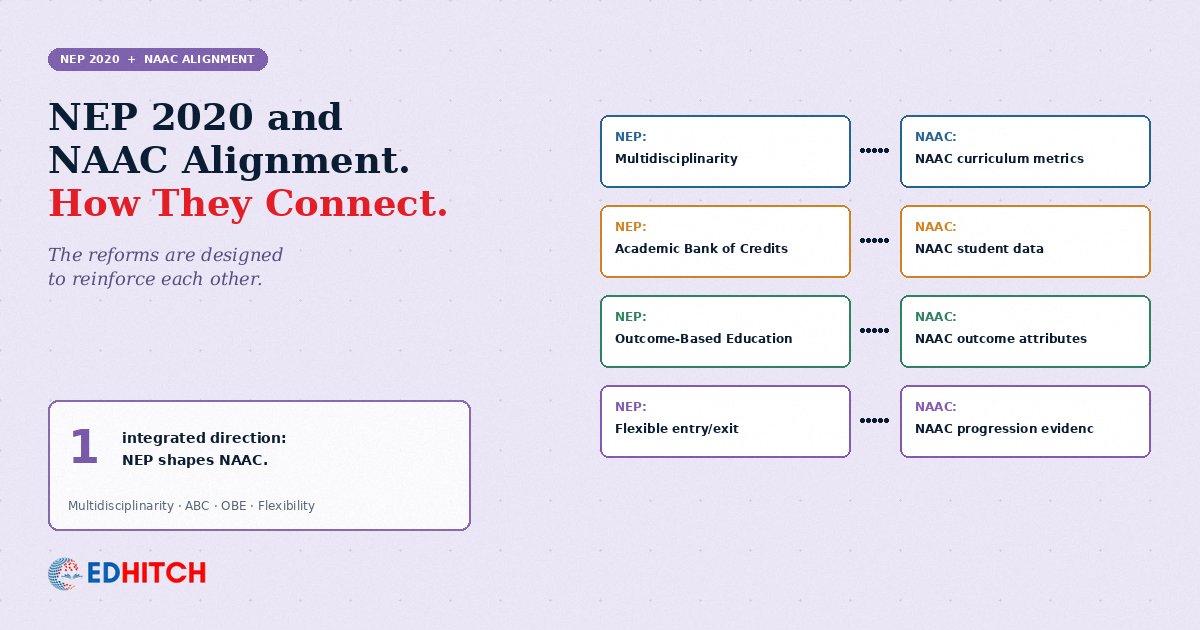
NEP 2020 + NAAC alignment means treating NEP 2020 implementation evidence and NAAC SSR / AQAR documentation as one integrated workstream rather than two parallel compliance tracks. NAAC has explicitly aligned its assessment and accreditation procedures with NEP 2020 through its draft white paper “The System of Assessment and Accreditation in India” (aligned with NEP 2020 and SDG 2030), updated AQAR guidelines to incorporate NEP preparedness from academic year 2021-22, and operationalised the NEP outcome-driven vision through the Binary Accreditation Framework + MBGL launched 10 February 2025.
In short: NEP 2020 implementation feeds NAAC SSR across all 7 NAAC criteria — not just Criterion 1. IQAC is the operational bridge translating NEP policy into NAAC-accreditable evidence. AQAR (mandatory annual report due 31 December) captures NEP preparedness for each academic year. The Binary Accreditation Framework (10 February 2025) operationalises NEP 2020 through its 10 attributes (Input 25% + Process & Output 75%), DCF 2025 digital data architecture, and One Nation One Data Platform cross-verification with AISHE/UGC. Institutions that treat NEP and NAAC as one integrated workstream produce stronger outcomes for both with less duplication.
Why NEP-NAAC alignment is the practical question
Most Indian higher education institutions still treat NEP 2020 implementation and NAAC accreditation as separate workstreams. Different committees, different documentation, different timelines. This is a structural mistake. NAAC has explicitly redesigned its framework to make NEP 2020 implementation the substrate for SSR and AQAR evidence — not an additional compliance layer alongside it.
Practically, this means: every CCFUGP curriculum implementation feeds Criterion 1. Every OBE attainment calculation feeds Criterion 2. Every faculty development on NEP themes feeds Criterion 2 and 6. Every NEP-aligned Best Practice feeds Criterion 7. The institutions that recognised this early are submitting cleaner SSRs and stronger AQARs; the institutions that treat NEP as a separate “additional” compliance are double-handling the same evidence.
The 7 NAAC criteria ↔ NEP 2020 themes mapping
This is the operational map. Every NEP 2020 theme has a home in the existing NAAC SSR. The integrated approach is to maintain one evidence base that covers both:
| NAAC Criterion | NEP 2020 Theme(s) it captures | Specific evidence required |
|---|---|---|
| Criterion 1 (Curricular Aspects) |
Multidisciplinary education, CCFUGP, multiple entry/exit, ABC integration, outcome-based curriculum, flexible electives, value-added courses | CCFUGP credit map, multidisciplinary electives, ABC student account integration, PEO/PO/PSO design, NEP-aligned curriculum revision evidence |
| Criterion 2 (Teaching-Learning & Evaluation) |
Outcome-based education (OBE), pedagogical reforms (experiential/discussion-based/art-integrated/flipped), continuous & comprehensive assessment, technology-enabled learning, faculty quality | CO/PO/PSO attainment data, pedagogical adoption records, faculty development on NEP themes, continuous assessment records, ICT-enabled lesson plans |
| Criterion 3 (Research, Innovations & Extension) |
Research culture promotion, innovation ecosystem, community engagement, IPR, consultancy, multidisciplinary research, undergraduate research | Faculty publications, research projects, IPR records, community extension activities, multidisciplinary research centres, undergraduate research circles |
| Criterion 4 (Infrastructure & Learning Resources) |
Digital infrastructure for blended learning, e-resources, ICT integration, library modernisation, lab modernisation | ICT infrastructure, LMS adoption, e-resource subscriptions, blended learning capacity, lab equipment for hands-on NEP-aligned pedagogy |
| Criterion 5 (Student Support & Progression) |
Equity and inclusion, scholarships, internships, holistic development, mentor-mentee, career counselling, alumni engagement, lifelong learning via ABC | Scholarship and EWS support, internship records, placement and progression data, alumni networks, mentor-mentee structures, multiple-exit graduate support |
| Criterion 6 (Governance, Leadership & Management) |
IQAC functioning under NEP era, e-governance, DCF 2025 data architecture, strategic planning aligned with NEP, performance appraisal, audits | IQAC meeting minutes and outcomes, DCF 2025 digital records, NEP strategic plan, e-governance platforms, financial and academic audit records |
| Criterion 7 (Institutional Values, Best Practices & Distinctiveness) |
Holistic and values-based education, Indian Knowledge Systems, equity and inclusion, gender empowerment, environmental sustainability, institutional NEP distinctiveness | Up to two documented Best Practices (NEP-aligned), institutional distinctiveness, environmental initiatives, gender empowerment cell, values-based education evidence |
The single most important insight: Don’t maintain a separate “NEP implementation tracker” alongside your NAAC SSR preparation. Build one institutional data architecture in DCF 2025 formats that captures NEP-aligned activities as they happen, then surface that evidence into the appropriate NAAC criterion at SSR/AQAR time. See the NAAC 56-metric framework for affiliated colleges → and the OBE under NEP operational guide →.
IQAC: the operational bridge between NEP 2020 and NAAC
The Internal Quality Assurance Cell (IQAC) has moved from being a compliance committee that produced AQARs to being the institutional unit responsible for translating NEP 2020 policy intent into NAAC-accreditable evidence. Under the NEP era, IQAC’s expanded responsibilities:
| IQAC Responsibility | NEP 2020 Driver | NAAC Evidence Output |
|---|---|---|
| Curriculum reform monitoring | CCFUGP implementation, multidisciplinary curriculum, multiple entry/exit | Criterion 1 evidence base |
| OBE attainment tracking | Outcome-based education at scale | Criterion 2 attainment data, continuous improvement cycle |
| ABC integration coordination | Academic Bank of Credits operationalisation | Criterion 1 + 5 evidence (credit accumulation, student mobility) |
| Faculty development on NEP themes | Faculty capacity for NEP delivery | Criterion 2 (Teacher Quality) + Criterion 6 evidence |
| DCF 2025 digital data architecture | NEP’s digital ecosystem vision | Criterion 6 governance evidence, AQAR submission readiness |
| AQAR drafting with NEP preparedness sections | Annual NEP implementation reporting | Annual AQAR submission to NAAC |
| NEP-aligned Criterion 7 Best Practice strategy | Institutional distinctiveness under NEP | Two documented Best Practices per cycle |
| Cross-framework data consistency (NAAC + AISHE + UGC) | One Nation One Data Platform | DVV validation readiness, peer team visit confidence |
AQAR: the annual NEP-NAAC reporting cycle
AQAR (Annual Quality Assurance Report) is the mandatory yearly self-assessment that every NAAC-accredited HEI must submit by 31 December each year. AQAR is prepared by IQAC, approved by the institution’s statutory body (Syndicate, Governing Council, or Board of Management), and submitted to NAAC. Since academic year 2021-22, AQAR explicitly incorporates NEP 2020 preparedness sections.
AQAR formats now align with DCF 2025 under the Binary framework. Institutions previously using the CGPA-era AQAR template must transition to the post-2025 format. AQAR is a Minimum Institutional Requirement (MIR) for re-accreditation under Binary and MBGL — an institution that fails to submit AQARs annually cannot apply for re-accreditation. For complete AQAR operational guidance, see Edhitch’s AQAR Reference Guide.
NEP-aligned Best Practices for Criterion 7
NAAC’s Criterion 7 accepts up to two Best Practices per cycle. NEP-aligned Best Practices are particularly strong because they connect institutional distinctiveness with national policy priorities. Strong NEP-aligned candidates:
Multidisciplinary curriculum integration
Formal cross-departmental electives, joint courses bridging arts and sciences, faculty co-teaching across disciplines. Documents NEP’s multidisciplinary priority with year-on-year cross-enrolment data.
NEP priority Multi-yearOutcome-based education at scale
Institution-wide PEO/PO/PSO/CO architecture with attainment-driven continuous improvement cycles. Documents OBE maturity beyond box-ticking — with curriculum revisions traceable to attainment data.
OBE maturity Data-drivenHolistic and values-based education
Indian Knowledge Systems integration, ethics and constitutional values embedded across curriculum, value-added courses on cultural heritage, environmental consciousness. NEP 2020 explicitly emphasises holistic development.
Distinctive NEP valuesFaculty development for NEP capacity
Structured year-round capacity building on NEP themes — OBE, multidisciplinary pedagogy, technology-enabled learning, continuous assessment. Goes well beyond one-off orientation.
Capacity buildingEquity, inclusion, and access programmes
First-generation learner support, gender empowerment cells, regional language inclusion, scholarship and EWS support, accessibility infrastructure. Aligned with NEP’s equity and inclusion priority.
InclusionResearch-teaching integration
Undergraduate research circles, faculty-mentored UG projects, multidisciplinary research centres, student-edited journals. Aligned with NEP’s research culture emphasis at all levels of higher education.
Research cultureThe pattern across strong NEP-aligned Best Practices: longitudinal, documented, measurable, and connected to at least one specific NEP 2020 priority. NAAC peer teams in 2026 increasingly recognise NEP-aligned distinctiveness as institutional strength.
Common gaps in NEP-NAAC alignment — and how to close them
From accreditation advisory experience across 100+ institutions, the recurring NEP-NAAC alignment gaps:
- NEP 2020 and NAAC SSR treated as separate workstreams. Different committees, separate documentation, duplicated effort, inconsistent evidence. The integrated approach treats them as one workstream with shared institutional data architecture.
- NEP claims in SSR generic rather than specific. “Aligned with NEP 2020” without specific CCFUGP curriculum maps, ABC integration evidence, OBE attainment data, or multidisciplinary elective records. Peer teams in 2026 are increasingly specific in their probing.
- AQAR not updated with NEP preparedness sections post-AY 2021-22. NAAC’s AQAR guidelines explicitly require NEP preparedness reporting; institutions still using pre-2021 templates are flagged at re-accreditation.
- IQAC treated as a quarterly meeting rather than continuous quality engine. NEP-era IQAC needs to be a continuous operational unit, not a committee that convenes for AQAR season.
- Faculty development on NEP limited to one-off orientation. NEP capacity building requires ongoing investment — on OBE methodology, multidisciplinary pedagogy, technology integration, continuous assessment, NEP-aligned curriculum design.
- Multiple entry/exit operationalisation absent or weak. Most institutions claim multiple entry/exit on paper but lack the bridge courses, credit accumulation infrastructure, or re-entry process needed to actually serve exiting and returning students.
- DCF 2025 data inconsistencies with AISHE/UGC submissions. The One Nation One Data Platform cross-verifies. Faculty count, student enrolment, infrastructure differing across NAAC SSR, AISHE, and UGC submissions get caught during DVV.
- Criterion 7 Best Practices generic rather than NEP-aligned. “Annual day celebrated” submitted as Best Practice misses the opportunity to claim NEP-aligned institutional distinctiveness with longitudinal impact.
- ABC registration without active credit deposit. Many institutions register on ABC platform but don’t actively deposit student credits. This will be increasingly scrutinised as ABC matures.
- Multidisciplinary curriculum claimed without cross-departmental elective evidence. Specific cross-enrolment data, joint courses, faculty co-teaching records make the difference between credible NEP claims and generic statements.
Frequently asked questions
How is NAAC accreditation aligned with NEP 2020?
NAAC has explicitly aligned its assessment and accreditation framework with NEP 2020 through its draft white paper titled “The System of Assessment and Accreditation in India,” which integrates NEP 2020 priorities and the Sustainable Development Goals 2030. AQAR guidelines were updated to incorporate NEP 2020 preparedness from academic year 2021-22. The Binary Accreditation Framework and Maturity-Based Graded Levels (MBGL) launched on 10 February 2025 are explicitly designed to operationalise the NEP 2020 quality vision — emphasising outcome-based education, multidisciplinarity, flexibility, digital data architecture (DCF 2025), and continuous improvement through IQAC and AQAR cycles.
Is NEP 2020 compliance evaluated separately from NAAC?
No — NEP 2020 implementation evidence is evaluated within the existing NAAC SSR across all seven criteria. There is no separate “NEP compliance” accreditation. The NAAC framework has been reshaped to make NEP 2020 implementation the substrate for SSR evidence. AQAR (Annual Quality Assurance Report) explicitly includes NEP 2020 preparedness reporting from AY 2021-22 onwards. Institutions that treat NEP 2020 implementation and NAAC SSR as one integrated workstream produce stronger outcomes for both with less duplication.
What is IQAC’s role in bridging NEP 2020 and NAAC?
The Internal Quality Assurance Cell (IQAC) is the operational bridge between NEP 2020 policy implementation and NAAC accreditation outcomes. IQAC’s NEP-era responsibilities include: monitoring NEP-aligned curriculum reforms (CCFUGP, multiple entry/exit, ABC integration), tracking outcome-based education (OBE) attainment, coordinating faculty development programmes for NEP capacity building, ensuring DCF 2025 digital data architecture compliance, drafting AQAR with NEP preparedness sections, and integrating NEP themes into Criterion 7 Best Practices. IQAC is no longer just a compliance committee — it is the institutional unit responsible for translating NEP policy intent into NAAC-accreditable evidence.
How are the 7 NAAC criteria mapped to NEP 2020 themes?
NEP 2020 themes map across all seven NAAC criteria: Criterion 1 (Curricular Aspects) — multidisciplinary education, CCFUGP, multiple entry/exit, ABC integration, outcome-based curriculum design; Criterion 2 (Teaching-Learning) — OBE implementation, attainment measurement, pedagogical reforms (experiential, discussion-based, art-integrated, flipped); Criterion 3 (Research, Innovations, Extension) — research culture, innovation focus, community engagement; Criterion 4 (Infrastructure) — ICT and digital infrastructure for blended learning, e-resources; Criterion 5 (Student Support) — equity and inclusion, internships, holistic development; Criterion 6 (Governance) — IQAC functioning, e-governance, DCF 2025 data architecture; Criterion 7 (Best Practices) — values-based education, holistic development, NEP-aligned institutional distinctiveness.
How does AQAR incorporate NEP 2020?
AQAR guidelines were updated by NAAC to incorporate NEP 2020 preparedness from academic year 2021-22 onwards. AQAR is the mandatory yearly self-assessment report that every NAAC-accredited HEI must submit by 31 December each year, prepared by IQAC and approved by the institution’s statutory body. AQAR formats now align with NAAC’s Data Capture Formats 2025 (DCF 2025) under the Binary framework. AQAR captures NEP-aligned activities for the academic year — multidisciplinary curriculum implementation, OBE attainment data, ABC integration, faculty development on NEP themes, pedagogical reform progress, and Best Practices including NEP-driven institutional initiatives. AQAR is a Minimum Institutional Requirement for re-accreditation under Binary and MBGL.
How does Binary + MBGL operationalise NEP 2020?
The NAAC Binary Accreditation Framework + MBGL Levels 1-5 (launched 10 February 2025) is explicitly designed to operationalise NEP 2020’s quality vision. Key NEP-aligned features: 10 attributes structured as Input (25%) + Process and Output (75%) — process and output weighting matches NEP’s outcome-driven philosophy; DCF 2025 + One Nation One Data Platform enable cross-verification with AISHE, UGC, and other government databases (NEP’s data ecosystem vision); AI-driven assessment benchmarks institutional data; MBGL Levels 1-2 fully digital, Level 3 hybrid, Levels 4-5 on-site — supporting differentiated assessment maturity. Binary outcome is Accredited / Not Accredited with optional MBGL Level for graded recognition. The 3-year validity cycle drives continuous NEP implementation.
What are good NEP-aligned Best Practices for Criterion 7?
Strong NEP-aligned Best Practices for Criterion 7 include: (1) Multidisciplinary curriculum integration — formal cross-departmental electives, joint courses, faculty exchange across disciplines; (2) Outcome-based education at scale — institution-wide PEO/PO/PSO/CO architecture with attainment-driven improvement cycles; (3) Holistic and values-based education — Indian Knowledge Systems integration, value-added courses, ethics and constitutional values embedded in curriculum; (4) Faculty development on NEP themes — structured year-round capacity building rather than one-off orientation; (5) Equity and inclusion programmes — first-generation learner support, gender empowerment, regional language inclusion; (6) Research-teaching integration — undergraduate research circles, faculty-mentored projects, multidisciplinary research centres. The pattern: longitudinal, documented, measurable, and aligned with at least one specific NEP 2020 priority.
What are common gaps in NEP-NAAC alignment?
Common gaps include: (1) Treating NEP 2020 and NAAC SSR as separate workstreams, resulting in duplication and inconsistent evidence; (2) NEP claims in SSR being generic rather than specific (no CCFUGP curriculum map, no ABC integration, no OBE attainment evidence); (3) AQAR not updated with NEP preparedness sections post-AY 2021-22; (4) IQAC treated as a quarterly meeting rather than continuous quality engine; (5) Faculty development for NEP capacity limited to one-off orientation; (6) Multiple entry/exit operationalisation absent or weak; (7) DCF 2025 data inconsistencies with AISHE/UGC submissions caught at DVV; (8) Criterion 7 Best Practices generic rather than NEP-aligned; (9) ABC registration without active credit deposit; (10) Multidisciplinary curriculum claimed without specific cross-departmental elective evidence.
How does Edhitch support NEP-NAAC integrated implementation?
Edhitch supports Indian higher education institutions with integrated NEP 2020 + NAAC implementation as a single workstream: NEP preparedness diagnostic across all 7 NAAC criteria, CCFUGP curriculum mapping advisory for FYUP transition, OBE attainment architecture (PEO/PO/PSO/CO matrices and continuous improvement cycles), ABC integration setup, IQAC functioning advisory under the NEP era, AQAR preparation with NEP preparedness sections aligned with DCF 2025, Binary + MBGL framework alignment, NEP-aligned Criterion 7 Best Practice strategy, and faculty capacity building on NEP themes. 12 years of higher-education accreditation advisory across 100+ institutions, 9,000+ faculty trained.
For NAAC’s official guidance, visit naac.gov.in. For NEP 2020 and UGC frameworks, see the Ministry of Education.
Discuss NEP-NAAC Integrated Strategy for Your Institution
Fill in your details. Our team will review your NEP preparedness across all 7 NAAC criteria and share next steps within 24 hours.
Enquiry Received!
Our team will respond within 24 hours.
For immediate help: WhatsApp +91-92051 19385