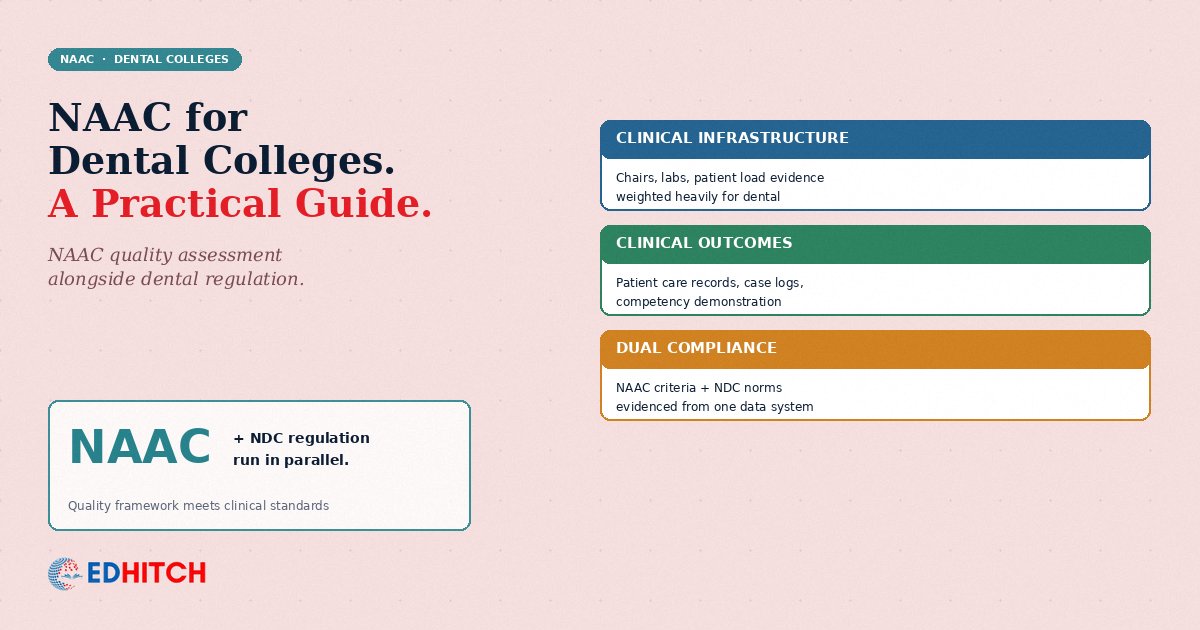
NAAC accreditation for dental colleges is governed by NAAC’s Unified Manual for Health Sciences Colleges. The manual applies to medical, dental, nursing, physiotherapy and allied health, Ayurveda, yoga and naturopathy, Unani, Siddha, and homeopathy institutions. Dental colleges submit their Self-Study Report under this manual with Part A (900 weightage points, 7 criteria, 109 metrics) common to all health-sciences disciplines, plus Part B (100 weightage points) specific to dental education.
In short: Indian dental colleges pursuing NAAC accreditation submit an SSR under the Unified Manual for Health Sciences Colleges — Part A (900 points, 7 criteria, 109 metrics) plus dental Part B (100 points). The assessment follows a 5-stage process: IIQA → SSR → DVV (25% pre-qualifier) → PTV → Result. With the National Dental Commission (NDC) replacing the Dental Council of India (DCI) on 19 March 2026, dental NAAC SSR Part B evidence must now reference the new NDC framework — including UGPGDEB (academic standards), DARB (assessment and rating), and EDRB (ethics and registration). NAAC accreditation continues independently of the regulatory transition; the evidence templates simply update.
Why NAAC matters for dental colleges
For most Indian dental colleges, three frameworks govern institutional quality and reputation: NDC compliance (formerly DCI — regulatory and mandatory); NAAC accreditation (institutional quality assurance and benchmarking); and NIRF Dental category ranking (public-facing reputational standing). Each framework asks for substantially overlapping evidence — faculty profiles, student data, infrastructure inventory, research output, clinical material, graduation outcomes — but with different templates, different deadlines, and different validation processes.
NAAC accreditation specifically validates the dental college as an academic institution. It addresses dimensions that regulatory compliance alone does not measure: curriculum design quality, teaching-learning innovation, student support systems, research culture, governance and leadership, and institutional values. For ambitious dental colleges, NAAC accreditation is not optional — it is the institutional credential that lets the college position itself competitively for student recruitment, research partnerships, and academic standing.
NAAC's Unified Health Sciences Manual: dental application
Unlike NAAC’s general affiliated-college manual, the Health Sciences manual is unified across all health-sciences disciplines but split into two parts to handle discipline-specific differences. For dental colleges, the structure is:
Part A — Generic Health Sciences
Common to all health sciences colleges: medical, dental, nursing, physiotherapy, allied health, AYUSH.
- Seven NAAC criteria applied to dental context
- 109 metrics in the SSR (QnM and QlM)
- Stakeholder participation: management, faculty, staff, students, parents, employers, alumni
- Student Satisfaction Survey (SSS) component
- QnM (quantitative) and QlM (qualitative) metrics on a 0–4 scale
Part B — Dental-Specific
Discipline-specific metrics that NAAC’s generic Part A cannot capture for dental education.
- Clinical material adequacy (OPD/IPD flow)
- Phantom lab capacity per student ratio
- Dental chairs and specialty equipment
- Dental department structures and specialty depth
- Bio-waste management infrastructure
- Hospital and OPD permissions for clinical training
- Faculty qualifications per the NDC framework
The five-stage NAAC A&A process for dental colleges
| Stage | What it is | What you submit / receive |
|---|---|---|
| 1. IIQA | Institutional Information for Quality Assessment | Eligibility data registered with NAAC; AISHE code mandatory for registration |
| 2. SSR | Self-Study Report submission | Part A (109 metrics, 900 points) + dental Part B (100 points) along with evidence uploads |
| 3. DVV | Data Validation and Verification | NAAC validates submitted data; 25 percent pre-qualifier on quantitative metrics |
| 4. PTV | Peer Team Visit | On-site assessment including dental department visits, stakeholder interactions, infrastructure inspection |
| 5. Result | Accreditation decision | Under the Binary framework: Accredited / Not Accredited; optionally MBGL Level for graded recognition |
Validation split: NAAC’s Revised Accreditation Framework conducts approximately 70 percent of validation online through DVV on quantitative metrics, with 30 percent on-site during the PTV. This means data hygiene matters before submission — not just narrative quality during the peer team visit. Dental colleges with rigorously maintained data architectures convert better at the DVV stage.
Dental Part B: what the 100-point discipline-specific layer covers
Part B is where dental-specific evidence lives. NAAC’s generic Part A cannot capture phantom lab adequacy, dental chair ratios, or clinical material flow — so Part B exists to address these dental-specific dimensions. The categories covered, based on real dental college SSR documentation:
| Category | Evidence required | NDC framework alignment |
|---|---|---|
| Clinical material adequacy | Daily OPD numbers, IPD where applicable, case mix across specialties, dental procedures per student per year | UGPGDEB curriculum norms; DARB rating criterion |
| Phantom lab capacity | Phantom heads per BDS student, simulation lab hours, pre-clinical training adequacy | UGPGDEB pre-clinical training standards |
| Dental chairs and specialty equipment | Dental chair counts, specialty equipment inventory (rubber dam kits, X-ray, OPG, CBCT, dental simulators, autoclaves) | DARB institutional infrastructure rating |
| Dental department structures | 9 BDS departments + MDS specialty departments; faculty cadres per department; PG training capacity | UGPGDEB academic structure requirements |
| Bio-waste & infection control | Bio-waste incinerator, segregation protocols, infection control SOPs, sterilization infrastructure | DARB safety and quality criterion |
| Faculty qualifications | BDS + MDS specialty qualifications per the NDC framework; cadre distribution; research output | UGPGDEB faculty norms (replaces DCI norms) |
| PG research and dissertations | MDS thesis quality, publication record, research methodology training | UGPGDEB postgraduate standards |
| Tissue processing for histopathology | Oral pathology lab capacity, tissue processing infrastructure, histopathology output | UGPGDEB specialty department requirements |
| Hospital and OPD permissions | Attached hospital agreements, OPD registration, specialty referral systems | DARB clinical training infrastructure |
| Community oral health activities | Rural dental camps, school dental health programs, tobacco cessation outreach | EDRB professional ethics + community service standards |
The NDC framework ↔ NAAC SSR mapping for dental colleges
With NDC now operational from 19 March 2026, dental college NAAC SSR evidence under both Part A and Part B should reference NDC’s framework rather than the dissolved DCI. The structural mapping:
| NDC Framework Element | NAAC SSR Criterion (Part A or Part B) | What evidence it provides |
|---|---|---|
| UGPGDEB curriculum standards | Part A Criterion 1 (Curricular Aspects), Criterion 2 (Teaching-Learning) | BDS / MDS curriculum design, syllabus structure, learning outcomes |
| UGPGDEB faculty qualification norms | Part A Criterion 2 (Teacher Quality), Part B (dental faculty) | Faculty cadre, qualifications, research output, cadre ratios per dental department |
| DARB institutional rating criteria | Part A Criterion 4 (Infrastructure), Part B (clinical material, equipment) | Dental chairs, phantom lab, specialty equipment, clinical training capacity |
| DARB safety and quality criteria | Part A Criterion 6 (Governance), Part B (bio-waste, infection control) | Quality systems, safety protocols, infection control, bio-waste management |
| EDRB ethics and registration standards | Part A Criterion 6 (Institutional Ethics), Criterion 7 (Best Practices) | Faculty registration with EDRB, ethics committee, professional conduct policies |
| EDRB community dental care standards | Part A Criterion 3 (Extension Activities), Criterion 7 (Best Practices) | Rural dental camps, school programmes, tobacco cessation, oral health awareness |
| NDC fee regulation framework (50% private seats) | Part A Criterion 6 (Governance), Criterion 5 (Student Support) | Fee structure transparency, scholarship and EWS support, governance practices |
| NExT-Dental readiness | Part A Criterion 2 (Outcome attainment) | Curriculum alignment with NExT-Dental, outcome-based assessment, exit-level competencies |
| Online National Register (EDRB) | Part A Criterion 5 (Student Support — alumni tracking) | Graduate registration tracking, alumni position in the national dentist register |
A dental college whose internal records track NDC framework elements rigorously is, in effect, building most of its NAAC SSR evidence at the same time. The integrated approach treats NDC compliance and NAAC SSR as one workstream serving two frameworks.
Criterion 7 Best Practices: high-value choices for dental colleges
NAAC’s Criterion 7 (Institutional Values, Best Practices, Institutional Distinctiveness) accepts up to two Best Practices per accreditation cycle. For dental colleges, Best Practices that combine longitudinal documentation, measurable outcomes, and dental-specific public health impact score strongly. Practical candidates:
School Dental Health Programme
Longitudinal partnership with government and private schools for biannual dental check-ups, oral hygiene education, and treatment referral. Document student-level data, intervention rates, follow-up.
Multi-year MeasurableRural Oral Health Camps
Quarterly or monthly rural dental camps with clinical service delivery, faculty supervision, and student rotation. Track camps, beneficiaries, treatments delivered, follow-up referrals.
Community engagement Faculty + studentTobacco Cessation Programme
Dedicated tobacco cessation counselling integrated with OPD intake. Document patient enrolment, cessation rates, follow-up adherence, peer-reviewed publications from the data.
Public health Research-alignedGeriatric Dental Outreach
Dental care for senior citizens through old-age homes, community centres, and home visits. Particularly strong for institutions wanting to differentiate on inclusion and outreach impact.
Underserved populationSpecialty Specialty-Day Outreach
Recurring specialty-specific public service days — orthodontic screening day, paedodontic screening, oral cancer screening day, prosthodontic affordability camps. Combines specialty depth with community service.
Specialty showcaseInter-Departmental Meets (IDM)
Structured monthly inter-departmental case discussions where every dental specialty presents research, case reports, and treatment planning. Strong evidence for Criterion 2 (Teaching-Learning) and Criterion 7.
Academic cultureThe pattern: well-documented longitudinal programmes with student-level data outperform one-off events. NAAC’s Best Practice evaluation looks for institutional commitment over years, not enthusiasm bursts.
Common gaps in dental NAAC SSRs — and how to close them
Across dental college NAAC SSR submissions, several gap patterns recur. Most can be closed by leveraging NDC compliance evidence already collected for regulatory purposes:
- Outdated DCI references throughout the SSR. Post-19 March 2026, SSR templates referencing DCI norms are dated. Faculty qualification language, accreditation references, and regulatory citations should now reference NDC and its three boards (UGPGDEB, DARB, EDRB).
- Part B clinical material under-documented. Daily OPD numbers, IPD where applicable, and case mix across specialties are often reported as monthly totals rather than student-level exposure. NAAC peer teams care about per-student clinical exposure, not aggregate hospital numbers.
- Phantom lab capacity reported vaguely. “Adequate phantom lab facilities” doesn’t score well. Specific phantom-head-to-student ratios, simulation lab utilisation hours, and pre-clinical training documentation score much better.
- Best Practices under Criterion 7 generic or one-off. “Dental check-up camp organized” submitted as a Best Practice misses the opportunity. NAAC favours longitudinal programmes with multi-year impact data — rural oral health programmes, tobacco cessation, school dental health.
- Inter-departmental meet evidence weak. Most dental colleges run IDMs but document them as attendance registers rather than as structured teaching-learning evidence with case discussions, research presentations, and outcomes.
- Faculty research disaggregation missing. NAAC Criterion 3 expects publication, citation, and project data structured by faculty and department. Many dental SSRs report aggregate institutional figures without the granularity that DVV can validate.
- Alumni tracking absent or vague. Criterion 5 expects alumni data including professional progression, registration status, contributions to dental academia. Dental SSRs often skip this.
- Cross-framework inconsistencies surfaced during DVV. Faculty count reported to NAAC differs from NDC/DCI submission; clinical material counts differ between submissions. These inconsistencies are caught during DVV and hurt the accreditation outcome.
Master Data Map for dental colleges
Your NDC data, your NAAC submission and your NIRF return all draw on the same faculty, student and infrastructure records. Master Data Map keeps them on one institutional record, and our advisory team runs NDC compliance alongside it. See how it works for dental colleges →
Frequently asked questions
Does NAAC apply to dental colleges in India?
Yes. NAAC’s Unified Manual for Health Sciences Colleges explicitly covers dental colleges, alongside medical, nursing, physiotherapy, allied health sciences, Ayurveda, yoga and naturopathy, Unani, Siddha, and homeopathy. Many leading Indian dental colleges hold NAAC accreditation in addition to recognition from the dental regulator — historically DCI, now the National Dental Commission (NDC) from 19 March 2026. ITS Dental College in Murad Nagar, an Edhitch client institution, is among the NAAC-accredited dental colleges in India.
What is NAAC’s manual for dental colleges?
Dental colleges are assessed under NAAC’s Unified Manual for Health Sciences Colleges. The manual has two parts: Part A contains 900 weightage points of generic metrics covering NAAC’s seven criteria common to all health sciences colleges (with 109 metrics in the SSR), and Part B contains 100 weightage points of dental-discipline-specific metrics. The discipline-specific Part B addresses dental-specific dimensions like clinical material, phantom lab capacity, dental chair counts, hospital permissions, and dental department structures that NAAC’s generic Part A cannot capture.
How does the NDC transition affect NAAC for dental colleges?
NAAC accreditation is independent of the NDC transition — dental colleges continue to pursue NAAC accreditation under the Unified Manual for Health Sciences Colleges. However, dental-specific Part B evidence that previously referenced DCI norms must now align with the NDC framework. This includes faculty qualification verified against NDC’s Undergraduate and Postgraduate Dental Education Board (UGPGDEB) norms, institutional rating evidence aligned with the Dental Assessment and Rating Board (DARB) framework, and professional conduct alignment with the Ethics and Dental Registration Board (EDRB). The smart play is to update SSR evidence templates to reference NDC and its three boards rather than DCI.
What is the 5-stage NAAC accreditation process for dental colleges?
The five-stage process is: (1) IIQA — Institutional Information for Quality Assessment, eligibility and registration; (2) SSR — Self-Study Report submission with Part A (900 points across 109 metrics) plus dental Part B (100 points); (3) DVV — Data Validation and Verification, with 25 percent pre-qualifier on quantitative metrics; (4) PTV — Peer Team Visit on-site assessment, including dental department inspections and stakeholder interactions; (5) Result declaration. Validation is conducted with approximately 70 percent online and 30 percent on-site under the Revised Accreditation Framework.
What does Part B of the dental NAAC manual cover?
Part B is the dental-discipline-specific 100-weightage layer that captures dimensions unique to dental education: clinical material adequacy (daily patient flow, OPD numbers, IPD when applicable), phantom lab capacity per student, dental chair counts and ratios, dental specialty department structures, hospital and OPD permissions, bio-waste handling infrastructure (incinerators, segregation), specialty equipment (rubber dam kits, X-ray units, CBCT, OPG, dental simulators), tissue processing for histopathology, postgraduate research and clinical exposure, MDS specialty department structures, and dental-specific community engagement activities. These are captured in Part B because NAAC’s generic Part A cannot address them adequately.
What are good Criterion 7 Best Practices for a dental college?
NAAC’s Criterion 7 (Institutional Values, Best Practices, Institutional Distinctiveness) accepts up to two Best Practices per cycle. Strong Best Practice candidates for dental colleges include longitudinal community oral health programmes — school dental health initiatives, rural oral health camps, tobacco cessation programmes, geriatric dental outreach, dental health awareness in marginalized communities, and “adopt a village” style programmes mapping to dental-specific public health priorities. The structural pattern is similar to how medical colleges leverage their Family Adoption Programme as a Best Practice — well-documented, longitudinal, with measurable outcomes.
How does NAAC accreditation interact with DCI/NDC and NIRF Dental?
Dental colleges typically navigate three separate frameworks: (1) NDC compliance (regulatory — formerly DCI), which is mandatory; (2) NAAC accreditation under the Unified Manual for Health Sciences Colleges (quality assurance); (3) NIRF Dental category ranking (reputation). The data overlap is substantial — faculty profiles, student enrolment, research output, infrastructure, clinical material, graduation outcomes all appear in all three. Maintaining one institutional data architecture that feeds NDC submissions, NAAC SSR, and NIRF Dental data has compounding efficiency benefits. Edhitch’s integrated approach builds this for dental college clients.
How does Edhitch support dental colleges with NAAC SSR?
Edhitch supports Indian dental colleges — including ITS Dental College — with NAAC SSR preparation, dental Part B evidence consolidation, gap diagnostics against the 7 criteria + 109 Part A metrics, Best Practice strategy for Criterion 7, faculty data alignment with the new NDC framework (formerly DCI norms), and integrated documentation that feeds NDC compliance, NAAC SSR, and NIRF Dental category submission. 12 years of higher-education accreditation advisory experience covering medical, dental, engineering, and management institutions.
For NAAC’s official Health Sciences Manual, visit the NAAC Health Science Manual page. For NDC notifications, see the Ministry of Health and Family Welfare.
Discuss NAAC Strategy for Your Dental College
Fill in your details. Our team will review your dental NAAC SSR readiness and post-NDC evidence alignment within 24 hours.
Enquiry Received!
Our team will respond within 24 hours.
For immediate help: WhatsApp +91-92051 19385