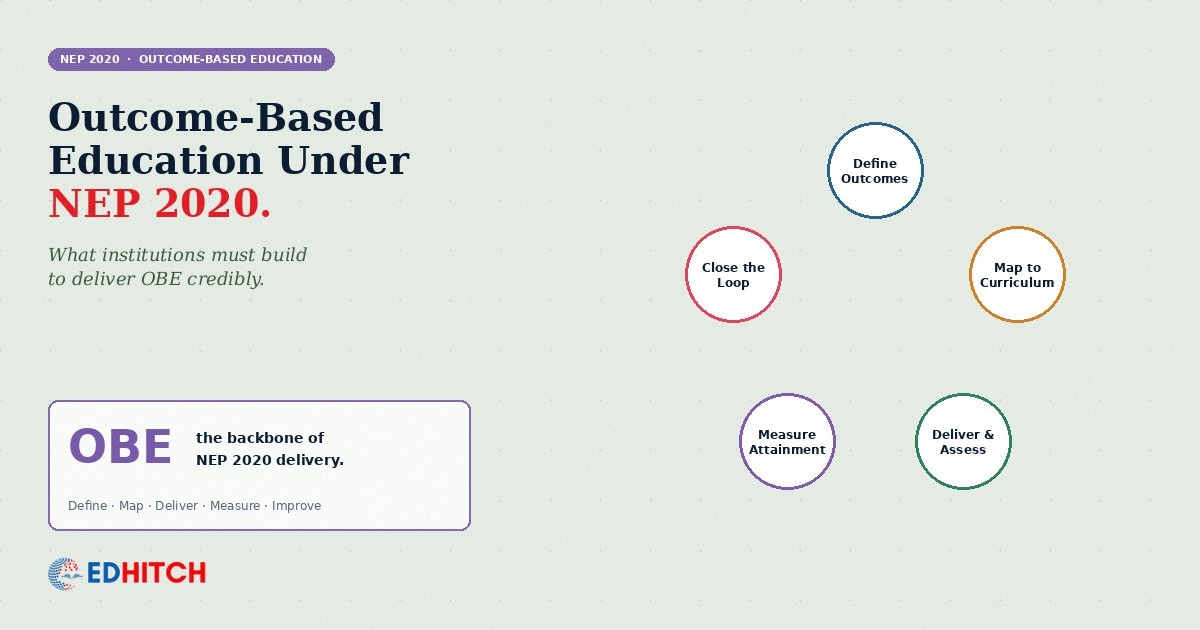
Outcome-Based Education (OBE) is a student-centric framework in which programmes are designed, delivered, and assessed against measurable learning outcomes — what students can demonstrably do after completing a course or programme, rather than the volume of content covered. The National Education Policy (NEP) 2020 — drafted under former ISRO chief K. Kasturirangan — explicitly mandates OBE across Indian higher education, supported by the UGC Learning Outcomes-based Curriculum Framework (LOCF) 2018 and the Curriculum and Credit Framework for Undergraduate Programmes (CCFUGP) released in December 2022. NAAC accreditation increasingly requires evidence of OBE implementation across its 7 criteria.
In short: OBE under NEP 2020 means designing programmes around a measurable outcome hierarchy: PEO → PO → PSO → CO → CLO. NEP 2020’s implementation is structured through 11 UGC frameworks — most operationally consequential being CCFUGP (3-year or 4-year UG, 120/160 credits, multiple entry/exit) and ABC (Academic Bank of Credits, digital credit accumulation across institutions). Attainment is measured as Direct (~80%) + Indirect (~20%) per common institutional policy. 105+ universities have adopted the Four-Year Undergraduate Programme (FYUP) since 2023-24. OBE evidence feeds NAAC SSR primarily through Criterion 1 (Curricular Aspects) and Criterion 2 (Teaching-Learning).
Why OBE matters under NEP 2020
Before NEP 2020, OBE was a quality-improvement practice that NAAC encouraged and NBA mandated for engineering. Under NEP 2020, OBE is structurally required across all higher education. The reason is philosophical: NEP 2020 reframes education from teacher-centric content delivery to student-centric outcome attainment. The whole machinery of CCFUGP, multiple entry/exit, ABC, and credit-based progression only works if outcomes are clearly defined and measurably attained.
For an affiliated arts and science college submitting a NAAC SSR in 2026, OBE evidence is no longer optional padding for Criterion 1 — it is core to demonstrating compliance with the post-NEP curriculum framework. Peer team visits will check for outcome attainment data, mapping matrices, continuous improvement cycles, and CCFUGP-aligned curriculum architecture. Institutions that delayed serious OBE implementation are increasingly visible at DVV and PTV stages.
The 11 UGC frameworks operationalising NEP 2020
NEP 2020 is a policy document; operational implementation flows through UGC frameworks and regulations. The eleven frameworks UGC has released (or drafted) for NEP 2020 implementation:
| Framework | Purpose | OBE relevance |
|---|---|---|
| NHEQF | National Higher Education Qualifications Framework | Defines qualification levels and learning outcomes per level |
| CCFUGP | Curriculum and Credit Framework for Undergraduate Programmes (12 Dec 2022) | Replaces CBCS; structures 3-yr/4-yr UG with credits and entry/exit |
| Multiple Entry/Exit Guidelines | Framework for student mobility within programmes | Requires credit-and-outcome architecture across exit points |
| Academic Bank of Credits (ABC) | Digital credit storage and transfer platform | Enables credit accumulation across institutions and time |
| National Credit Framework (NCrF) | National-level credit equivalence framework | Bridges school education, higher ed, and vocational credits |
| Multidisciplinary Universities Guidelines | Transformation of single-discipline institutions | Curriculum redesign for multidisciplinary outcomes |
| Internationalization Guidelines | Foreign HEI operations in India | OBE alignment with international benchmarks |
| Blended Learning Concept Note | Online + offline learning integration | Pedagogical flexibility for outcome attainment |
| National Mission on Mentoring | Faculty mentoring infrastructure | Faculty capacity for OBE implementation |
| Pedagogical Approaches Guidelines | Evaluation reforms (October 2022) | Continuous and comprehensive assessment, pedagogical shift |
| Global Citizenship Framework | Values-based holistic education | Affective domain outcomes |
How these connect to your daily work: Most institutional decisions in 2026 trace back to CCFUGP (curriculum architecture) + ABC (credit infrastructure) + Pedagogical Guidelines (teaching-learning). The other frameworks define the broader policy context. For OBE specifically, focus on CCFUGP for structure, the Pedagogical Guidelines for teaching reform, and NHEQF for outcome-level definitions.
CCFUGP: the credit architecture for FYUP
Under CCFUGP, students can exit and re-enter the undergraduate programme at defined credit milestones:
UG Certificate
After 1 year
UG Diploma
After 2 years
Bachelor's Degree
After 3 years
Honours / Research
After 4 years
Credits accumulate in ABC (Academic Bank of Credits) — a digital platform managed by the Ministry of Education and UGC. Students become academic account holders; credits earned at one institution can be redeemed for further programme completion at the same or a different institution within their defined shelf life. This is a foundational shift from the rigid 3-year UG framework that preceded NEP 2020. Major discipline credit minimums: 60 credits for 3-year UG, 80 credits for 4-year UG. Per-semester credits: 20-22 credits.
The OBE outcome hierarchy: PEO → PO → PSO → CO → CLO
OBE is structured around five levels of outcomes, each more granular than the one above. The hierarchy creates traceability from course-level delivery to institutional vision:
Programme Educational Objectives — describe what graduates achieve 3-5 years after graduation. Connect to institutional vision, mission, and societal needs. Aspirational but measurable through alumni outcomes.
Programme Outcomes — graduate attributes at degree completion. NBA defines 12 POs for engineering (PO1 Engineering Knowledge through PO12 Life-long Learning). UGC LOCF defines POs for general degree programmes.
Programme Specific Outcomes — discipline-specific outcomes. What B.Sc. Chemistry students specifically should be able to do, beyond the general PO set. Typically 2-4 PSOs per programme.
Course Outcomes — what a student can do after completing a specific course. Typically 5-6 COs per course. Each CO maps to one or more POs and PSOs via mapping matrices.
Course Learning Outcomes — granular learning outcomes within a course; typically 4-6 CLOs per course. Each CLO uses Bloom’s Taxonomy action verbs (analyse, evaluate, create) defining the cognitive level expected.
The traceability principle: Every assessment item (an exam question, an assignment, a project task) should be tagged to a CLO. CLOs aggregate to CO attainment. COs aggregate via mapping matrices to PO and PSO attainment. POs and PSOs evidence PEO achievement. This is what NAAC peer teams check — not the existence of the hierarchy on paper, but evidence that assessment data flows through it to drive continuous improvement.
Bloom's Taxonomy: the cognitive level architecture
Bloom’s Taxonomy (revised version) provides the action-verb framework for defining CLOs. Three domains: Cognitive (knowledge, understand, apply, analyse, evaluate, create — the 6 ascending cognitive levels); Affective (receiving, responding, valuing, organising, characterising); Psychomotor (perception, set, guided response, mechanism, complex overt response, adaptation, origination).
For affiliated arts and science colleges, the practical use is: each CLO begins with an action verb at a specified Bloom’s level (“Analyse the structure of...”, “Evaluate the impact of...”, “Create a model for...”). Assessments should test at that level. A CLO claiming “Analyse” cognitive level but assessed with a recall-only multiple-choice test is misaligned — a common gap that NAAC peer teams catch during course-file review.
Attainment measurement: Direct + Indirect methodology
Outcome attainment is what makes OBE measurable. The standard methodology combines two assessment types with weighted aggregation:
| Assessment Type | Typical Weight | What it measures |
|---|---|---|
| Direct Assessment | ~80% | Actual student performance: internal exams, end-semester exams, lab work, projects, assignments — each tagged to specific Course Outcomes |
| Indirect Assessment | ~20% | Student perception: course-exit surveys, programme-exit surveys, alumni feedback, employer feedback — capturing perceived attainment |
| Combined CO Attainment | 0–3 scale typical | Weighted aggregation: e.g. 0.8 × Direct + 0.2 × Indirect = CO attainment level |
| PO/PSO Attainment | Via mapping matrix | CO attainment aggregated through CO-PO/PSO mapping matrix (Strong = 3, Medium = 2, Weak = 1) |
| PEO Attainment | Multi-year | Alumni surveys, employer feedback, graduate career progression — measured 3-5 years post-graduation |
Pedagogies NEP 2020 advocates
NEP 2020 explicitly endorses pedagogical methods that support OBE attainment. UGC’s October 2022 Guidelines for Innovative Pedagogical Approaches detail these:
Experiential learning
Hands-on projects, internships, field work — learning through doing. Supports CLO attainment at “Apply” and “Create” Bloom’s levels.
Discussion-based learning
Seminars, debates, case-method discussions. Supports “Analyse” and “Evaluate” CLOs and the affective domain (valuing, characterising).
Art-integrated learning
Cross-disciplinary integration of arts with sciences and humanities. Supports multidisciplinary outcomes and creative cognitive levels.
Flipped classroom
Self-paced content consumption before class, in-class application. Supports continuous assessment and higher-order CLOs.
How OBE feeds NAAC SSR
OBE implementation evidence is not just for Criterion 1. It runs through almost the entire SSR. The mapping for affiliated arts and science colleges under the 56-metric framework:
| OBE Implementation Element | NAAC SSR Criterion | Evidence sought |
|---|---|---|
| Programme outcomes design + CCFUGP alignment | Criterion 1 (Curricular Aspects) | PEO/PO/PSO definitions, CCFUGP-aligned credit structure, multidisciplinary curriculum |
| CO-PO mapping matrices + Bloom’s alignment | Criterion 1 + Criterion 2 (Teaching-Learning) | Course files, mapping matrices, action-verb-aligned CLOs |
| Outcome-driven pedagogy + continuous assessment | Criterion 2 (Teaching-Learning) | Lesson plans, pedagogy adoption, continuous assessment records |
| Attainment data + improvement cycles | Criterion 2 (Outcome attainment) | CO/PO attainment trends, gap analysis, curriculum revisions, improvement evidence |
| Placement and progression outcomes | Criterion 5 (Student Support & Progression) | Placement records, higher-study progression, alumni careers — PEO attainment evidence |
| IQAC continuous improvement cycle on OBE data | Criterion 6 (Governance & IQAC) | IQAC meeting minutes, OBE review outcomes, institutional decisions |
| OBE implementation as institutional Best Practice | Criterion 7 (Best Practices) | Longitudinal OBE journey, faculty capacity building, measurable impact data |
| ABC integration, Multiple Entry/Exit operations | Criterion 1 + Criterion 5 | ABC student accounts, exit-point credit certification, re-entry mechanism |
| Faculty OBE training records | Criterion 2 (Teacher Quality) | Faculty development records, OBE-specific training, certification |
The takeaway: OBE is not a separate workstream from NAAC SSR. OBE evidence is NAAC evidence. Institutions that treat OBE implementation and NAAC SSR preparation as one integrated workstream produce better outcomes for both, with less duplication.
Common gaps in OBE implementation — and how to close them
From advisory experience across 100+ Indian higher-education institutions, the recurring OBE implementation gaps:
- Mapping matrices exist on paper but don’t drive curriculum review. CO-PO/PSO mappings filed as compliance artefacts. The matrices should be used to identify under-mapped POs (POs that few COs target) and over-mapped POs (POs that many COs target weakly). Both indicate curriculum design issues.
- Attainment data calculated but not analysed. Annual attainment reports filed without gap analysis or curriculum revision. The whole point of measurement is action — not just calculation.
- Indirect assessment treated as compliance survey. Course-exit surveys distributed for tick-box compliance. Student feedback should be analysed for actionable insights, with responses fed back to faculty and curriculum committees.
- Bloom’s Taxonomy applied superficially. CLOs use action verbs (analyse, evaluate, create) but assessments don’t actually test the verb level claimed. A “Create”-level CLO assessed by a recall MCQ is misaligned. Peer teams catch this during course-file review.
- PEO statements aspirational but disconnected. PEOs framed as inspirational paragraphs without measurable connection to POs/PSOs. PEOs should be specific, observable in alumni outcomes, and connected to PO attainment via traceability.
- Faculty OBE training limited to one-off orientation. NEP 2020 / CCFUGP requires ongoing faculty capacity building — on Bloom’s, on continuous assessment, on attainment computation, on outcome-driven pedagogy. Single-session orientation is insufficient.
- Inconsistent attainment computation across departments. Different departments use different formulas, weights, or scales. NAAC peer teams notice this. An institution-wide attainment computation protocol is essential.
- NEP 2020 / CCFUGP alignment evidence weak in NAAC SSR. SSR claims NEP alignment generically without specific evidence (CCFUGP-mapped curriculum, ABC integration, multiple entry/exit operationalisation). Peer teams increasingly look for specifics.
- ABC integration absent or partial. Many affiliated colleges register on ABC but don’t actively deposit student credits. This will be increasingly scrutinised as ABC matures.
Frequently asked questions
What is Outcome-Based Education (OBE)?
Outcome-Based Education (OBE) is a student-centric educational framework that focuses on measuring learning outcomes — what students can demonstrably do after completing a course or programme, rather than what was taught. OBE structures education around a hierarchy of outcomes: Programme Educational Objectives (PEOs) describe what graduates achieve 3-5 years after graduation; Programme Outcomes (POs) describe graduate attributes at degree completion; Programme Specific Outcomes (PSOs) capture discipline-specific outcomes; and Course Outcomes (COs) with Course Learning Outcomes (CLOs) describe course-level learning. UGC adopted the Learning Outcomes-based Curriculum Framework (LOCF) in 2018.
How does NEP 2020 mandate OBE?
The National Education Policy 2020 (drafted under former ISRO chief K. Kasturirangan) explicitly advocates Outcome-Based Education across Indian higher education. NEP 2020 calls for holistic development, multidisciplinary education, flexible curricula, multiple entry and exit, choice-based credit systems, continuous and comprehensive assessment, and pedagogies including experiential learning, discussion-based learning, art-integrated learning, and flipped classroom. UGC has released 11 implementation frameworks aligned with NEP 2020 including CCFUGP, ABC, NHEQF, and pedagogical guidelines. NAAC accreditation increasingly requires evidence of OBE implementation across the 7 criteria, particularly Criterion 1 (Curricular Aspects) and Criterion 2 (Teaching-Learning).
What is CCFUGP and how does it support OBE?
The Curriculum and Credit Framework for Undergraduate Programmes (CCFUGP) was released by UGC via public notice F.No:-1-1/2021(QIP)(CBCS) on 12 December 2022. It implements NEP 2020 curriculum reforms at the undergraduate level. Key features: 3-year or 4-year UG programmes with flexibility, multidisciplinary approach, multiple entry and exit options, single major/double major/multidisciplinary degrees, integration with vocational courses, internships, skill enhancement. Credit structure: minimum 120 credits for 3-year UG, 160 credits for 4-year UG, 20-22 credits per semester. Major discipline: 60 credits (3-year) or 80 credits (4-year). CCFUGP replaces the older CBCS and provides the structural backbone for OBE implementation at affiliated arts, science, and commerce colleges.
What is the Academic Bank of Credits (ABC)?
The Academic Bank of Credits (ABC) is a digital credit platform established and managed by the Ministry of Education and UGC under NEP 2020. Students become academic account holders and accumulate credits across institutions, programmes, and time periods. ABC enables seamless credit recognition, accumulation, transfer, and redemption — supporting the multiple entry and exit framework. The credit accumulation in ABC has a defined shelf life and credit redemption protocols per UGC regulations. ABC is foundational to NEP 2020’s lifelong learning vision: a student can earn credits at one institution, exit with a certificate or diploma, return later to redeem credits and complete the degree at the same or a different institution.
How does Multiple Entry and Exit work?
Under NEP 2020 and CCFUGP, students can exit and re-enter undergraduate programmes at defined milestones: UG Certificate after 1 year (40 credits earned); UG Diploma after 2 years (80 credits earned); Bachelor’s Degree after 3 years (120 credits); Bachelor’s Degree with Honours after 4 years (160 credits) — with research focus or course-based variant. The objective is to ensure zero year loss in case of exit, reduce drop-out rates, improve Gross Enrolment Ratio (GER), and support lifelong learning. Credits earned are stored in ABC and remain redeemable for future programme completion.
What is the OBE attainment measurement methodology?
OBE attainment is typically measured through a combination of Direct Assessment (around 80 percent weight) and Indirect Assessment (around 20 percent weight), per common institutional policy. Direct Assessment measures actual student performance through internal examinations, end-semester examinations, lab work, projects, and assignments mapped to specific Course Outcomes. Indirect Assessment captures student perception through course-exit surveys, programme-exit surveys, alumni feedback, and employer feedback. The CO attainment is then aggregated upward — CO mapped to PO and PSO via mapping matrices, PO/PSO mapped to PEO. Annual attainment data drives continuous improvement cycles required by NAAC and NBA.
How does OBE feed NAAC SSR?
OBE implementation evidence feeds NAAC SSR across multiple criteria. Criterion 1 (Curricular Aspects) requires evidence of programme outcome design, OBE curriculum mapping, syllabus alignment with NEP 2020 / CCFUGP. Criterion 2 (Teaching-Learning) needs evidence of outcome-driven pedagogy, continuous assessment, attainment data, course-outcome attainment trends. Criterion 5 (Student Support) tracks placement and progression outcomes — direct evidence of programme outcome attainment in graduate destinations. Criterion 6 (Governance) covers IQAC functioning including the continuous-improvement cycle on attainment data. Criterion 7 (Best Practices) accepts OBE implementation as a Best Practice when documented as a longitudinal institutional commitment with measurable outcomes.
What are common gaps in OBE implementation at Indian colleges?
Common gaps include: (1) Mapping matrices defined on paper but not used to drive curriculum review — CO/PO/PSO mappings exist as compliance artefacts rather than continuous-improvement tools; (2) Attainment data calculated annually but not analysed for gap closure or curriculum revision; (3) Indirect assessment treated as compliance survey rather than insight source; (4) Bloom’s Taxonomy applied superficially — CLOs use action verbs but assessments don’t actually test the verb level claimed; (5) PEO statements aspirational and disconnected from PO/PSO; (6) Faculty training on OBE limited to orientation sessions without ongoing capacity building; (7) Inconsistent attainment computation across departments; (8) NEP 2020 / CCFUGP alignment evidence weak or generic in NAAC SSR.
How does Edhitch support OBE implementation?
Edhitch supports Indian colleges and universities with OBE implementation tailored to NEP 2020 and CCFUGP requirements: PEO/PO/PSO/CO mapping matrix design and review, Bloom’s Taxonomy-aligned CLO framing, attainment measurement methodology (Direct + Indirect with 80/20 weighting or institutional variants), continuous improvement cycle setup, faculty capacity building, OBE evidence consolidation for NAAC SSR (Criterion 1 and 2), CCFUGP curriculum mapping for FYUP institutions, ABC integration advisory, and integrated documentation that feeds NAAC SSR, AISHE annual submission, and NIRF where applicable. 12 years of higher-education accreditation advisory across 100+ institutions, 9,000+ faculty trained.
For official NEP 2020 documents and UGC frameworks, visit the Ministry of Education and the University Grants Commission.
Discuss OBE & NEP Strategy for Your Institution
Fill in your details. Our team will review your OBE implementation maturity, NEP/CCFUGP alignment, and NAAC SSR readiness within 24 hours.
Enquiry Received!
Our team will respond within 24 hours.
For immediate help: WhatsApp +91-92051 19385