Under old NAAC, the mechanic that decided your CGPA was a peer-team visit. Three to seven evaluators on campus for two to four days. They saw what you showed them, asked what they wanted to ask, formed an impression. Their score was their judgement.
Binary replaces that mechanic. Institutions now self-declare — answer YES or NO to each metric, then upload evidence. No peer team comes to campus for Binary; verification is automated and continuous. The intuition many institutions form on first reading this is that self-declaration must be easier, more permissive, more forgiving. The intuition is wrong.
What "self-declaration with evidence" actually means
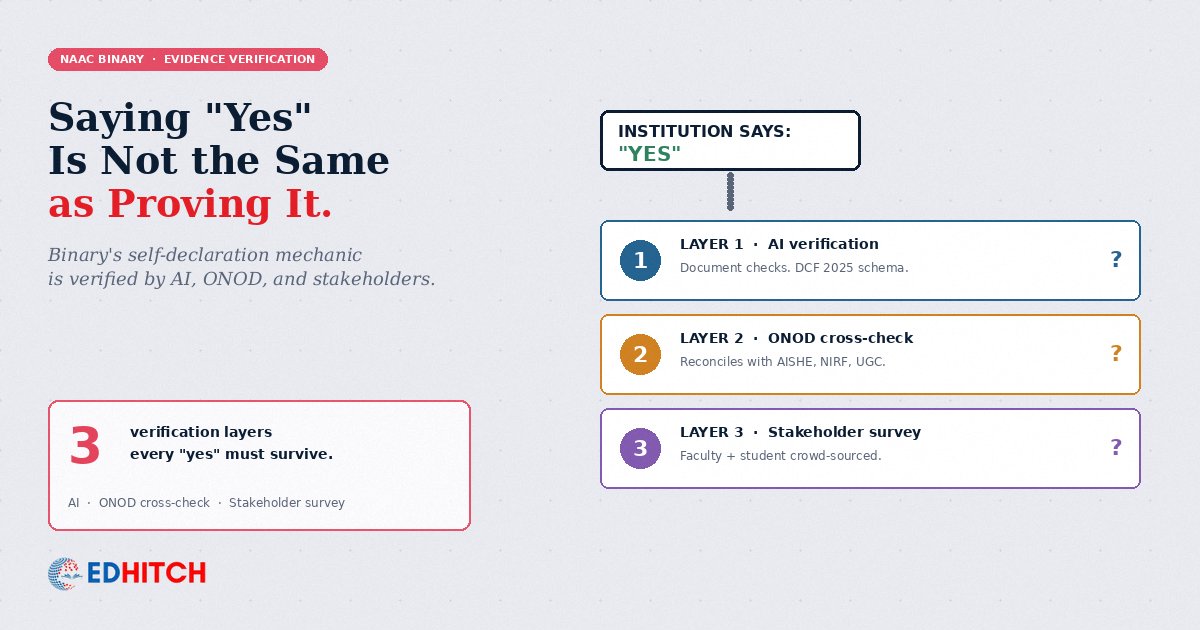
The mechanic has three verification layers running against every YES:
- Layer 1: AI document verification. Uploads are parsed against NAAC's Data Capture Formats (DCF 2025). Required document types, naming conventions, date ranges, and content patterns are checked machine-side before human eyes look at anything. A YES backed by the wrong evidence type — say, an approval letter instead of a board resolution — fails this layer silently.
- Layer 2: ONOD cross-check. The One Nation One Data platform reconciles institutional claims against AISHE, NIRF, UGC, and other government databases. A faculty count claimed as 240 in your Binary submission while AISHE shows 198 isn't a clerical issue any more — it's a flagged discrepancy.
- Layer 3: Stakeholder survey. Faculty and student stakeholders associated with the institution are crowd-sourced for verification. NAAC's reform documents describe automated questionnaires sent to stakeholders, comparing their responses against institutional claims and producing an independent test score.
Each layer is unforgiving in its own way. AI doesn't argue with documents; it accepts them or flags them. ONOD doesn't interpret discrepancies; it surfaces them. Stakeholders don't perform; they report what they remember. The composite mechanic is more rigorous than a peer-team visit in many dimensions and less rigorous in none.
What this does to institutional bluffing
Old NAAC tolerated a degree of narrative inflation. A claim that placements were "robust" survived if the documentation looked reasonable and the peer team didn't probe. A statement that faculty "actively engaged in research" survived if the publication list looked plausible at glance.
Binary punishes this in two specific ways:
First, YES means YES with documentary proof of the precise claim. The DCF 2025 schema specifies what counts as proof for each metric. A YES on "the institution conducts industry-aligned curriculum review" requires a specific document type, specifically dated, with specified content elements. Anything less fails AI parsing.
Second, your data is now cross-referenced. The faculty count in Binary has to match the faculty count in AISHE has to match the faculty count in NIRF (with documented reasons for any reconciliation needed). The student strength in Binary has to match enrolment data in UGC records. Submissions that worked when frameworks were siloed don't survive when frameworks are reconciled automatically.
The "credibility score" mechanic
NAAC's published reform documents describe institutions starting with a baseline credibility score that adjusts based on stakeholder validation outcomes. Implementations vary across the rollout, but the principle is consistent: how stakeholders respond to surveys shifts how heavily AI weights the institution's self-declared data.
The structural implication is that an institution can submit perfect documentation and still lose marks if its stakeholders — faculty and students — describe a different reality than the documents do. The mechanic surfaces gaps between what institutions report and what they actually deliver.
What this means in practice
The institutions that are adapting fastest to Binary's verification mechanic share a few characteristics:
- They've stopped writing aspirational narratives and started documenting verified facts.
- They've reconciled their data across frameworks before submitting anything anywhere — Binary, AISHE, NIRF, UGC all show the same numbers for the same facts.
- They've invested in stakeholder communication so that what faculty and students actually experience matches what the institutional submission claims.
- They treat evidence collection as a continuous operation, not a pre-submission scramble.
The institutions struggling hardest are the ones treating Binary as a documentation exercise. The mechanic isn't designed to read documents; it's designed to verify claims against multiple independent sources. Documents are only the first source.
Want a diagnostic read of where you stand?
Edhitch runs an Accreditation Diagnostic across NIRF, NAAC, and NBA — surfacing the gaps that don't show up on your dashboard.
See the Diagnostics Catalogue →The deeper shift
What Binary's self-declaration mechanic really does is transfer the accreditation conversation from "can we describe ourselves well enough to score" to "can our institution survive automated cross-verification."
The first is a writing exercise. The second is an operational one. The two require completely different preparation, and the institutions that mistake the second for the first tend to discover the difference only after submission, when the verification layers start surfacing discrepancies they didn't know were there.
Saying YES has always been easy. Binary makes proving it the actual work.
About Edhitch
Edhitch is an independent accreditation and ranking diagnostics firm working with Indian higher education institutions. Twelve years in the sector. 100+ institutions served. A seven-year NIRF dataset spanning 5,076+ institution-year records across 13 disciplines. Founder-led advisory combining proprietary diagnostic software with strategic engagement. Read more about us →