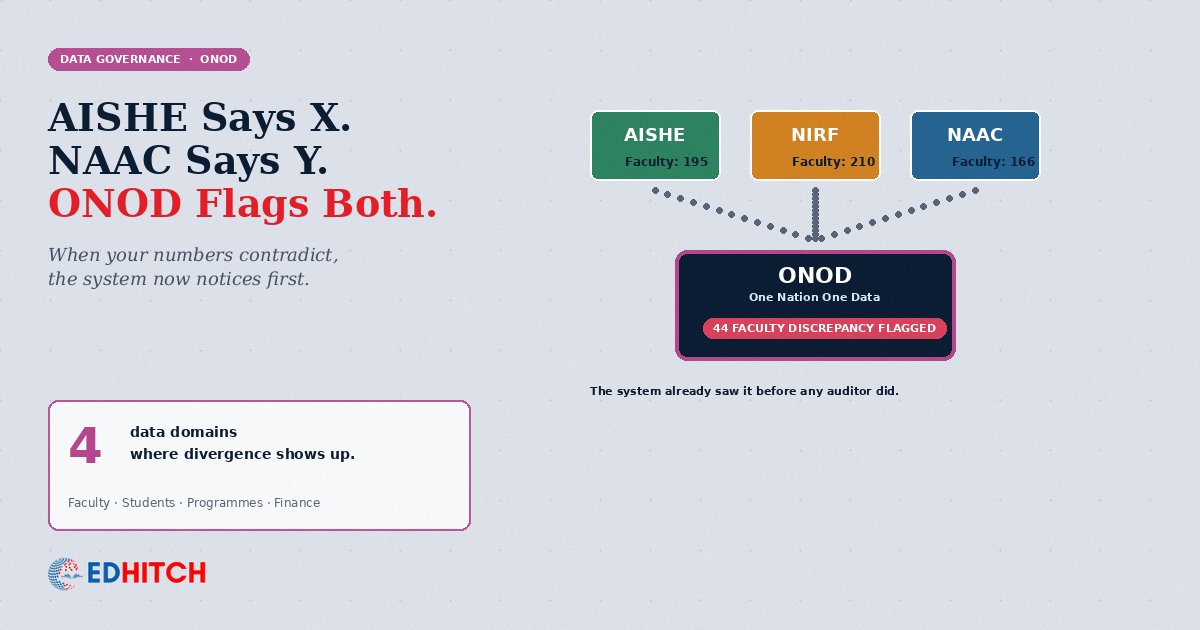
For two decades, Indian higher education institutions submitted data to multiple frameworks in parallel — AISHE annually to track enrolment and faculty, NIRF for rankings, NAAC for accreditation, UGC for compliance. Each submission had its own deadlines, its own forms, its own interpretation of the same underlying facts. Discrepancies between submissions were normal, sometimes intentional, almost never consequential.
That period is ending. The One Nation One Data (ONOD) platform — the Government of India’s cross-framework data infrastructure, hosted at onod.aicte-india.org — is being progressively rolled out across NAAC, NIRF, AISHE, UGC, AICTE, and other frameworks. As its capabilities expand, the same institution reporting different numbers for the same fact across frameworks will increasingly find those discrepancies visible to evaluators.
What ONOD is designed to do
Per NETF/NAAC/NBA chairman Anil Sahasrabudhe’s public remarks in September 2025, the ONOD vision is straightforward: institutions submit institutional data once a year, and the various agencies (NAAC, NBA, NIRF, AISHE, UGC, AICTE) access that data through APIs rather than each agency collecting its own submission separately. The goal is to reduce administrative burden, improve data accuracy, and surface inconsistencies that have previously lived invisibly across siloed submissions.
The infrastructure piece that operationalises this:
- A shared identifier. ONOD uses the AISHE Code as the unique identifier for each higher education institution. This anchor allows data submitted to any framework to be tied back to the same institutional record.
- A growing network of Open APIs. Frameworks that integrate with ONOD can pull and push data through standardised interfaces, reducing redundant data collection.
- AI-supported anomaly detection. Sahasrabudhe has publicly described the development of AI-based tools to flag suspicious or inconsistent data — helping evaluators identify discrepancies before manual review.
- Cross-portal verification capability. NAAC’s Binary framework, in particular, has been designed to use ONOD-linked cross-checks against AISHE, UGC, and other databases during the Data Validation and Verification (DVV) process.
The full vision — submit once, share everywhere — is still being rolled out progressively. Different framework integrations are at different stages of maturity. But the direction of travel is clear, and the institutional practice of maintaining inconsistent data across portals is becoming less tenable each year.
The four data domains where divergence shows up first
Across institutional submissions, the same data points reported to different frameworks tend to diverge in four recurring domains:
1. Faculty counts
This is the most common area of divergence. AISHE’s faculty data captures regular and contractual faculty with specified definitions. NIRF’s faculty data uses different counting rules (regular faculty, faculty taught in both semesters, etc.). NAAC has historically used yet another definition. The same institution counts faculty differently across the three submissions — sometimes without realising the definitions vary.
When data is reconciled across portals, the variations show. Some of this is legitimate definitional variation; some of it is institutional optimism across submissions; some of it is data-management inconsistency between departments handling the different submissions.
2. Student strength
Enrolment data, intake data, and outturn data are reported to multiple frameworks across the year, and the counts often diverge. AISHE’s annual enrolment differs from NIRF’s intake-and-outturn, which differs from NAAC’s Extended Profile figures. Cross-portal reconciliation surfaces institutions where these don’t tie out.
3. Programme offerings
Number of programmes, AICTE approvals, UGC affiliations, and the breakdown across UG/PG/Doctoral all get reported differently to different frameworks. The discrepancies here are often technical — different inclusion criteria for “active programmes” — but they show up as variances nonetheless.
4. Financial data
Total budget, capital expenditure, salary expenditure, infrastructure investment — financial data submitted to NAAC, NIRF, AICTE-approved reports, and UGC differs based on accounting categorisation, reporting period, and the specific question being asked. Financial discrepancies are harder to reconcile mechanically, but major variations remain visible.
Why this changes the institutional posture
Pre-ONOD, institutions could treat each framework submission as a standalone document. The faculty count in AISHE didn’t need to match the faculty count in NAAC because no one was checking. As ONOD-linked cross-checks expand, that changes.
The implications:
Submissions optimised in isolation become harder to defend. Institutions that historically optimised each submission for that framework’s evaluation may find their submissions contradicting each other in ways the system surfaces.
Reconciliation becomes a pre-submission discipline, not a post-submission afterthought. Before drafting a Binary submission, an institution needs to ensure its AISHE, NIRF, and UGC data tells a consistent story. Reconciliation work that used to happen post-submission (if at all) increasingly needs to happen pre-submission.
The penalty for discrepancy is structural rather than punitive. ONOD doesn’t issue fines. But flagged discrepancies become part of the evaluation context for every framework that reads ONOD output. An institution with multiple unresolved discrepancies looks less credible across all frameworks simultaneously.
How evaluators may handle ONOD-flagged discrepancies
When a NAAC Binary evaluation includes an ONOD-flagged discrepancy, the typical evaluator options include:
- Accepting the institution’s reconciliation explanation if the discrepancy is explained by legitimate definitional variation and the institution has documented the reconciliation.
- Treating the lower of the two figures as the working value in calculations where the framework normalises against the data point — though this depends on framework-specific procedures, which are still being formalised under Binary.
- Flagging the institution for further verification, triggering stakeholder surveys or additional documentation requests.
Institutions with one or two flagged discrepancies that are well-documented and well-explained will likely fare better than institutions with many unresolved variances or with discrepancies that suggest systematic inconsistency. Exact procedures will be defined by the frameworks themselves as ONOD integrations mature.
The reconciliation work this implies
The work required to operate cleanly as ONOD-linked verification expands isn’t a one-time fix. It is a continuous data governance practice:
Single source of truth. An institution needs to maintain a master data repository where each fact — faculty count, student strength, programme offering, financial figure — has one authoritative value, with documented definitions, and from which all framework submissions are derived.
Definitional alignment. Where different frameworks use different definitions (e.g., NIRF’s “regular faculty” differs from AISHE’s), the institution needs documented reconciliation rules: how the master data is transformed to each framework’s required format, with the reasoning documented for any difference.
Timing discipline. AISHE submissions, NIRF submissions, and NAAC submissions happen at different times of year. The data must remain internally consistent across these submission windows — a faculty member counted in AISHE in September must reconcile to faculty counted in NIRF in March, even if the underlying numbers changed in between.
Reconciliation logging. When discrepancies do arise, the institution needs documentation explaining why — faculty hired between submissions, students added late, programmes restructured. Discrepancies become defensible when paired with logged reconciliation notes.
Want a diagnostic read of where you stand?
Edhitch runs an Accreditation Diagnostic across NIRF, NAAC, and NBA — surfacing the gaps that don’t show up on your dashboard.
See the Diagnostics Catalogue →The longer trajectory
ONOD is the visible part of a longer institutional shift. The frameworks themselves are becoming more interconnected — NAAC’s Binary, NIRF’s annual rankings, NBA’s programme accreditation, UGC compliance — and the data layer underneath them is unifying. What used to be parallel submission processes are becoming aspects of a single institutional data identity.
The institutions adapting fastest aren’t the ones with the best individual submissions. They’re the ones whose underlying data architecture treats AISHE, NIRF, NAAC, and UGC as views into one institutional reality, rather than as separate submission exercises. ONOD will make this architecture necessary — and the institutions that recognise that early avoid the discrepancies that catch others off-guard as cross-portal verification matures.
About Edhitch
Edhitch is an independent accreditation and ranking diagnostics firm working with Indian higher education institutions. Twelve years in the sector. 100+ institutions served. A seven-year NIRF dataset spanning 5,076+ institution-year records across 13 disciplines. Founder-led advisory combining proprietary diagnostic software with strategic engagement. Read more about us →