Important note (June 2026): The NAAC Binary Accreditation portal has not yet launched operationally. NAAC initially indicated an April–May 2025 launch when the framework was announced in February 2025; that timeline passed without launch, and no revised date has been officially confirmed. This piece describes the framework as currently published in NAAC's reform documents. Deployment timing remains uncertain.
For thirty years, NAAC asked institutions seven questions. Curriculum. Teaching. Research. Infrastructure. Student support. Governance. Institutional values. Each one a "criterion" with its own metrics, sub-metrics, evidence requirements, and CGPA weight. The framework was familiar, sometimes too familiar — most IQACs could draft an SSR in their sleep by 2024.
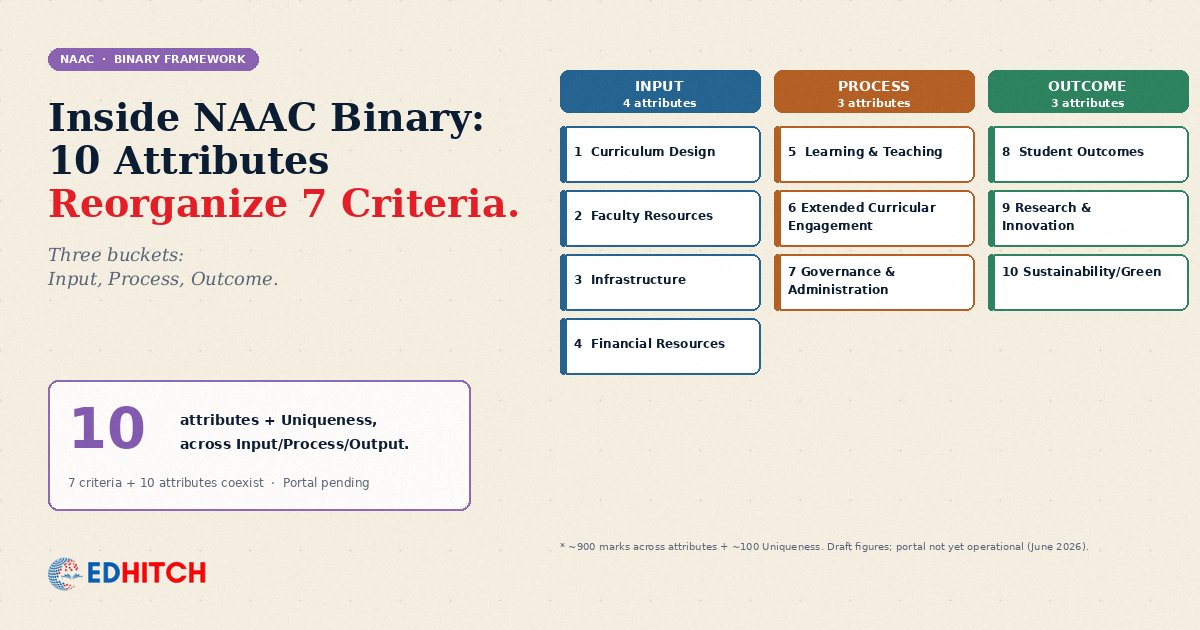
That framework is being restructured. NAAC Binary, announced February 10, 2025, reorganises assessment around 10 attributes grouped into three buckets: Input, Process, Outcome. The 7 criteria don't disappear — they remain the structural foundation. The 10 attributes are the new operational evaluation units, sitting alongside the criteria, not replacing them.
That coexistence matters. Most institutions reading about Binary assume they have to choose — old framework or new framework. The accurate framing is that the old criteria continue as the broad chapters, and the 10 attributes are the specific assessment dimensions within those chapters. Both apply.
The three-bucket structure (plus one)
The Binary framework's first move is conceptual. Rather than asking "what does your institution do" across seven dimensions, it asks three questions in sequence — with a fourth, discipline-specific dimension layered on top:
- Input — What does your institution start with? Curriculum design, faculty resources, infrastructure, financial resources.
- Process — What does your institution do with those inputs? Learning and teaching processes, extended curricular engagement, governance and administration.
- Outcome — What did the inputs and processes actually produce? Student outcomes, research and innovation outcomes, sustainability outcomes.
- Uniqueness / Situatedness — A discipline-specific dimension carrying its own weight, recognising what makes an institution distinctive in its particular context.
Per the draft metrics presented in NAAC's stakeholder consultations, the 10 attributes carry roughly 900 marks distributed across the three buckets — indicatively Input around 275, Process around 400, Outcome around 225 — with the Uniqueness / Situatedness component carrying approximately 100 marks, bringing the notional total to 1000. In weightage terms, NAAC's documents describe Input at roughly 20–25%, with Process and Output together carrying about 75%.
These figures come from NAAC's draft consultation materials and presentations by NAAC advisory members. The exact marks per attribute and per bucket vary by institution type (university, autonomous college, affiliated college) and remain subject to refinement until the official manuals and portal are published. Treat the numbers as directional, not final.
The 10 attributes
Within the three core buckets, the 10 attributes are:
| # | Attribute | Bucket |
|---|---|---|
| 1 | Curriculum Design | Input |
| 2 | Faculty Resources | Input |
| 3 | Infrastructure | Input |
| 4 | Financial Resources & Management | Input |
| 5 | Learning & Teaching | Process |
| 6 | Extended Curricular Engagements | Process |
| 7 | Governance & Administration | Process |
| 8 | Student Outcomes | Outcome |
| 9 | Research & Innovation Outcomes | Outcome |
| 10 | Sustainability Outcomes (incl. Green Initiatives) | Outcome |
Sitting alongside these ten is the Uniqueness / Situatedness dimension — discipline-specific metrics that don't fit neatly into one bucket and are evaluated as process-and-outcome together. Within each attribute sits a set of metrics; NAAC's consultation drafts describe roughly 50–60% of these metrics being newly introduced versus the old framework, with quantitative metrics making up about 70% and qualitative metrics about 30% of the assessment.
How scoring actually works at the metric level
This is where many institutions misread Binary. The label "Binary" creates an expectation that every metric is yes/no. That's not how the underlying scoring works.
NAAC's documentation describes three-tier metric-level scoring — each metric is classified as Good, Concern, or Weak, replacing the old CGPA and grading system. The binary in NAAC Binary refers to the institutional-level outcome — Accredited or Not Accredited — not to the underlying metric assessment.
NAAC's consultation materials also describe threshold benchmarks that differ by institution type — indicatively around 40% for colleges, 50% for autonomous institutions, and 60% for universities — that an institution must cross to be Accredited. There is also a "Provisionally Accredited" status (described as valid for one year) for institutions that fall just short. The precise threshold mechanics will be confirmed when the portal launches.
Mapping old criteria to new attributes
The temptation when first reading Binary is to assume the old work translates linearly. That a Criterion 2 narrative on teaching-learning maps cleanly into the new Attribute 5 Learning & Teaching section. It rarely does.
The reason is that the old framework asked criteria-by-criteria; the new framework asks bucket-by-bucket through attributes that frequently cross old criteria. The same evidence — a student satisfaction survey, say — may have anchored Criterion 5 in the old structure, but in Binary it speaks to Attribute 5 (Process) and Attribute 8 (Student Outcomes) simultaneously, with different framing requirements in each place.
A rough conceptual mapping (subject to NAAC's detailed manuals):
- Old Criterion 1 (Curricular Aspects) → New Attribute 1 (Curriculum Design)
- Old Criterion 2 (Teaching-Learning & Evaluation) → New Attribute 2 (Faculty Resources, Input) + Attribute 5 (Learning & Teaching, Process)
- Old Criterion 3 (Research, Innovations & Extension) → New Attribute 9 (Research & Innovation Outcomes)
- Old Criterion 4 (Infrastructure & Learning Resources) → New Attribute 3 (Infrastructure)
- Old Criterion 5 (Student Support & Progression) → New Attribute 6 (Extended Curricular Engagement) + Attribute 8 (Student Outcomes)
- Old Criterion 6 (Governance, Leadership & Management) → New Attribute 7 (Governance & Administration)
- Old Criterion 7 (Institutional Values & Best Practices) → New Attribute 10 (Sustainability & Green Initiatives)
The mapping is rarely one-to-one. Most old criteria contribute to multiple new attributes, and most new attributes draw from multiple old criteria.
The directional shift: outcomes carry more weight
If there's one directional message from this structural reorganisation, it's that Outcome attributes carry more weight than they did under the old framework. Old NAAC distributed outcome-style measurement across criteria; Binary concentrates it into three of the 10 attributes.
This favours institutions with strong, defensible outcome data: placement records that survive offer-letter audits, research publications with verifiable affiliations, sustainability initiatives with measurable impact. It disadvantages institutions whose strength was always in their narratives and documentation rather than in what those narratives described.
What "Accredited" actually means under Binary
The framework produces a binary institutional outcome — Accredited or Not Accredited — replacing the graded A++/A+/A/B++ system. Below the threshold, NAAC's documentation also describes a "Provisionally Accredited" status as an intermediate outcome with conditions, though the operational details continue to evolve.
Above the Accredited line, Maturity-Based Graded Levels (MBGL Levels 1–5) sit as an optional progression for institutions that want to demonstrate further depth — we cover MBGL in a separate piece in this series.
The work that doesn't translate
Here's the harder truth most IQACs are still adjusting to: the work an institution did to score well under the old framework — the documentation discipline, the criterion-anchored narratives, the SSR drafting expertise — doesn't fully translate. Some of it transfers (faculty data, infrastructure records, governance documents). Some of it has to be re-thought from the ground up, particularly anything that crossed multiple old criteria.
The institutions adjusting fastest are the ones that stopped trying to retrofit Binary into the old framework and started reading it as a different framework that happens to share some of the same evidence base.
Want a diagnostic read of where you stand?
Edhitch runs an Accreditation Diagnostic across NIRF, NAAC, and NBA — surfacing the gaps that don't show up on your dashboard.
See the Diagnostics Catalogue →What to do while the portal is pending
With the Binary portal still not operational as of June 2026, institutions face a planning question: what does productive preparation look like before the framework goes live? Three things are worth doing now, regardless of when the portal launches:
- Re-read your last SSR through the Input-Process-Outcome lens. Mark which paragraphs map cleanly to the new attributes, which ones need re-framing across multiple attributes, and which ones don't belong in any attribute. This isn't a draft — it's a structural diagnostic.
- Identify your Outcome evidence first. The new framework concentrates outcome assessment in three attributes. If your placement data isn't audit-defensible, your research output isn't verifiable, or your sustainability metrics aren't measurable, that's the gap to close before drafting begins.
- Reconcile your data across frameworks now. Binary submissions will be cross-verified against AISHE, NIRF, and UGC records via the ONOD platform. Discrepancies that have lived quietly across siloed submissions for years will surface once cross-checking matures. Pre-launch reconciliation work is rarely wasted.
The institutions that will score well in Binary won't be the ones with the best old SSRs. They'll be the ones that used the pre-launch waiting period to internalise that this is a different framework, and built accordingly.
About Edhitch
Edhitch is an independent accreditation and ranking diagnostics firm working with Indian higher education institutions. Twelve years in the sector. 100+ institutions served. A seven-year NIRF dataset spanning 5,076+ institution-year records across 13 disciplines. Founder-led advisory combining proprietary diagnostic software with strategic engagement. Read more about us →