Most institutional IQACs track NAAC. Many track NIRF. Some track NBA. Few systematically track IIC Star Ratings, despite the rating being public, annually awarded by the Ministry of Education's Innovation Cell, and increasingly read by stakeholders who care about innovation and entrepreneurship signals.
The IIC — Institution's Innovation Council — is a structure that the Ministry of Education's Innovation Cell (MIC) encourages higher education institutions to establish on a voluntary basis. The Council coordinates innovation, entrepreneurship, and startup activities on campus. The Star Rating evaluates how active and impactful this Council is, on a 1-5 star scale, based on participation in MoE-organised activities and self-driven innovation work.
For institutions positioning around innovation, this rating is a more current signal than ARIIA (whose most recent confirmed rankings appear to be from 2022) and a more focused signal than the broader research and outreach parameters that NIRF measures. For institutions not currently positioning around innovation, the IIC Star Rating may be the lowest-effort visible win available — and IQACs that don't engage with it leave a credibility signal on the table.
What the rating actually measures
Per MIC's published guidelines, the IIC Star Rating evaluates institutional performance across categories including:
- IIC Calendar Activities — participation in MIC's scheduled programmes through the year (typically a defined set of calendar activities at the threshold level, with higher participation scored progressively).
- Self-driven activities — activities the institution initiates on its own that align with innovation and entrepreneurship objectives.
- Participation in MoE Innovation Cell programmes — engagement with national-level initiatives like Smart India Hackathon, YUKTI portal, NEAT courses, and similar.
- Establishment of supporting infrastructure — Innovation Ambassador training, IIC office setup, internal innovation policy adoption.
- Outcomes from innovation activities — startups facilitated, IPR generated, students engaged in innovation projects.
The rating produces a score, and institutions are classified into star tiers based on score thresholds. The most recent confirmed cycle is IIC 2023–24, with results announced in January 2025. In the earlier 2022–23 cycle, IIM Kashipur was recognised as the only IIM to receive the highest 4-star rating that year, surpassing its previous 3.5-star rating.
The structural advantage IIC Star Rating offers
Among institutional ratings, IIC has a few characteristics that make it strategically distinct:
It's annual. Unlike NAAC's cycle-based accreditation or NIRF's annual ranking, IIC's evaluation happens annually and updates the rating accordingly. Improvement compounds quickly.
It's achievable by mid-tier institutions. A 4-star IIC rating doesn't require IIT-scale resources. It requires engagement with MoE programmes, sustained calendar activity, and structured innovation work. Institutions outside the top NIRF bands can earn 4-star IIC ratings if they engage seriously.
It signals contemporary alignment. The IIC ecosystem is one of the more visible NEP 2020-aligned MoE initiatives. Institutions with strong IIC ratings demonstrate alignment with current policy direction in a way that older accreditation alone doesn't show.
It builds activity that supports broader recognition. The innovation activity, IPR generation, and ecosystem partnerships that drive a strong IIC rating are the same kinds of activity that contribute to NIRF's research and outreach parameters and to NAAC's innovation-related criteria. Strong IIC engagement isn't a separate workstream — it tends to support multiple institutional recognition tracks simultaneously.
The five-star ladder
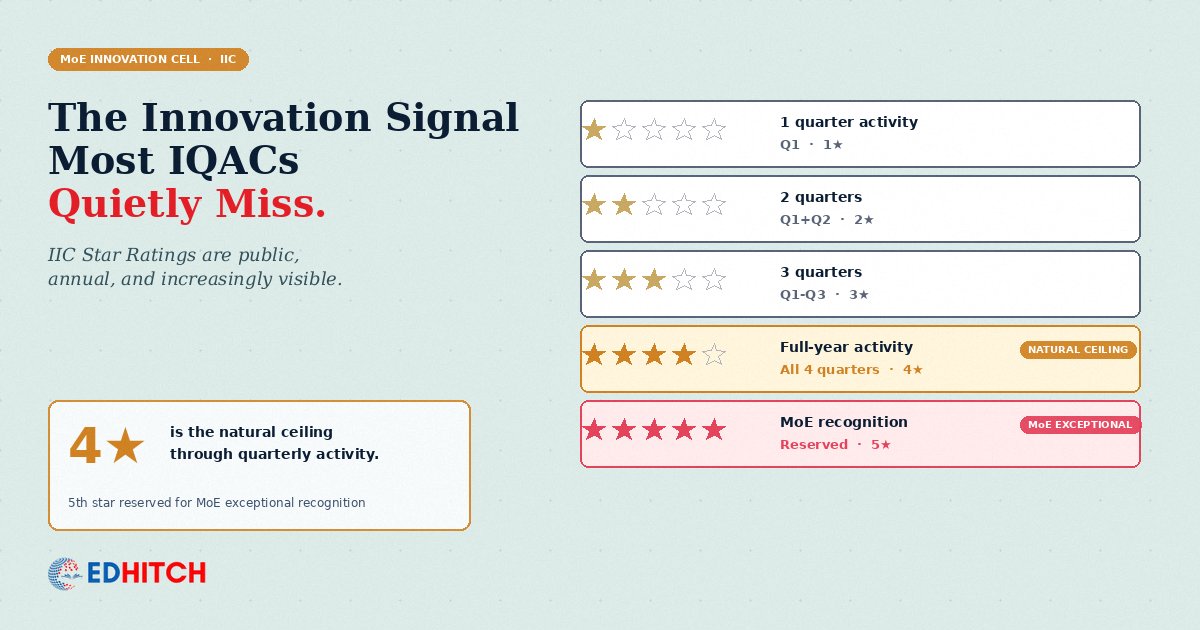
Per MIC's published IIC framework, the rating works on a quarterly activity basis across the IIC calendar year. Institutions accumulate scores by performing the prescribed minimum activities across the required activity types each quarter, and sustained full-year engagement is what moves an institution up the star bands. The exact score-to-star conversion is set by MIC and revised across rating cycles, so institutions should confirm the current year's scoring rubric on the MIC portal rather than assume a fixed formula. The directional logic is consistent: more quarters of genuine, well-documented activity move you up; sporadic participation does not. Above that:
- 1 star. Institution has established an IIC and met minimum activity thresholds for one quarter equivalent.
- 2 stars. Sustained engagement across two quarters of minimum activity.
- 3 stars. Sustained engagement across three quarters.
- 4 stars. Full-year engagement, meeting minimum activity thresholds across all four quarters. The practical ceiling for most engaged institutions.
- 5 stars. Based on MIC's framework, the 5th star appears to require significantly exceeding minimum activity requirements in each quarter and demonstrating outcomes that earn specific recognition from MoE. It is not typically a tier institutions can target through additional quarterly activity alone. Institutions targeting 5 stars should confirm the current year's exact criteria on the MIC portal.
This mechanic matters strategically: the path from 0 to 4 stars is sustained quarterly activity at threshold levels. The path from 4 to 5 stars appears qualitatively different — it requires not just more activity but recognition that goes beyond routine participation. For most institutions, the realistic target is 3 or 4 stars; pursuing 5 stars without first establishing strong 4-star foundations rarely produces the outcome.
Why most IQACs don't track this
Three reasons IQACs miss the IIC Star Rating:
It sits outside the traditional accreditation portfolio. NAAC, NBA, and NIRF are the framework triad most IQACs track. IIC is administered by a different MoE wing (the Innovation Cell, not NAAC or AICTE) and gets categorised mentally as "not our remit."
Innovation activities are often delegated to other offices. The institutional E-Cell, the placement office, the incubation centre — these often handle innovation-related work independently from the IQAC. Without coordination, IQAC isn't tracking the activities that drive the rating.
The rating doesn't carry the regulatory weight of NAAC or NBA. An institution can operate without an IIC Star Rating; it can't operate without NAAC accreditation. So the prioritisation makes intuitive sense in the short term — and produces the strategic blind spot in the longer term.
What stronger IIC engagement looks like
Without prescribing detailed implementation, institutions that earn high IIC Star Ratings share characteristics:
The IIC is treated as a strategic council, not an administrative formality. It has senior leadership representation, meets regularly, and produces decisions that affect institutional resource allocation.
Calendar activity participation is treated as default, not optional. When MIC announces a calendar activity, the institution participates as a routine rather than as a discretionary choice each time.
Self-driven activities align with institutional strategy. The innovation work the institution does on its own connects to its broader strategic objectives — programme design, research direction, student development — rather than being parallel-track activity.
Outcomes are tracked and reported. Startups facilitated, IPR filed, students placed in innovation roles, research that became commercial — these are tracked institutionally and reported to MIC.
The Innovation Ambassador programme is actively used. Trained Ambassadors run programmes, mentor students, and connect the institution to the broader MoE innovation ecosystem.
The practical target most institutions should set
For institutions not currently engaged with IIC, the realistic target is reaching the 3-star or 4-star band within 2-3 cycles of sustained engagement. The 5-star band is exceptional and shouldn't be the immediate target. The 4-star band is the practical ceiling that demonstrates serious engagement without requiring resources only the largest institutions have.
The path to 4 stars typically involves: establishing the IIC properly with senior representation, training and deploying Innovation Ambassadors, exceeding calendar activity thresholds consistently, building out self-driven activity portfolios, and ensuring outcomes are documented as they happen rather than reconstructed before reporting.
None of this is exotic work. It's institutional discipline applied to a domain most IQACs haven't formally included in their portfolio yet.
Want a diagnostic read of where you stand?
Edhitch runs an Accreditation Diagnostic across NIRF, NAAC, and NBA — surfacing the gaps that don't show up on your dashboard.
See the Diagnostics Catalogue →The signal IIC sends
An institution with a strong IIC rating sends a specific signal: this institution is engaged with the current direction of Indian higher education policy, is doing the work to support innovation and entrepreneurship, and has the institutional discipline to sustain activity across multiple cycles. That signal is increasingly read by:
- Students choosing among institutions. Particularly those interested in entrepreneurship or innovation pathways.
- Recruiters in innovation-aligned sectors. Tech, biotech, social enterprise, manufacturing-tech.
- Funding partners and ecosystem collaborators. Institutions with established IIC infrastructure are visible candidates for innovation-focused partnerships, mentorship networks, and ecosystem collaborations.
- Parents and other stakeholders. A public star rating is read by audiences that may not parse the detail of NIRF parameters but recognise a visible, recent, government-endorsed innovation signal.
For IQACs tracking institutional reputation comprehensively, IIC engagement is one of the higher-leverage activities currently underweighted in most institutional dashboards. The work to earn a strong rating is achievable. The signal it sends is durable. And the institutions that do it well tend to compound the benefits across multiple stakeholder groups simultaneously.
About Edhitch
Edhitch is an independent accreditation and ranking diagnostics firm working with Indian higher education institutions. Twelve years in the sector. 100+ institutions served. A seven-year NIRF dataset spanning 5,076+ institution-year records across 13 disciplines. Founder-led advisory combining proprietary diagnostic software with strategic engagement. Read more about us →