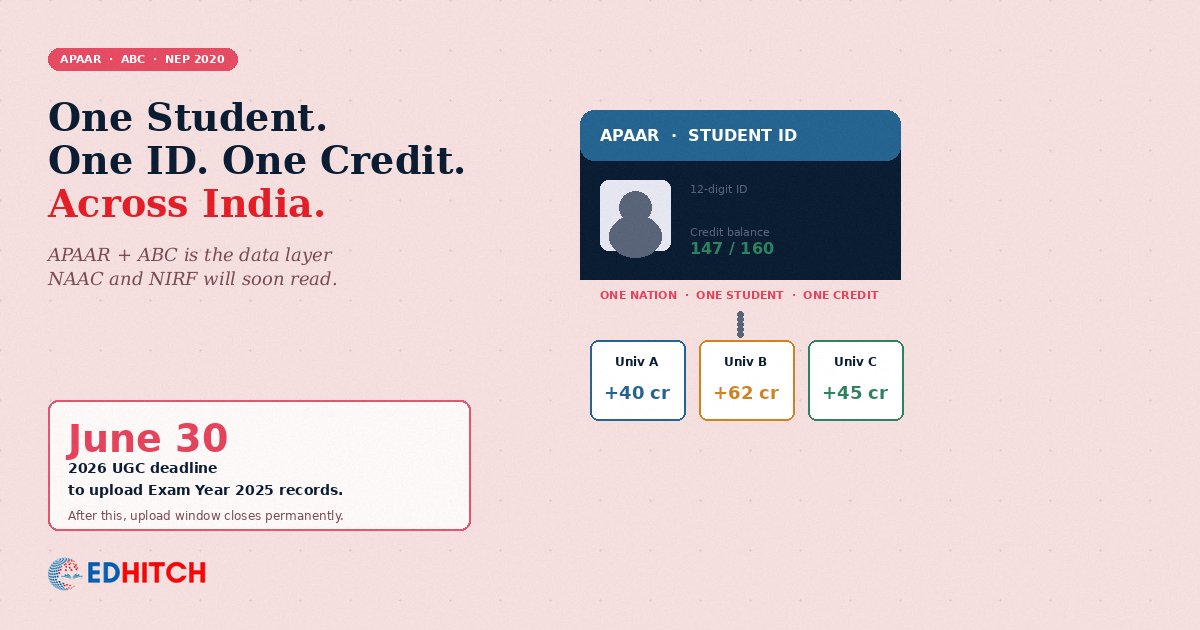
One of NEP 2020's largest infrastructure plays gets less attention than the framework-level reforms it makes possible. APAAR — Automated Permanent Academic Account Registry — is the "One Nation, One Student ID" backbone. ABC — Academic Bank of Credits — is the digital repository that stores credits earned against each APAAR ID. Together they create the substrate on which multiple-entry-and-exit, credit-based flexible learning, and cross-institutional academic mobility actually function.
The story most institutions know is the policy story. The story most institutions miss is the implementation status — and what it means for their NAAC, NIRF, and operational compliance going forward.
The policy intent in one sentence
Every student in Indian higher education is supposed to have a 12-digit APAAR ID, linked to an ABC account, into which institutions deposit credits as the student completes courses, programmes, or examinations. The credits are portable: a student exiting a degree midway can return later, at the same or different institution, and pick up where they left off. The credits are durable: the ABC stores them for at least seven years.
This is the data infrastructure that NEP 2020's flexible-learning promises depend on. Without it, multiple entry and exit is a slogan. With it, it's an operational reality.
The implementation status — and the active deadline
Active deadline (June 2026): UGC has issued a directive requiring HEIs to upload marksheets, grade sheets, and corresponding credit data for Examination Year 2025 on the NAD-ABC platform no later than June 30, 2026. The deadline is final — once the upload window closes, no fresh academic records for Examination Year 2025 will be accepted on the platform.
The June 30, 2026 deadline isn't the first in this sequence. The earlier UGC notifications established:
- HEIs were required to upload credit data for academic years 2021, 2022, and 2023 by December 31, 2024.
- For examinations conducted in 2024, credit information had to be uploaded and mapped to student APAAR IDs by June 2025.
- For Examination Year 2025, the upload deadline is now June 30, 2026.
- Across all phases, the operative clause is consistent: "the HEIs shall not be allowed to deposit credits on the ABC eco-system" after the respective deadline.
That clause is the consequential one. Each deadline closes a window permanently. Institutions that miss June 30, 2026 will not be able to back-fill Examination Year 2025 records onto the platform later. The data for that examination year, for those students, will simply not be there in the ABC system.
And the historical compliance gap is large. As reported by multiple sources tracking the rollout, only about 30% of the approximately 1,800 institutions on the ABC platform had successfully completed credit upload as of 2024 reports. The current rate may have shifted with the additional deadlines and intervening UGC follow-ups, but the structural pattern — that a large portion of institutions struggle to keep current with ABC upload requirements — appears to persist.
The downstream consequences institutions miss
Three implications matter for institutional strategy:
1. Multiple entry-exit becomes formally constrained
NEP 2020 promised that students could exit a UG programme after one year with a certificate, after two years with a diploma, and return later to complete the degree. This requires the credits earned in the first one or two years to be deposited in the student's ABC account. Institutions that haven't uploaded those credits have students whose paper credits exist but whose digital credits don't.
Per reports tracking the rollout, multiple-entry-exit usage remains modest in absolute numbers — a small fraction of the total student population had successfully used the pathway as of 2024-25 reports. The number is small partly because of student preference, but substantially because the underlying credit infrastructure isn't yet fully populated. A student can only exercise multiple entry-exit if their credits are actually in the ABC system to begin with.
2. NAAC and NIRF will increasingly cross-check against ABC
The directional trajectory is clear: ABC data will become a primary verification source for student-related claims in both NAAC and NIRF. When an institution claims 600 graduates in a given year, NAAC's evaluation will eventually be able to cross-check against the number of ABC accounts showing degree-completion credits from that institution.
Institutions that lag on ABC upload will find their student-related claims becoming structurally harder to verify, which means evaluators will weight those claims more conservatively. The institutions with clean ABC data will look more credible by default.
3. Inter-institutional credit transfer becomes a competitive signal
Students increasingly value the ability to take credits earned at one institution and transfer them to another. This is foundational to programmes like undergraduate research collaboration, summer courses at partner institutions, and exchange programmes. Institutions whose ABC data is current can receive transferred credits and award credits transferred outward. Institutions whose data isn't current can't participate in this flow at scale.
For institutions positioning around flexibility, multidisciplinarity, and student-centred learning, this matters substantially. A clean ABC infrastructure becomes part of the institutional brand.
What strong APAAR-ABC implementation looks like
Without prescribing detailed processes, the institutions handling this well share characteristics:
APAAR ID coverage is near-universal at admission. Every new student is enrolled with an APAAR ID, generated if not already present. The institution treats APAAR ID provision as part of admission, not as an afterthought.
Credit upload is part of the examination-results workflow. When semester results are released internally, credit upload to ABC happens in the same workflow, not as a separate periodic activity. This keeps the data current automatically.
Historic data has been reconstructed where possible. Institutions have gone back through admissions records, examination records, and result archives to populate historic credit data for current students — even where the deadlines passed, the work was done to provide students with complete records.
The ABC dashboard is monitored institutionally. Credit upload status, error logs, and discrepancy reports from the ABC platform are reviewed regularly, and issues are resolved within days rather than left to accumulate.
What weak implementation looks like — and why it matters
The institutions that lag on APAAR-ABC implementation typically show patterns:
Periodic batch uploads that lag behind actual examination results by 6-12 months. Credit data in the ABC system that doesn't match the institution's own internal student records. Significant portions of the student population without APAAR IDs at all. Limited internal awareness of where the institution stands on its ABC compliance.
The matter isn't punitive in the short term — UGC's enforcement mechanism is gradual rather than immediate. But the structural disadvantages compound over time:
- Students applying for further studies elsewhere can't cleanly transfer credits.
- NAAC and NIRF evaluation processes view the institution's student-data claims with reduced confidence as they cross-check.
- The institution can't participate in inter-institutional credit-sharing arrangements.
- NEP 2020-aligned positioning becomes harder to claim credibly.
The cost of weak implementation isn't a fine. It's structural disadvantage across multiple evaluation contexts.
What ABC means for the accreditation roadmap
The directional signal is that accreditation is moving toward verified data architecture, where institutional claims are checked against authoritative national databases. ABC is the student-data dimension of that architecture. ONOD covers institutional-data dimensions. AISHE remains the annual census layer. Together they form an interconnected verification system.
For institutions planning the next 3-5 years, the operational implication is that data infrastructure investment now compounds across multiple framework requirements. Building a clean APAAR-ABC pipeline doesn't just satisfy NEP compliance — it strengthens NAAC submission credibility, supports NIRF data verification, and prepares the institution for whatever framework changes come next.
Want a diagnostic read of where you stand?
Edhitch runs an Accreditation Diagnostic across NIRF, NAAC, and NBA — surfacing the gaps that don't show up on your dashboard.
See the Diagnostics Catalogue →The infrastructure shift to internalise
The pattern visible across NEP 2020-aligned reforms is consistent: paper compliance is being replaced by data compliance, and data compliance requires infrastructure rather than documentation. APAAR-ABC is the student-data half of this shift. ONOD is the institutional-data half.
Institutions still operating with the previous-era assumption that periodic compliance documentation is sufficient will find the next 24-36 months increasingly uncomfortable. The frameworks are reading data, not documents. The institutions that have built the data architecture handle the transition smoothly; the institutions that haven't, don't.
The headline isn't really about APAAR or ABC specifically. It's about whether your institution's data infrastructure is keeping up with what the regulatory environment now expects to read.
About Edhitch
Edhitch is an independent accreditation and ranking diagnostics firm working with Indian higher education institutions. Twelve years in the sector. 100+ institutions served. A seven-year NIRF dataset spanning 5,076+ institution-year records across 13 disciplines. Founder-led advisory combining proprietary diagnostic software with strategic engagement. Read more about us →