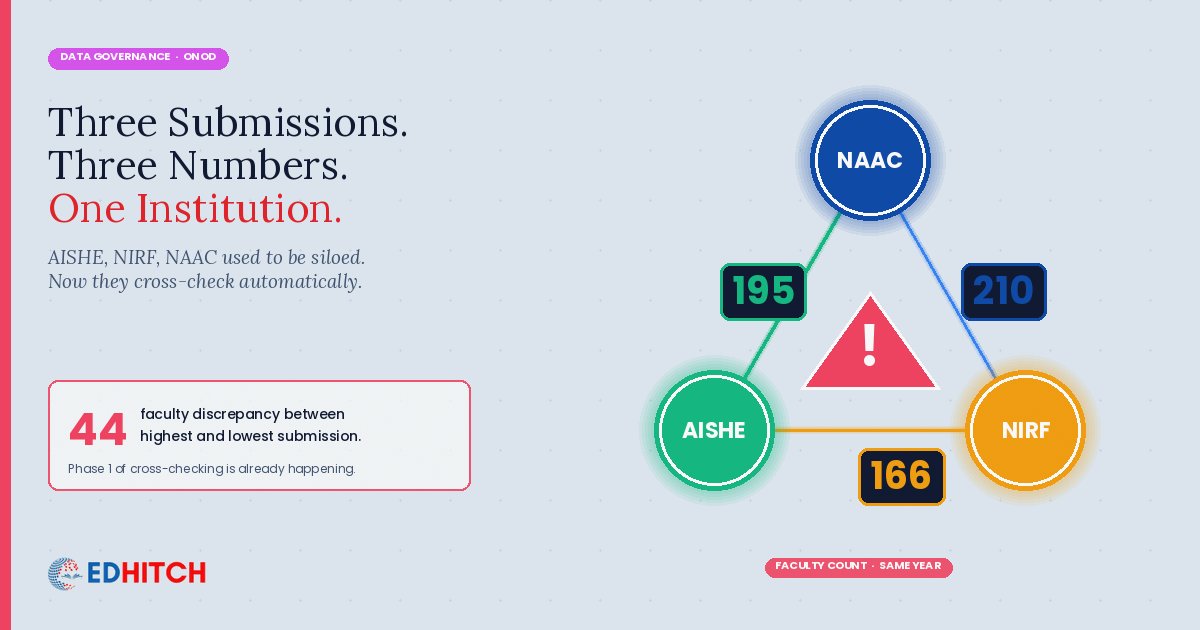
An institution we audited last quarter had three numbers for the same fact. Same institution. Same year. Same definition.
Faculty count, NAAC SSR: 210. Same year, NIRF DCS: 166. Same year, AISHE return: 195.
None of the numbers were fabricated. Each was filled by a different team. Each pulled from a different source. Each was internally consistent within its own submission. And each was 20 to 40 faculty members away from the others.
For most of the last decade, this kind of inconsistency stayed largely invisible. The frameworks did not talk to each other. AISHE collected data. NAAC collected data. NIRF collected data. NBA collected data. Each agency had its own portal, its own format, its own deadline. As long as each individual submission looked clean, no one compared.
That is changing. The cross-checking has started. And institutions that built parallel narratives over a decade may discover what their data looks like when laid side by side.
Why three different numbers exist for the same fact
The cause isn't fraud. It's organisational design — or rather, the absence of it.
In a typical institution:
- The IQAC coordinator fills the NAAC SSR using HR records and academic department reports
- The NIRF in-charge fills the DCS using a different cut of HR data and Scopus searches
- The Registrar files the AISHE return using yet another cut, often pulled at a different time of year with different cutoffs
- The NBA coordinator prepares the SAR for specific programmes using programme-level faculty data
Four people. Four sources. Four submissions. Four deadlines. No reconciliation step.
Faculty count diverges because:
- NAAC counts permanent faculty as of a specific date in the assessment period
- NIRF counts regular faculty using its own definition (full-time, two consecutive semesters, AICTE-qualified)
- AISHE counts everyone with a teaching appointment as of a particular reference date
- NBA counts only programme-affiliated faculty for the specific programme being accredited
The definitions overlap but do not align. The same faculty member can be counted differently across them. The same institution can show different totals.
The numbers diverge not because anyone is wrong, but because nobody is in charge of making them match.
Where the contradictions usually live
From audits across hundreds of institutions, six fields produce most of the divergence:
Faculty count and category breakdown
The single largest source of cross-framework inconsistency. Beyond total count, the breakdown by cadre (Professor / Associate / Assistant), by qualification (PhD / Masters), and by appointment type (regular / contractual / visiting) varies across the three frameworks. NIRF's FQE, NAAC's Criterion 2.4, and AISHE's faculty profile all use slightly different categorisations.
Student enrolment and intake
NAAC counts enrolled students by programme and category. NIRF counts intake against approved sanctioned strength. AISHE counts headcount by level (UG, PG, PhD). When students drop out, transfer, or move between programmes, the three frameworks see different numbers depending on when each takes its snapshot.
Publication count and quality
NAAC SSR collects publications faculty self-report. NIRF pulls publication data independently from Scopus using the institution's registered name. AISHE captures aggregate research metrics. The same faculty member's papers can be counted in NAAC, missed by NIRF (because of affiliation mismatch in Scopus), and grouped differently in AISHE.
Placement and progression
NAAC's Criterion 5 includes placement. NIRF's GO parameter includes placement and median salary. AISHE asks about graduation outcomes. The same student placed at the same company can appear with different details — different salaries, different categorisation as "placed" vs "higher studies" — depending on which form was filled when.
Financial data
NAAC's Criterion 6 covers institutional finances. NIRF's TLR includes Financial Resources and Utilisation (FRU). AISHE collects financial summaries. Same audited financial statement, but different classification rules across frameworks. Capital expenditure, recurring expenditure, salary expenditure, library spend — each framework slices the same totals differently.
Infrastructure
Land area, built-up area, classroom count, lab count, library volumes, sports infrastructure. Reported as standard numbers in each framework, but the definitions vary. NAAC's "library volumes" might include digital resources counted by title. NIRF's library count might be physical only. AISHE might use yet another metric.
Phase 1 of cross-checking is already happening
Institutions assuming this is only a 2027 problem may have missed what is already operational.
NAAC's Data Validation and Verification (DVV) process now cross-references claims against NIRF and AISHE submissions. Institutions that recently went through DVV have experienced this — clarification queries arising not from internal SSR inconsistencies, but from discrepancies with what the institution submitted to other agencies for the same period.
The pattern is recognisable: the institution submits the SSR, the DVV team queries a number, and the institution discovers that the queried number conflicts with what was submitted to AISHE three months earlier or to NIRF eighteen months earlier.
NIRF's verification has been pulling Scopus data independently for years. The shift now is that AISHE data is increasingly being used to cross-check NIRF claims about faculty count, student enrolment, and infrastructure.
Phase 2: the One Nation One Data infrastructure
The government's One Nation One Data (ONOD) initiative is the institutional response to this fragmentation. Per public statements from the chairman of the National Educational Technology Forum, the model is:
- Institutions submit core data once, annually, to a centralised portal
- All quality frameworks (NAAC, NBA, NIRF, AICTE, UGC, AISHE) draw from this single source via APIs
- Each framework applies its own analysis to the common data, not its own collection process
- AI tools detect anomalies and flag suspicious data patterns automatically
This is not a distant future. ONOD is in active development. The infrastructure is being built. NAAC's binary accreditation framework is designed to work with this unified data model — using AI-supported document verification rather than traditional peer team visits.
Per industry reporting, NAAC's Binary system can auto-fetch institutional data from AISHE, AICTE, and APAAR/ABC. When the institution uploads its own numbers during accreditation, the system can compare automatically. Mismatches flag the institution.
If the portal sees 40 teachers in AISHE but 45 in your NAAC submission, your institution is flagged before any human reads your application.
The historical data trap
The uncomfortable part is that cross-checking can apply retroactively.
An institution preparing for NAAC reaccreditation in 2027 may have its SSR cross-referenced against the AISHE returns for 2024, 2025, and 2026 — submissions made years ago, by different teams, under different reporting cycles. If those historical submissions do not reconcile with what is being claimed now, the institution faces a structural problem: not just inconsistent current data, but a documented history of inconsistent past data.
Institutions that have parallel-tracked for years have built up a multi-year inconsistency record. They cannot fix the past submissions. They can only:
- Map the historical inconsistencies and prepare explanations
- Standardise current and future submissions so the inconsistency stops at this year
- Document the cause of past divergence (changed definitions, new HR systems, etc.) so that historical mismatches have a defensible narrative
The audit institutions should run now
Before any framework forces this audit, institutions should run it themselves. The structure is straightforward:
Step 1: Pull all three submissions for the same year. Pick the most recent year where you have all three. Get the AISHE return, the NIRF DCS submission, and the NAAC SSR (or AQAR if no full SSR was filed).
Step 2: Build a comparison sheet for the six high-divergence fields. Faculty count and breakdown. Student enrolment by level. Publication count. Placement count and salary. Financial summary. Infrastructure metrics. List what each framework received.
Step 3: Identify the divergences. Every field where the three submissions don't tell the same story is a flag. Mark each one. Don't try to fix yet — just identify.
Step 4: For each divergence, identify the cause. Different definitions. Different cutoff dates. Different counting methodologies. Different source systems. Sometimes data entry error. Sometimes legitimate measurement difference.
Step 5: Decide on the canonical number. For each field, what is the right number? This becomes your institutional position. Future submissions to all three frameworks should reconcile to this canonical number, with documented exceptions where framework-specific definitions require different counts.
Step 6: Build the data governance to maintain consistency. Single source for each canonical number. Defined methodology for adapting to each framework's specific definition. Sign-off process before any submission goes out. Audit trail.
This audit takes 3-6 weeks for a typical institution. It produces an inventory of inconsistency, a remediation plan, and a governance framework to prevent recurrence.
What changes when you do this
Three things shift:
Future submissions become defensible. Cross-framework queries — whether from NAAC's DVV, NIRF's verification, or NBA's data check — get answered from a single canonical record. The institution stops being surprised by its own historical data.
Internal credibility improves. Leadership stops getting different numbers from different teams. The HR director, IQAC coordinator, NIRF in-charge, and Registrar all reference the same canonical institutional facts.
Strategic decisions get better. When leadership genuinely knows how many PhD faculty the institution has — not three different numbers in three different reports — staffing decisions, recruitment plans, and investment priorities improve.
Audit your data triangle before the system audits it for you
Edhitch's institutional data audit reads your AISHE, NIRF, and NAAC submissions for the same year and flags every divergence — faculty, enrolment, publications, finances, infrastructure. You get a remediation plan and a governance baseline before automated cross-checking forces the conversation.
Run a data triangle audit →The shift in what "good data" means
For most of the last decade, "good data" in higher education meant numbers that looked good in each individual submission. The NAAC SSR was polished. The NIRF DCS was complete. The AISHE return was filed on time. Each one, taken alone, was acceptable.
That definition is narrowing. "Good data" increasingly means numbers that hold up under cross-framework comparison — internally consistent within each submission, externally consistent across all submissions, traceable to source records, and defensible when an automated system asks why the AISHE faculty count is 42 different from the NIRF count for the same year.
The institutions that adapt to this definition early build durable data integrity. The institutions that do not — that continue parallel-tracking — may spend the next several years explaining historical inconsistencies instead of preparing for assessments.
The data triangle is not going to go away. The question is whether your institution audits it now, or has it audited later.
About Edhitch
Edhitch is an independent accreditation and ranking diagnostics firm working with Indian higher education institutions. Twelve years in the sector. 100+ institutions served. A seven-year NIRF dataset spanning 5,076+ institution-year records across 13 disciplines. Founder-led advisory combining proprietary diagnostic software with strategic engagement. Read more about us →