The first question NBA asks an engineering institution applying for programme accreditation isn't about your curriculum, faculty, or outcomes. It's a structural question: which tier do you fall into?
Tier I or Tier II. Same NBA. Same 1000-mark scoring. Different evaluation focus, different international recognition, different rules about when each applies. Institutions that misread their bracket — or don't know which one they're supposed to be in — end up either over-preparing for the wrong evaluation or, more commonly, applying under the wrong tier and getting their application returned.
What the two tiers actually are
Per NBA's published manuals (nbaind.org), the two tiers serve different categories of institution:
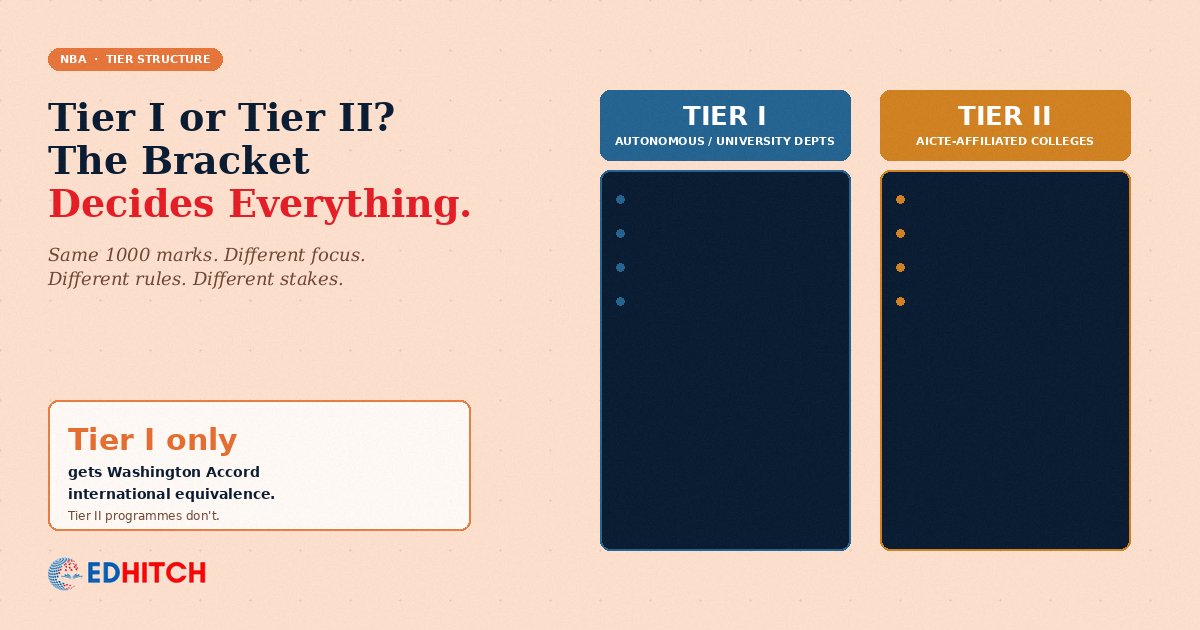
Tier I applies to engineering and technology programmes offered by:
- Academically autonomous institutions
- University departments
- Constituent colleges of universities
Tier II applies to engineering programmes offered by:
- AICTE-approved institutions affiliated to a university (non-autonomous)
This isn't a quality hierarchy. A strong Tier II programme can be substantially better than a weak Tier I programme. What the tiers reflect is institutional autonomy: who controls the curriculum, the assessment, the evaluation processes. Autonomous bodies are evaluated as Tier I; affiliated colleges as Tier II.
The scoring difference
Both tiers use the same ten criteria with the same 1000-mark total. What differs is the weight given to outcome-based versus output-based criteria.
NBA's published Tier I manual explicitly states: "In the TIER-I document, the criteria which are based on outcome parameters have been given more focus, whereas in the TIER-II document, the focus for outcome based criteria has been reduced, significantly, thereby enhancing the focus on the output-based criteria."
What does this mean practically? Tier I programmes are evaluated more heavily on attainment — what students actually learn, how programme outcomes are demonstrably achieved, how continuous improvement loops actually change practice. Tier II programmes are evaluated more heavily on outputs — what was produced, what was offered, what activities ran.
The institutions that score well in Tier I tend to be those that can demonstrate verified outcome attainment year after year. The institutions that score well in Tier II tend to be those with strong organisational discipline and well-documented processes. Same total marks; different paths to them.
The rule most affiliated colleges get wrong
Here's the most consequential operational rule about the two tiers, and one that institutions transitioning between them frequently miss:
Per NBA's published policy on Tier II eligibility: "For all the cases in which an institution gets academic autonomy either from the UGC or from the affiliating University, it becomes autonomous and is required to apply for accreditation of its UG Engineering Programs in Tier I only."
And the transition rule: "When an institution gets autonomous status for the first time, it can apply in Tier II in the interim period, if it wishes to, before one batch of students passes out under autonomous status. After one batch of students under autonomous status passes out, the institution shall have to apply for accreditation of its UG Engineering Programs in Tier I only."
Translation: the moment your college becomes autonomous, you have one autonomous batch's worth of grace period to apply under Tier II. After that, Tier I is mandatory. You don't choose; the rule chooses for you.
The consequence is that newly autonomous institutions sometimes spend years preparing for Tier II accreditation, only to discover when applying that the rule forces them into Tier I, where the scoring philosophy is different and their Tier-II-built evidence architecture doesn't translate cleanly.
The Washington Accord question
NBA is a member of the Washington Accord, the international agreement that establishes substantial equivalency between engineering accreditation systems globally. A programme accredited under Washington Accord-recognised processes has international portability — graduates' degrees are recognised by Washington Accord member countries.
The critical detail: only Tier I accreditation produces Washington Accord equivalence. Tier II accreditation is valued domestically but does not carry international recognition under the Accord.
For institutions whose students aspire to international careers, postgraduate study abroad, or work in multinational engineering contexts, this matters substantially. A graduate of a Tier I accredited programme in India has a different international standing than a graduate of an otherwise equivalent Tier II accredited programme.
What this means for institutional strategy
The Tier I / Tier II question isn't simply about which form to fill. It shapes:
Evidence architecture. Tier I demands attainment evidence — what students actually learned, how outcomes were measured, how the data was used. Tier II demands process and output evidence — what was offered, what was implemented. The same institutional records get framed differently across the two tiers.
Preparation timeline. Tier I evaluation depth requires outcome data accumulated over years; an institution can't shortcut to Tier I readiness in a few months. Tier II preparation is more achievable in shorter windows.
International positioning. Institutions targeting international rankings, partnerships, and student outcomes need to operate as Tier I-eligible, regardless of where they currently sit.
Investment priorities. Tier I rewards depth in CO-PO attainment, continuous improvement loops, faculty research. Tier II rewards organisational discipline and process documentation. Where you invest depends on where you're scored.
Want a diagnostic read of where you stand?
Edhitch runs an Accreditation Diagnostic across NIRF, NAAC, and NBA — surfacing the gaps that don't show up on your dashboard.
See the Diagnostics Catalogue →The transition that gets institutions stuck
The hardest institutional transition we see in NBA work isn't from unaccredited to accredited. It's from Tier II to Tier I — specifically, the period after an institution becomes autonomous when its evidence systems were built for output-based evaluation but the next accreditation cycle demands outcome-based evaluation.
This transition takes years, not months. Programmes that try to compress it tend to produce SARs that read as Tier II evidence dressed in Tier I language — and evaluators see through that quickly. The institutions that navigate the transition well treat their first Tier I cycle as a learning cycle, accept that scores may be lower than their Tier II baseline suggested, and use the experience to rebuild their evidence architecture for the new evaluation philosophy.
If your institution is approaching this transition, the work to do isn't on the SAR document. It's on the underlying systems that produce the evidence the SAR will eventually capture.
About Edhitch
Edhitch is an independent accreditation and ranking diagnostics firm working with Indian higher education institutions. Twelve years in the sector. 100+ institutions served. A seven-year NIRF dataset spanning 5,076+ institution-year records across 13 disciplines. Founder-led advisory combining proprietary diagnostic software with strategic engagement. Read more about us →