A research-active university in central India had 180 faculty members. Their internal records showed over 420 Scopus-indexed publications in the last three years. The research cell was confident this would translate into a strong RP score in NIRF.
When the NIRF results came, their RP score reflected fewer than 280 publications.
140 papers had vanished. Not retracted. Not rejected. Simply invisible.
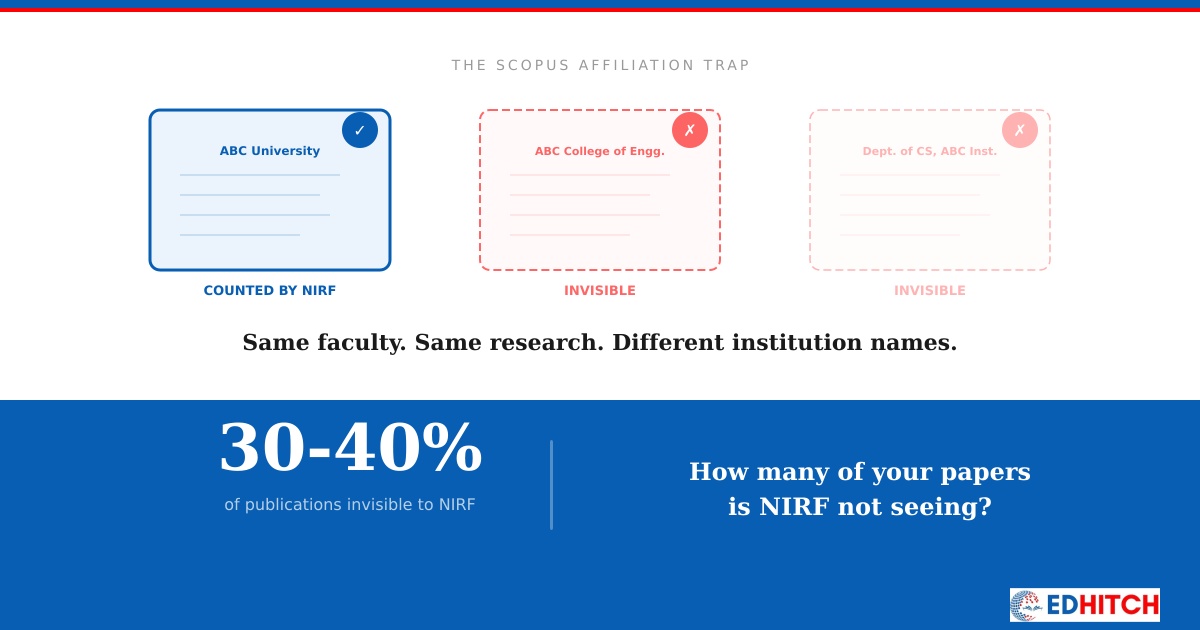
The reason was something nobody in the institution had thought to check: their faculty had published under four different versions of the institution name. NIRF was counting only one.
How NIRF counts your publications
This is the part most institutions don't realise. When you fill the NIRF portal, you submit student data, faculty data, financial data, and placement data. But you do not submit publication data.
NIRF extracts publication and citation data directly from third-party databases — primarily Scopus and Web of Science. It searches for publications linked to your institution's registered name and affiliation ID.
If a paper is in Scopus but linked to a different version of your institution name — NIRF doesn't see it. The paper exists. The citation exists. But as far as your NIRF score is concerned, it doesn't.
This matters because RP (Research and Professional Practice) carries 30% weightage in NIRF. Within RP, publications (PU) and quality of publications (QP) together account for 75 marks out of 100. A 30-40% drop in counted publications can cost several points on your final score — and in a comparative ranking, that can mean a difference of 50-100 rank positions.
How the mismatch happens
When a faculty member submits a paper to a journal, they type their institutional affiliation in a text field. There's no dropdown. No standardised list. They type whatever they remember — or whatever they've always written.
Over the years, this creates multiple versions of the same institution in Scopus:
"ABC College of Engineering" — the name used by senior faculty who joined when it was a standalone college.
"ABC College of Engineering, Autonomous" — used after the college received autonomous status.
"ABC University" — used after the parent university was established and the college became a constituent institution.
"Department of Computer Science, ABC University" — used by faculty who listed their department instead of the institution.
Scopus treats each of these as a separate institution with a separate affiliation ID. Your NIRF registration is linked to one of them. The publications under the other three? Gone.
This isn't a hypothetical problem. We've seen it at almost every institution we've worked with. The older the institution, the worse it gets — because there are more years of accumulated name variations.
The five common mismatch patterns
After auditing Scopus profiles across dozens of institutions, we've found that mismatches fall into five predictable categories:
Pattern 1: Pre-university name. The institution was a college, then became part of a university, then became a university itself. Faculty who published during the college era used the old name. Those papers are linked to the old affiliation.
Pattern 2: Autonomous suffix. When a college receives autonomous status, some faculty add "Autonomous" to the name, others don't. Scopus creates two profiles. One matches NIRF, the other doesn't.
Pattern 3: Department-level affiliation. Faculty write "Department of Mechanical Engineering, XYZ Institute" instead of just "XYZ Institute." Scopus sometimes creates a separate affiliation for the department.
Pattern 4: Abbreviation and spelling variations. "Institute of Technology" vs "Inst. of Tech." vs "Institute of Technolgy" (note the typo). Each creates a separate Scopus entry. Typos are permanent in published papers — they don't get corrected.
Pattern 5: Hospital vs university name. Specific to medical institutions. Faculty in the teaching hospital publish under the hospital name. Faculty in the medical college publish under the college name. NIRF is registered under the university name. Three affiliations, one NIRF ID.
Every variant name in Scopus is a leak in your publication count. The more variants, the more papers NIRF can't see.
Why this problem is getting worse
Three trends are making the affiliation trap more damaging every year.
First, NIRF now penalises retracted papers. From 2024 onwards, retracted publications receive negative marks. This means the denominator for quality calculations is more sensitive — losing legitimate papers to affiliation mismatch while keeping retracted ones is doubly damaging.
Second, the TOP25P metric. NIRF gives extra marks for publications in top 25 percentile journals by impact factor. If your best papers — the ones in high-impact journals — happen to be under a mismatched affiliation, you're losing marks precisely where they count the most.
Third, the normalisation factor. NIRF calculates publications per faculty (using FRQ — a normalised faculty count). If your faculty count is correct but your publication count is artificially low because of affiliation mismatch, the ratio suffers doubly. You look like you have unproductive faculty when in reality you have uncounted papers.
The real cost — worked out
Let's put numbers to this.
An institution with 150 faculty and 400 Scopus publications over three years. If 35% are under mismatched affiliations, NIRF sees 260 papers instead of 400.
PU (Publications) is worth 35 marks within RP. The score is calculated as a function of publications per faculty. With 400 papers and 150 faculty, the ratio is 2.67. With 260 papers, the ratio drops to 1.73. That's a 35% reduction in the input to a 35-mark sub-parameter.
QP (Quality of Publications) is worth 40 marks. It uses citation count and TOP25P — both of which are also reduced proportionally if publications are missing.
RP carries 30% weightage. A loss of even 15 marks within RP translates to 4.5 points on the final 100-point NIRF score. In many ranking bands, that's the difference between being ranked and not being ranked.
And the worst part? This is entirely fixable. The papers exist. The citations exist. They're just linked to the wrong name.
How would you know if this is happening to you?
Here's a simple test. Ask your research cell or IQAC coordinator to do the following:
Go to Scopus. Search for your institution name — the exact name registered with NIRF. Note the total number of publications in the last three years.
Now search for common variations — the old college name, the name with "Autonomous," the department-level name, the hospital name if you're a medical institution.
If the variations show additional publications that didn't appear in the first search — you have an affiliation mismatch. The gap between the first number and the total across all variations is the number of publications NIRF can't see.
We've done this exercise with dozens of institutions. The gap is almost always between 20% and 45%.
The test takes 15 minutes. The gap it reveals can explain years of disappointing RP scores.
What happens after you find the gap
Finding the gap is straightforward. Fixing it is more involved.
Scopus has a formal process for merging duplicate institutional affiliations. It requires identifying every variant name, mapping which publications belong to which variant, and submitting a correction request. The request needs to come from an authorised institutional representative, and Scopus typically takes 4-8 weeks to process it.
But the merge only fixes the Scopus profile going forward. It doesn't automatically fix how NIRF counted your publications in the previous submission. The corrected profile helps in the next NIRF cycle — not the current one.
There's also a preventive step: ensuring every faculty member uses the exact NIRF-registered institution name in all future publications. This sounds simple but requires a formal communication from the IQAC to all departments, followed by periodic verification.
The audit, the merge request, the faculty communication, and the verification — this is a structured exercise that requires someone who understands both the Scopus system and the NIRF scoring mechanism. Getting it wrong — or doing it partially — can leave gaps that persist for years.
We Cover Scopus Audit Strategy in Our Programme
Session 4 of our 5-Day programme walks through how NIRF counts publications, how to identify affiliation mismatches, and what a systematic Scopus audit looks like — with real institutional examples.
April 6-10, 2026 · Mon-Fri · 7-9 PM · Online · NAAC 6.3.4 Certified
Register Now — ₹2,499 →Frequently Asked Questions
Does NIRF use Scopus data for publications?
Yes. NIRF extracts publication and citation data directly from Scopus and Web of Science. Institutions do not submit this data — NIRF pulls it using the registered institution name and affiliation ID.
Why are my publications not showing in NIRF?
The most common reason is affiliation mismatch. If faculty published under a different institution name than what is registered with NIRF, those publications are not counted.
What is a Scopus affiliation ID?
Every institution in Scopus has a unique affiliation ID. Papers are linked to this ID based on what the author wrote as their affiliation. Different spellings create different IDs.
How much can this affect NIRF score?
RP carries 30% weightage. Publications and quality together account for 75 marks within RP. A 30-40% drop in counted publications can cost several points on the final score.
Can this be fixed?
Yes. Scopus has a process for merging duplicate affiliations. However, it requires systematic identification of all variant names and formal requests — typically taking 4-8 weeks to process.

Edhitch Advisory
Accreditation & Ranking Intelligence · NAAC · NBA · NIRF · 12 Years · 100+ Institutions