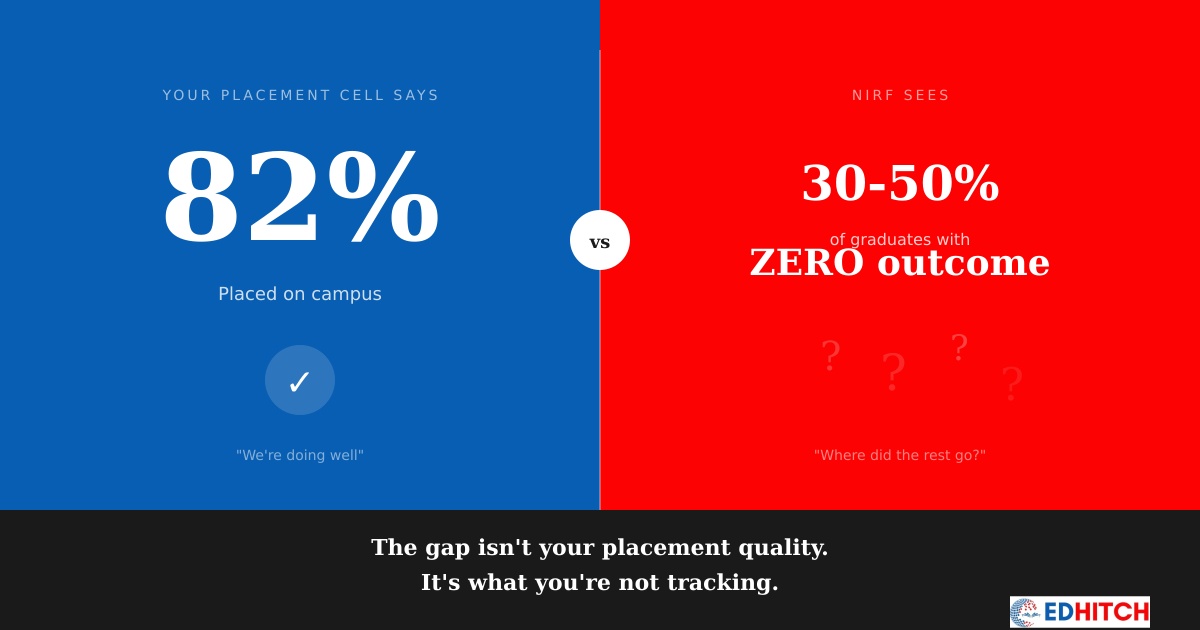
A placement officer at an engineering college in Bangalore told us: "Sir, our placement rate is 82%. Companies come on campus every year. Our students get placed. But NIRF gave us a low GO score. How is that possible?"
We looked at his NIRF data. The answer took two minutes to find.
His placement cell tracked one thing. NIRF measures four.
The disconnect
NIRF's Graduate Outcomes parameter carries 20% weightage. It doesn't just measure placements. It measures multiple dimensions of what happens to students after they graduate — and it combines them into a single score.
Most placement cells track campus recruitment. That's their function and they do it well. But NIRF asks a bigger question: what happened to ALL your graduates?
The students who went for higher education. The ones who cleared competitive exams. The ones who started their own businesses. The ones who found jobs through their own networks. The ones who entered professional practice.
If these outcomes aren't in the NIRF portal, they don't exist as far as the ranking is concerned.
The numbers that surprised us
At the Bangalore engineering college, 480 students graduated. 394 were placed on campus. Good number. But the remaining 86 showed zero outcome in the NIRF data.
Did those 86 students really have no outcome? Of course not. They're engineering graduates. They went somewhere. But because the placement cell doesn't track what happens beyond campus recruitment, those 86 students contributed nothing to the GO score.
We've seen this pattern at nearly every institution we've worked with. The gap between actual graduate outcomes and reported graduate outcomes is usually 30-50%.
At a medical university, 136 MBBS graduates in one year. Placed: 10. Higher studies: 31. The remaining 95 graduates — 70% of the batch — showed zero outcome. These are doctors. They didn't disappear. They joined residencies, government service, private practice. But none of that was captured.
The institution's graduates have outcomes. The institution's data doesn't show them. NIRF ranks what it can see — not what actually happened.
It's not just about tracking more outcomes
The GO parameter has layers that most institutions don't realise.
There's a salary component — and it doesn't ask for the number most placement cells report. It asks for a specific calculation that can differ from your published "average package" by 30-50%. Getting this wrong doesn't just reduce accuracy — it can push your score in the wrong direction.
There's a graduation rate component — how many students complete the programme in the stipulated time. Every year-back and backlog reduces this number.
And there's a doctoral output component — which is structurally zero for institutions without PhD programmes.
Each component is weighted differently. And the combined effect of getting even two of them wrong can cost an institution several rank positions.
Why this keeps happening
The root cause is structural. The placement cell is designed for campus recruitment. Tracking what happens to graduates after they leave — higher education, government jobs, independent practice, entrepreneurship — requires a completely different process.
It requires reaching out to alumni. It requires a systematic follow-up mechanism. It requires the right questions asked at the right time to the right people. And it requires someone who understands what NIRF actually counts versus what a placement brochure needs.
This is an institutional capability gap — not a placement cell failure. The placement cell is doing its job. The institution hasn't built the system for the rest.
The opportunity most institutions miss
Here's what makes this frustrating. The outcomes already exist. Your graduates are employed, studying, practising, or building businesses. The data is out there — in your alumni WhatsApp groups, in your faculty's personal networks, in your university's convocation records.
You don't need to improve your placement quality. You don't need to sign more companies. You don't need to spend more money.
You need to count what's already happening.
The institutions that score well on GO are not always the ones with the best placements. They're the ones that have built a system to capture all outcomes — and report them in the format NIRF requires.
Building that system — knowing what to track, how to collect it, how to calculate the numbers NIRF expects, and how to feed it into the portal correctly — is the gap between an 82% placement rate and the NIRF score that should go with it.
The question isn't "how do we place more students." The question is "how many of our graduated students are we not counting?" The answer is usually between 30% and 50%.
We Help Institutions Close This Gap
Our NIRF diagnostic identifies exactly where your GO score is leaking — which outcomes are missing, which calculations need correction, and what a complete tracking system looks like for your specific institution. We also cover GO strategy in detail in our 5-Day programme.
April 6-10, 2026 · Mon-Fri · 7-9 PM · Online · NAAC 6.3.4 Certified
Register Now — ₹2,499 →Frequently Asked Questions
Why is my NIRF GO score low despite good placements?
NIRF GO measures multiple dimensions beyond campus placement. Most institutions track only one. The gap between what your placement cell reports and what NIRF counts is where marks are lost.
What does NIRF count as a graduate outcome?
Several categories beyond campus placement. Any productive outcome counts — but only if the institution reports it in the portal.
Does NIRF use the same salary metric as placement cells?
No. NIRF uses a different calculation than what most placement cells report. The two numbers can differ by 30-50%, directly affecting the score.
How many outcomes do institutions typically miss?
Based on our diagnostics, the gap is typically 30-50%. A third to half of all graduate outcomes go unreported.
Can GO score improve without better placements?
Yes. The outcomes already exist. Capturing them systematically can change the score without any change in actual performance.

Edhitch
Accreditation & Ranking Intelligence · NAAC · NBA · NIRF · 12 Years · 100+ Institutions