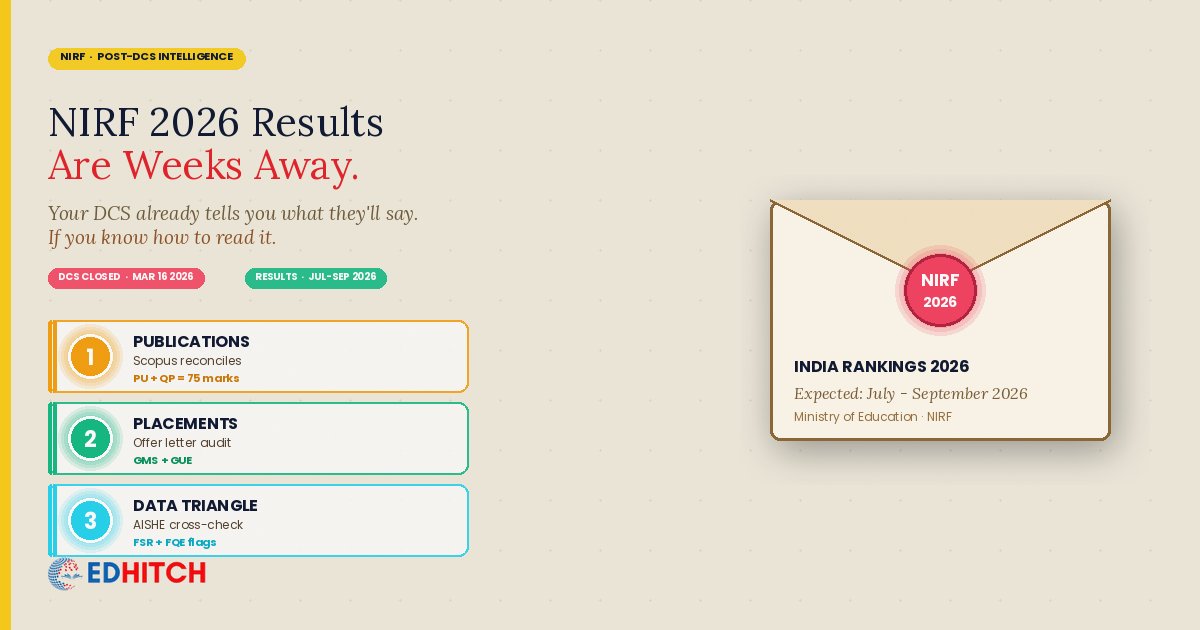
The NIRF 2026 Data Capture System closed on March 16. NIRF 2025 results were released on September 4, 2025. By that historical pattern, NIRF 2026 results are likely to land between July and September 2026 — somewhere in the next two to four months.
Most institutions are in the same posture they take every year between submission and release: waiting. Refreshing the NIRF portal. Watching news for date announcements. Hoping the numbers turn out alright.
This is the wrong posture. Your DCS data is locked. The submission is what it is. But the patterns inside it — the choices you made about what to report and how to report it — already give you a fairly clear read on where you'll land in the rankings. You just have to know how to look.
Here are three things your closed DCS submission is already telling you, if you're willing to look.
1. Whether your publication count survives Scopus reconciliation
NIRF doesn't take your publication number on faith. It pulls publication data independently from Scopus. The PU and QP sub-parameters under Research and Professional Practice — together about 75 marks — are computed from what Scopus knows about your institution, not what you reported.
This is where many institutions discover, after results are released, that the publication count they submitted does not match the publication count NIRF actually scored.
The mismatch comes from three places:
Affiliation inconsistency. A faculty member published 14 papers over the last three years. Eight list the institution by its current name. Three list a former name (institutions that renamed in the last five years can lose papers this way). Two list the faculty member's previous institution because they had not updated their Scopus profile after joining. One has the institution name misspelled. NIRF counts what Scopus shows under the institution's current registered name. The other six papers may not contribute to the score.
Self-citation inflation. NIRF's QP (Quality of Publications) sub-parameter weights citations. If 40% of an institution's citations come from its own faculty citing each other, NIRF's normalisation drops the QP score sharply. Institutions that submitted impressive citation counts without auditing for self-citation density learn this the hard way when results land.
Predatory journal exclusion. NIRF does not credit publications in journals flagged as predatory or those de-indexed by Scopus during the assessment window. Institutions that included these in their submission may find them excluded during scoring.
If your DCS publication count was based on faculty self-reporting without an independent Scopus audit against your institution's exact registered name, your effective PU+QP score may be 15 to 30 percent lower than what your submission claims.
You can verify this now. Pull your three-year Scopus search using your institution's exact name as registered with NIRF. Compare to your DCS submission. If the numbers diverge, you already know where some of your marks went.
2. Whether your placement and salary data has the evidence trail to survive verification
NIRF's Graduation Outcomes (GO) sub-parameter rewards placement quality, not just placement count. The Median Salary (GMS) carries 25 marks in the NIRF 2025 Engineering framework. To score on it, you need offer letters with verifiable salary numbers — not just a tally of "students placed."
Three patterns predict whether your GMS submission will hold up:
The salary-to-placement ratio. If your placement count is high but your reported median salary is suspiciously low, NIRF's verification flags it. Conversely, if your median salary is unusually high relative to your category and discipline, that gets flagged too. Both flags trigger requests for offer-letter samples.
Offer letter availability. NIRF does not always ask for every offer letter — but it can. If your placement cell has only spreadsheet records and no actual offer letters from companies, the data is structurally hard to verify. We have seen institutions discover during NIRF audit that a sizeable share of their reported placements have no offer letters on file.
Higher Studies and Entrepreneurship (HEE) overlap. Students who continued to higher studies are sometimes also counted in placement numbers. NIRF specifically separates GUE (Graduating Students in Higher Studies, Entrepreneurship) from placement. If your DCS counted the same student twice, the duplication reduces both scores when caught.
The signal here is procedural, not numeric. If you don't have offer letters on file for at least 90% of your reported placements with verifiable contact details for the placing company, your GO score is fragile. You won't know how fragile until results land.
3. Whether your AISHE, NIRF, and NAAC numbers tell the same story
This is the new vector — and the one many institutions have not internalised yet.
NIRF 2026 is among the early cycles where automated cross-verification with AISHE has matured. AISHE — the All India Survey on Higher Education — has data on every recognised institution: faculty count, student count, programme structure, infrastructure. NIRF can now pull AISHE data and compare it to what you submitted in your DCS.
If your DCS reports 240 faculty and your AISHE return for the same year reports 198, that is a 42-faculty discrepancy. NIRF's verification can flag it. You may not be asked to explain — your scores can simply be reconciled toward the lower number, which affects FSR, FQE, and several other sub-parameters under TLR.
The same applies to NAAC data, particularly for institutions in active assessment cycles. If you reported one set of faculty PhD percentages to NAAC and a different set to NIRF for overlapping years, the One Nation One Data infrastructure flags the inconsistency.
The institutions that come through NIRF 2026 cleanly tend to share one trait: their NIRF, NAAC, and AISHE numbers reconcile. Institutions that took the easier path of reporting the most flattering numbers to each agency may discover that the agencies are now talking to each other.
Cross-framework consistency is not a 2027 problem. It is already affecting 2026 scores in ways many institutions will only fully understand once results are released.
You can audit this now too. Pull your most recent AISHE return. Pull your NIRF DCS submission. Compare faculty count, student count, and programme structure. If they diverge, you already know one source of marks lost.
What the rank ranges actually mean this year
Beyond the score itself, NIRF 2026 will show ranks. Rankings get published in bands — 1-10, 11-25, 26-50, 51-100, 101-150, 151-200, and so on. Your strategic interpretation of the rank you get depends on which band you're in.
If you rank in the top 25 of your category: the score difference between rank 1 and rank 25 is usually meaningful — 10-15 points or more on a 100-point scale. Climbing within this band is a multi-year project.
If you rank between 26-100: this is the densest band. Score differences between adjacent ranks are typically 0.3-0.8 points. Small operational improvements move you significantly within this band.
If you rank between 101-200: this is where data quality matters more than parameter improvement. Most institutions in this band have decent academic operations — the rank is set by what the data shows, not by what's actually happening on the ground. Cleaning up data presentation often moves these institutions 15-25 ranks without any change in operations.
Below 200 (rank-band publication): the gap between rank-band publication and being unranked is sometimes a single operational threshold being missed — minimum publication count, minimum placement reporting, minimum infrastructure declarations. Often a fixable problem if identified post-result.
Why most institutions interpret their NIRF result wrong
Two patterns:
The "rank improvement" trap. An institution moves from rank 87 to rank 78. Leadership celebrates a 9-position improvement. The actual cause is often that institutions ahead dropped out, slowed down, or had data quality issues this cycle — not that the celebrating institution did anything new. Year-over-year rank movement in dense bands is frequently cohort-driven, not institution-driven.
The "score is fine, rank is bad" misread. An institution holds its score at 41.2 from one year to the next, but its rank drops from 65 to 78. The institution looks at the static score and concludes "we held steady." What actually happened is that the institutions ranked 70-100 last year improved their scores enough to push past the static institution. Holding steady in NIRF is losing ground in a system where everyone else is improving.
The right interpretation isn't rank or score in isolation. It's whether your improvement rate is faster than the institutions ranked just above you.
The strategic question for the next two months
NIRF 2026 results will land. You can't change the data. But you can use the waiting period to do three things that will determine NIRF 2027:
One: Audit your own submission. Pull every parameter and trace it back to source documents. Where the source doesn't exist or doesn't reconcile, mark it. This becomes your data improvement list for the November-December 2026 DCS opening.
Two: Reconcile across frameworks. Compare your NIRF, NAAC, and AISHE submissions for the same period. Where they diverge, decide what the right number is and standardise. This becomes your data governance baseline.
Three: Build the verification infrastructure you'll need for 2027. Offer-letter archive. Scopus affiliation alignment. PhD count reconciliation. Faculty register against AICTE records. None of these are visible improvements — but they're the foundation on which 2027's score will be calculated.
The institutions that climb in NIRF 2027 are often the ones who used the post-2026 lull to fix the upstream issues. Institutions that wait for results before starting to plan have less runway to work with.
Audit your NIRF 2026 submission before results land
Edhitch's post-DCS diagnostic reads your locked submission against current NIRF methodology and cross-references with AISHE and Scopus. You can't change 2026's score — but you can know what it'll be, and what to fix for 2027.
Audit your NIRF submission →One closing observation
NIRF result week generates the most institutional anxiety of any quality framework event in India. The phone calls. The press releases. The sudden interest in "what we'll do differently next year."
The institutions that have a calmer result week are the ones who already had a sense, in May, of what the announcement might say. Their submission audit told them. Their reconciliation work told them. They are not surprised by their rank because they read the signals weeks before they went public.
The window before results is when audit and reconciliation work matters. Your DCS is closed. The data is what it is. But what your data already reveals about your incoming rank — that, you can read right now.
About Edhitch
Edhitch is an independent accreditation and ranking diagnostics firm working with Indian higher education institutions. Twelve years in the sector. 100+ institutions served. A seven-year NIRF dataset spanning 5,076+ institution-year records across 13 disciplines. Founder-led advisory combining proprietary diagnostic software with strategic engagement. Read more about us →