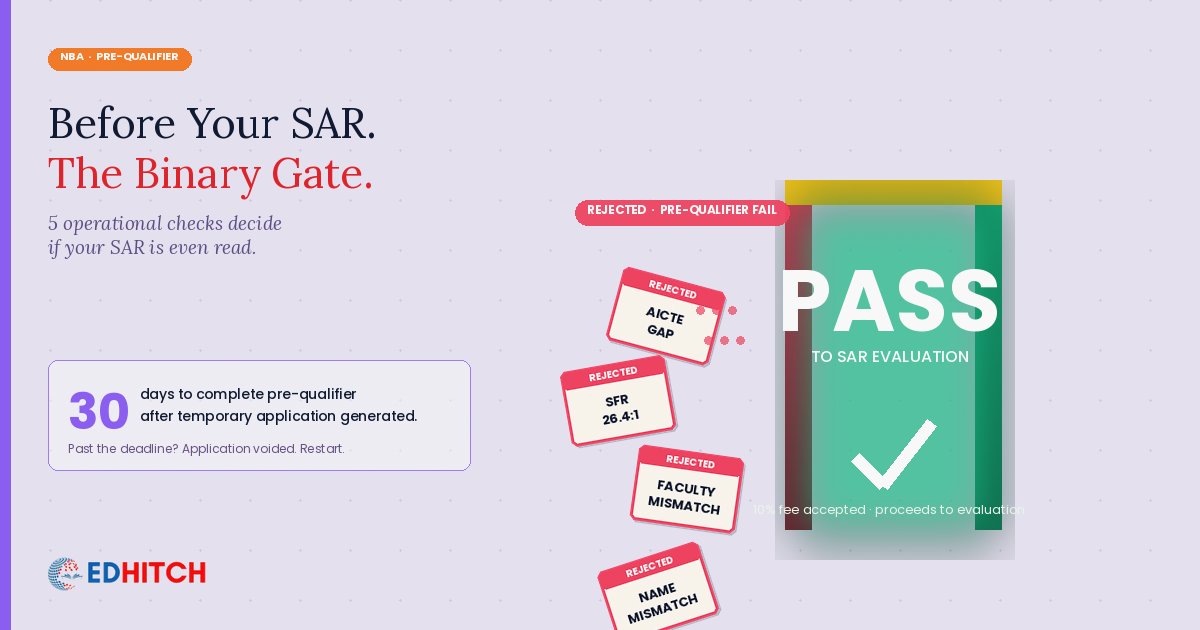
Last quarter, an Engineering programme submitted its NBA application after eighteen months of preparation. The Self-Assessment Report ran 240 pages. Course outcomes documented. CO-PO mapping evidence ready. Faculty publications catalogued. Continuous improvement records spanning three assessment cycles.
The application was rejected.
Not after a peer team visit. Not after evaluation. Before any of that. The application was rejected at the pre-qualifier stage — the first check NBA runs before it agrees to evaluate your SAR.
Many institutions do not realise this gate exists.
What the pre-qualifier actually is
NBA's accreditation process has two distinct stages. The pre-qualifier is the first. The Self-Assessment Report (SAR) and the visiting team evaluation come second.
You apply through the e-NBA portal. You generate a temporary application. You pay 10% of the accreditation fee. Then you fill in the pre-qualifier form for each programme you want accredited. NBA reviews the pre-qualifier. If it is approved, you can submit your SAR and pay the remaining 90% of the fee.
If your pre-qualifier is not approved, the application does not proceed. You are informed of the shortcomings. The 10% fee is non-refundable. The work you did on the SAR — eighteen months of it — sits unread.
The pre-qualifier is a binary check. Either your programme is eligible for evaluation, or it is not. There is no partial credit and no peer team to plead your case to at this stage.
The five things NBA checks before it reads anything else
Per NBA's published manuals for both Tier-I and Tier-II Engineering, the pre-qualifier collects information under five sub-heads. Each carries its own conditions that must be satisfied:
1. Programme-specific information
The first check is whether the programme exists in a form NBA can accredit. The programme title in your application must match exactly the title on graduating students' degrees and on regulatory approval letters from AICTE, the affiliating university, or the Department of Higher Education.
Programmes accredit. Departments don't. If your application names a department instead of a specific programme, it doesn't qualify.
NBA also checks that the programme has graduated at least two batches of students under the structure being submitted. If your latest curriculum revision is two years old and no batch has graduated under it yet, the programme isn't ready for accreditation regardless of how strong your other indicators are.
2. AICTE / regulatory approval status
Your programme must hold valid AICTE approval (or equivalent regulatory approval) for the last five years from the current academic year. This is verified against AICTE's records, not against your declared status.
This is the most common failure point we see. An institution adds an approved programme but discovers later that the approval was for a different intake, a different shift, or a different specialisation than what's currently being taught. Or the approval lapsed for one academic year three years ago. Or the institution changed names but the AICTE approval is still in the old name and the alignment was never updated.
NBA cross-verifies. If the records don't match, the application doesn't proceed.
3. Student admission and intake patterns
NBA examines your last three years of admission data. The check isn't whether you admitted students — it's whether your admissions follow the regulatory pattern you're approved for. Programmes with consistent under-admission, programmes where the intake-vs-admitted gap is wider than NBA tolerates, and programmes where the admission methodology doesn't conform to the regulator's prescribed channels are flagged here.
This is also where merit cut-offs and entry standards come into question. Programmes that admit substantially below the regulatory minimum — even if the admission is technically legal — face additional scrutiny.
4. Faculty information and Student-Faculty Ratio
This is among the more rigorous parts of the pre-qualifier and a frequent reason programmes fail without realising they will. NBA's Tier-I Engineering pre-qualifier requires a Student-Faculty Ratio of not exceeding 25:1, averaged over three years. Tier-II requirements are similar. The cadre ratio — the proportion of Professors, Associate Professors, and Assistant Professors — must satisfy AICTE's prescribed cadre structure.
The calculation is not simple. NBA defines "regular faculty" with specific conditions: AICTE-prescribed qualifications and experience, full-time appointment, and a minimum of two consecutive semesters of work in the academic year being evaluated. Visiting faculty do not count. Faculty shared across multiple programmes count fractionally. Faculty whose appointment letters do not match their working profile may not count.
A programme that claims 50 faculty members on paper might have 38 who satisfy NBA's definition of regular faculty when the audit happens. That difference can move SFR from 22:1 to 29:1 — and the programme that thought it was comfortably within the threshold can find itself rejected.
5. Compliance status
The final pre-qualifier check is what NBA calls "compliance status" — a synthesis question about whether the programme satisfies the broader institutional and regulatory framework it operates within. Land area, building approvals, lab availability, library volumes, fire safety clearances, accessibility compliance — these all sit in this bucket.
This isn't a deep audit. It's a checklist. But the checklist is verified against AICTE Annexures, university affiliation documents, and statutory clearances. Mismatch in any of these — even on items unrelated to academic quality — causes pre-qualifier rejection.
Why the pre-qualifier exists
NBA evaluates a Self-Assessment Report on roughly 1,000 marks across ten criteria for Engineering Tier-I programmes. The peer team visits cost real money — assessor fees, travel, institutional time. NBA cannot send teams to programmes that are not operationally eligible for evaluation in the first place.
The pre-qualifier is NBA's filtering mechanism. It separates programmes that are operationally ready for assessment from programmes that need to fix structural issues before evaluation makes sense. From NBA's perspective, this protects assessor capacity. From an institution's perspective, it means a programme can do everything right on the academic side and still fail at this gate because of an AICTE approval lapse from three years ago.
The pre-qualifier doesn't measure how good your programme is. It measures whether your programme is structurally eligible to be measured.
The hidden trap: the 30-day window
There is a procedural detail in NBA's Tier-I manual that catches many applications: all pre-assessment steps must be completed within 30 days of generating the temporary application.
If you generate the application, fill in basic programme information, and then realise you need to fix faculty appointment letters or update AICTE annexures — the 30-day clock keeps running. If you cannot get those documents in order in 30 days, the application is voided and you have to regenerate it. The pre-qualifier needs to be filled again.
This is one reason programmes that "applied for NBA but did not get past the early stages" sometimes go through 2-3 application cycles before realising the issue was not in their SAR at all. It was upstream, at the pre-qualifier stage, where they were trying to fix structural data inside a 30-day window.
What changed with GAPC v4.0
The Graduate Attributes and Professional Competencies framework v4.0 — aligned with the Washington Accord 2021 review — became mandatory for Tier-I autonomous programmes from January 1, 2025, and for Tier-II affiliated programmes from January 2025 with a transition window allowing the previous SAR format until June 2025.
GAPC v4.0 didn't change the pre-qualifier structure significantly. The five sub-heads remain. SFR thresholds remain. AICTE approval requirements remain.
What changed is what comes after the pre-qualifier. Programme Outcomes were reduced from 12 to 11. Sustainability and ethics are no longer standalone POs but are woven into Design, Investigation, and Analysis. Complex Engineering Problems became a formal 20-mark item. Industry involvement in curriculum is now expected for autonomous programmes.
The pre-qualifier hasn't changed. The SAR has. Programmes assuming their old SAR format still works are walking into a different rejection vector entirely — but that's a separate problem from the pre-qualifier gate.
Why a strong SAR doesn't save you here
This is the part most institutions get wrong. They invest heavily in the SAR — course outcomes, CO-PO mapping, attainment calculations, action-taken reports, faculty publications, continuous improvement narratives. They prepare for the visiting team's questions. They run mock visits.
None of this is wasted. But none of it helps at the pre-qualifier stage.
The pre-qualifier is a binary check on operational eligibility. It doesn't read your CO-PO mapping. It doesn't evaluate your assessment methodology. It doesn't care how well your programme has documented its continuous improvement. It checks five operational facts. If those facts aren't in order, the SAR isn't read.
The asymmetry is worth absorbing: your SAR could be among the strongest in your discipline, and your application can still be rejected because your SFR averaged 25.4:1 over the last three years instead of 25:1 — and you may not have been aware which months tipped the average.
What competent programmes do differently
Programmes that clear the pre-qualifier on the first attempt do something unglamorous: they audit operational eligibility before they apply. Not after. Before.
The audit covers, at minimum:
- AICTE approval continuity and exact-name match for the last five years
- Programme title alignment across degree certificates, AICTE letters, and university affiliation orders
- Faculty register validated against NBA's definition of regular faculty — appointments, qualifications, work continuity, fractional sharing across programmes
- SFR computation using NBA's methodology, averaged over the last three academic years, including current
- Cadre ratio against AICTE's prescribed structure for the programme's intake
- Admission patterns matched against approved intake and regulatory channels
- Statutory clearances — building, fire, accessibility, biological waste — current and on file
This audit takes 4-6 weeks for a typical programme. It's done before any SAR work begins. If gaps are identified, they're fixed before the application is generated. The 30-day post-generation window is then spent on actual pre-qualifier filling, not on emergency document-chasing.
The programmes that fail the pre-qualifier aren't usually the ones with bad academic data. They're the ones who jumped to SAR preparation without first verifying that they were eligible to be evaluated.
Verify your pre-qualifier readiness before you apply
Edhitch's NBA pre-qualifier diagnostic audits all five eligibility heads against current NBA methodology — AICTE alignment, faculty register, SFR computation, cadre ratio, admission patterns, statutory compliance. Eighteen months of SAR work shouldn't fail at the gate.
Run a pre-qualifier diagnostic →The strategic point
NBA accreditation has two failure modes many institutions do not distinguish between: structural ineligibility and academic underperformance. The first blocks you at the pre-qualifier. The second weighs against you at the peer team visit.
These are different problems with different remedies. Institutions that conflate them — assuming a strong SAR will compensate for AICTE inconsistencies, or that good faculty publications will offset SFR violations — end up doing the right work in the wrong sequence.
The pre-qualifier doesn't measure quality. It measures eligibility. Get eligible first. Then get accredited.
About Edhitch
Edhitch is an independent accreditation and ranking diagnostics firm working with Indian higher education institutions. Twelve years in the sector. 100+ institutions served. A seven-year NIRF dataset spanning 5,076+ institution-year records across 13 disciplines. Founder-led advisory combining proprietary diagnostic software with strategic engagement. Read more about us →