An institution we worked with prepared for nine months for its NAAC peer team visit. Documentation curated. Evidence files indexed. Faculty briefed on possible questions. Students primed for stakeholder interaction. Campus walkthrough route mapped. Lab demonstrations rehearsed.
Two weeks before the visit, NAAC informed them: your visit will be online.
The institution's preparation did not go to waste — but much of it stopped being directly relevant. The campus walkthrough would not happen. The labs would not be physically toured. The faculty would not sit across a table from the assessors. A significant share of what they had spent nine months optimising for was now a different exercise.
This is happening more often. And institutions still tend to treat online, hybrid, and onsite peer team visits as if they were the same exercise scored in different settings. They are not.
What NAAC actually does in 2025-26
Per NAAC's published Standard Operating Procedures (updated 6 May 2025) for pending institutions under the existing Revised Accreditation Framework:
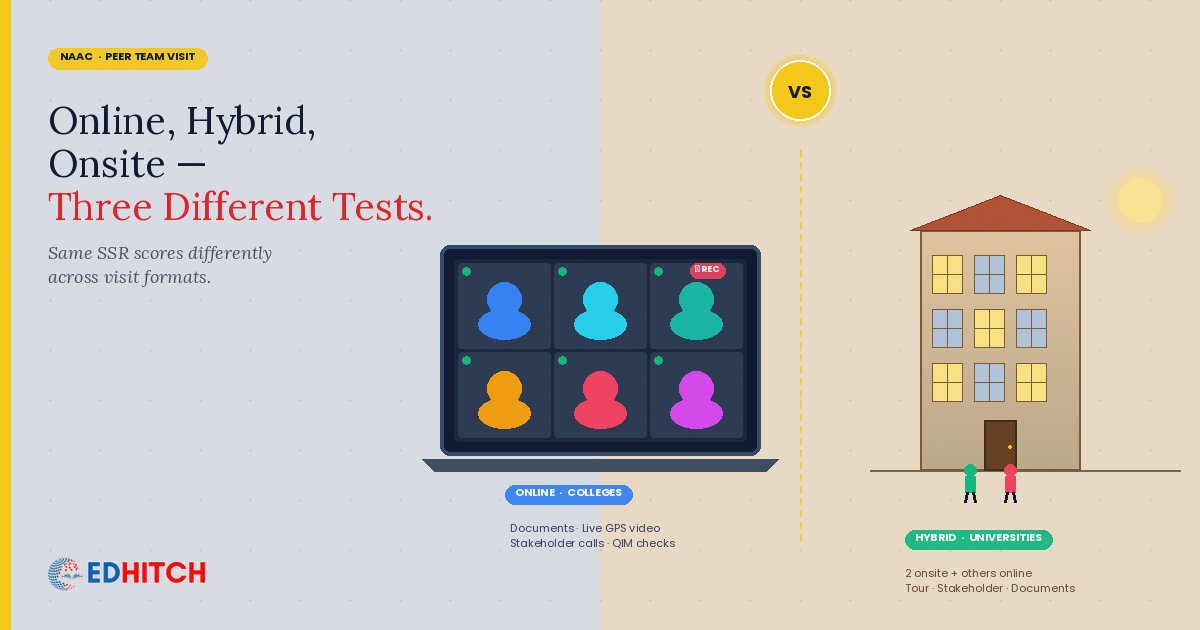
- Colleges are assessed in online mode. The peer team conducts a virtual visit. No physical assessor presence.
- Universities are assessed in hybrid mode. Two members of the peer team are physically present on campus. The remaining members participate online.
- Onsite-only visits for institutions under RAF have largely been replaced by these formats during the transition window before binary accreditation rolls out.
This isn't COVID-era continuity. It's NAAC's deliberate format choice for clearing the RAF pipeline before the binary framework launches. The proposal, per NAAC's own SOP, is to "complete all the pending visits before the launch of Basic Accreditation."
Each format produces different information for the assessors. Each format verifies different things. And each format requires a different preparation strategy.
What an online peer team visit actually verifies
In an online visit, the entire interaction happens via video conference. NAAC records the entire visit. Assessors see what the institution chooses to show on camera, when the institution chooses to show it.
What gets verified:
- Documents in the SSR. Every quantitative metric (QnM) the institution claimed must be substantiated with the original document. Assessors ask to see signed sanction letters, audited financials, attendance records, MoUs. Documents are screen-shared. The peer team checks dates, signatures, and consistency with what was claimed.
- Live video of physical infrastructure. NAAC requires HEIs to show GPS-enabled live video on request. Labs, library, classrooms, infrastructure — all shown via live camera feed with location verification. The peer team chooses what they want to see.
- Stakeholder interaction. Faculty, students, and other stakeholders join via video. Conversations happen on the record.
- Qualitative metric (QlM) responses. The narrative claims in the SSR are tested through structured questions to leadership and faculty.
What does not get verified the same way:
- The "feel" of campus quality. Onsite visits historically gave assessors a holistic sense of institutional culture — clean corridors, active classrooms, motivated students between classes. Online visits give a much narrower window. What looks decent on a 12-inch screen reveals less than walking through.
- Spontaneous evidence discovery. An onsite visit might surface evidence the institution didn't proactively present — a research lab the assessor walks past, a student-led initiative seen in passing. Online visits constrain the assessors to what gets shown.
- Behavioural cues during interaction. Body language, group dynamics in stakeholder interactions, off-the-record campus conversations — these come through less clearly in video format.
Online visits are documentation-heavy. Onsite visits are observation-heavy. Hybrid splits the difference for universities — two assessors observe, the rest verify documents.
The strategic asymmetry institutions miss
Online assessment shifts where marks are won and lost. The shift cuts in two directions:
Documentation precision matters more. In an onsite visit, a missing signature or an undated document might be overlooked if the rest of the institution presents well. In an online visit, the document is what is being evaluated. Hygiene problems that were forgivable in person can become harder to ignore on screen.
Soft factors matter less. Institutions that historically scored well on "institutional vibrancy" through campus life, student energy, and intangible quality cues lose part of that scoring channel in online format. The opposite is also true — institutions that did not show well in person but had strong documentation often score better online.
Institutions that do not recognise this asymmetry tend to prepare for the wrong things. They polish the campus visit experience that may not happen. They under-invest in document organisation that becomes the dominant scoring vector.
What the SOP requires that institutions overlook
NAAC's online visit SOP includes specific requirements that institutions routinely miss:
Cameras must remain on throughout. Both the HEI's camera and every peer team member's camera must stay switched on for the duration of the virtual meeting. Some institutions assume they can switch off non-active cameras during long sessions. They cannot.
Only SSR documents can be presented. Inputs and supporting documents shown during the visit must be from the SSR (specifically the QlM section) for the assessment period. Institutions that try to present documents prepared after SSR submission — even if those documents support their claims — are out of scope.
Live video with GPS on request. Per the May 2025 SOP, when the peer team asks for live infrastructure verification, the HEI must show video with GPS/location enabled. Pre-recorded footage isn't a substitute. Phones with disabled location services don't satisfy the requirement.
No contact outside the visit. HEIs are explicitly prohibited from contacting peer team members or NAAC officials except during the scheduled visit, and only for technical assistance. Backdoor communication — even for clarifications — violates NAAC's code of conduct and can lead to cancellation of the entire accreditation process.
The visit is recorded. NAAC records the entire online peer team visit. In case of a Standing Committee re-visit or Appeal re-visit, the recording is reviewed. This means everything said during the visit becomes part of the permanent assessment record.
Hybrid visits — why universities get a different format
For universities, two assessors are physically present on campus while the remaining team members participate online. Per NAAC's SOP, all travel and accommodation for the two onsite members is coordinated by NAAC, and universities are explicitly required not to provide formal welcomes or offer gifts (bouquets, shawls, mementos).
The hybrid format exists because universities are larger, more complex, and harder to assess fully online. The two onsite members provide ground-truth verification that the online team uses to calibrate against what they're seeing on screen.
What this means for university preparation:
- The onsite team members will physically tour critical infrastructure — research centres, libraries, hostels, hospitals (for medical universities)
- They report back to the online team about what they saw, both formally and informally
- Discrepancies between what online team sees on video and what onsite team sees in person become a verification flag
- Stakeholder interactions can happen both in person (with onsite team) and via video — and stakeholders need to be prepared for both
Universities that prepare only for the online portion of a hybrid visit, or only for the onsite portion, are preparing for half the assessment.
Why scores can differ across formats — even for the same institution
Two institutions with identical SSRs but different visit formats may not get identical scores. Three reasons:
One: The peer team's evaluation of QlM (qualitative metrics) is partly a function of what they observed during the visit. Different formats produce different observations.
Two: The structure of stakeholder interactions varies. A faculty meeting with assessors over lunch (onsite) is a different conversation than a 45-minute scheduled video call (online). The assessors get different information from each format.
Three: Document scrutiny is more granular online. Screen-shared PDFs invite line-by-line examination in a way that flipping through a printed file in person doesn't. Documentation hygiene matters more.
This isn't fair or unfair — it's structural. Different formats genuinely produce different evidence. The institution's job is to match its preparation to the format it will be assessed in.
What competent institutions do differently
The institutions that score consistently across formats follow three preparation principles:
Document everything as if it will be screen-shared. Every QnM document needs a clean digital copy with clear signatures, dates, and supporting evidence. The "in-person verification" loophole no longer exists.
Prepare for both visit formats, but commit early when the format is announced. Once NAAC confirms online or hybrid, the preparation focus shifts. Institutions still preparing campus walkthroughs two weeks before an online visit may be misallocating their effort.
Treat stakeholder interactions as scripted, not spontaneous. Online visits give less room for organic conversation. Faculty, students, and leadership benefit from knowing what they will be asked, who will be in the call, and what evidence might come up. This is not coaching — it is making sure people who have not done this before do not fumble what they actually do well.
Prepare for the visit format you'll actually face
Edhitch's NAAC peer team visit diagnostic audits your readiness across all three formats — online, hybrid, and onsite. We identify the documentation, infrastructure, and stakeholder gaps that scoring methodology will surface, format by format.
Audit your visit readiness →The format question for binary accreditation
Looking forward: the binary accreditation framework, when it goes fully live, replaces traditional peer team visits with AI-supported document verification. Online visits are the bridge — and institutions that develop strong online-visit capability now are also developing the capability to perform well in binary accreditation, which is even more documentation-driven.
Institutions still treating peer team visits primarily as a hospitality exercise — elaborate welcome ceremonies, formal lunches with assessors — are preparing for an assessment model that is gradually being replaced. The future leans more toward verification than ceremony.
What you optimise for today should reflect what NAAC actually scores tomorrow.
About Edhitch
Edhitch is an independent accreditation and ranking diagnostics firm working with Indian higher education institutions. Twelve years in the sector. 100+ institutions served. A seven-year NIRF dataset spanning 5,076+ institution-year records across 13 disciplines. Founder-led advisory combining proprietary diagnostic software with strategic engagement. Read more about us →