True story from a NAAC assessment.
A well-known college in Karnataka. Grade A aspirant. Strong academics. Their SSR claimed: "92% of faculty have PhD or are pursuing PhD."
DVV asked for proof.
The college sent a table: faculty name, qualification, year of PhD.
DVV rejected it.
Not because the number was wrong. It was accurate. But a self-declared table is not evidence. It's a claim.
DVV wanted three things: the PhD certificate (or registration letter for "pursuing"), the appointment letter showing the same person, and the AISHE faculty return showing them as "regular." Three documents. For each faculty member. Cross-referenced.
That's an evidence chain. Remove one link and the claim falls apart.
The college had all the documents. Just not linked together. It took them three weeks of emergency work to compile what should have been ready from day one.
They got their grade — but it could have been much cleaner.
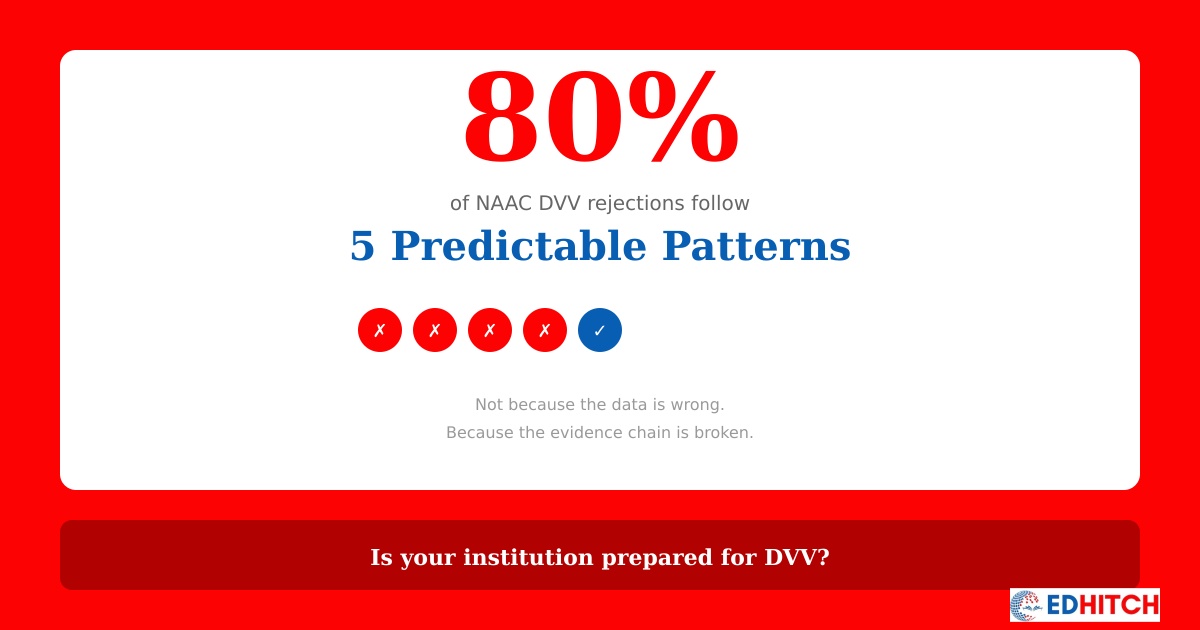
After working with 100+ institutions on accreditation, we've found that 80% of DVV rejections follow five predictable patterns. Not because institutions are fabricating data. But because they don't understand how DVV thinks.
Pattern 1: The Missing Evidence Chain
This is the most common pattern. The claim is correct. The evidence exists. But the evidence isn't linked.
DVV doesn't verify numbers. DVV verifies evidence chains. Every claim in your SSR needs to trace back to two or three documents that independently confirm the same fact.
Faculty count? DVV wants the appointment letter, the joining report, and the AISHE return — all showing the same person, same designation, same date. A single consolidated table prepared by the IQAC doesn't survive DVV scrutiny.
Research publication count? DVV wants the Scopus or Web of Science listing showing the author's affiliation matching your institution name. A departmental list of "faculty publications" doesn't work.
Placement data? DVV wants the offer letter from the employer, not just a placement cell summary. Or at minimum, a letter from the company confirming the appointment.
The rule is simple: if the only evidence for a claim is a document your institution created, DVV will question it. You need at least one external or independently verifiable document in the chain.
Pattern 2: Cross-Framework Data Mismatch
This is the pattern that's becoming more dangerous every year.
Your NAAC SSR says 210 faculty. Your NIRF submission says 166. Your AISHE return says 195.
All three numbers might be "correct" — because each framework counts differently. NIRF excludes contractual faculty who didn't teach both semesters. AISHE includes everyone on payroll. Your SSR includes visiting faculty who teach regularly.
But DVV doesn't care about your counting methodology. DVV sees three different numbers for the same claim and raises a query.
The same problem appears in research data. Your SSR reports sponsored research of five crore. NIRF shows three crore. AISHE says four crore. Different reporting windows, different inclusion criteria — but to DVV, it looks like inconsistency.
With NAAC moving towards AI-based assessment and the government pushing "One Nation One Data," this cross-referencing is becoming automated. Institutions that maintain separate data silos for each framework are building a problem that will only get bigger.
The fix: one master dataset that feeds all three frameworks. If you must report different numbers, document exactly why they differ — before DVV asks.
Pattern 3: Metric Definition Mismatch
NAAC asks for the percentage of full-time teachers against sanctioned posts. Sounds straightforward.
But what counts as "full-time"? What counts as "sanctioned"? If your institution has a self-financed wing, are those posts "sanctioned"? If a professor holds a dual charge, do they count once or twice?
Most DVV queries in this pattern arise because the institution used its own definition instead of NAAC's definition.
Another common example: NAAC asks for "teachers with PhD." The institution includes faculty "pursuing PhD." NAAC counts only awarded PhDs. The number drops. DVV flags it.
Or: NAAC asks for research publications in "UGC-recognised journals." The institution counts all Scopus publications. But not all Scopus journals are in UGC's list, and not all UGC-listed journals are in Scopus. The overlap is partial, not complete.
Before claiming any metric, read NAAC's exact definition in the manual. Not what you think it means. What NAAC says it means. One word — "sanctioned" vs "approved" vs "filled" — can change a number by 30%.
Pattern 4: Backdated or Bulk Documentation
DVV can tell when documentation was created in bulk.
If all your faculty feedback forms have the same date, the same handwriting pattern, or the same formatting — it's visible. If your MoU documents with industries were all signed in the same month, three months before the SSR deadline — it's visible.
This pattern catches institutions that treat accreditation as a deadline rather than a process. They spend six months before the SSR submission creating evidence for five years of activity.
DVV looks for temporal consistency. Were feedback forms collected every semester? Were MoUs active during the claimed period? Were research papers published across the assessment period or clustered at the end?
The most common trigger: IQAC meeting minutes. If your IQAC shows 20 meetings in the last year but the minutes were all prepared in the same formatting, same font, same template — DVV notices. Real meetings produce real variation in minutes.
The only defence against this pattern is genuine continuous documentation. If you're reading this before your next NAAC cycle — start now. Not everything at once. One process per month. Build the trail as you go.
Pattern 5: Wrong Evidence Format
This is the most frustrating pattern because it's the most avoidable.
DVV asks for a "geo-tagged photograph" of your laboratory. You upload a regular photograph. Rejected — not because the lab doesn't exist, but because the photograph doesn't have GPS metadata.
DVV asks for an "audited utilisation certificate" for sponsored research. You upload the project completion report. Rejected — because DVV specifically asked for the utilisation certificate signed by the auditor.
DVV asks for "minutes of the Board of Studies meeting approving the revised curriculum." You upload the revised curriculum itself. Rejected — because the curriculum is not the minutes.
In every case, the institution has the right evidence. They just uploaded the wrong document.
Read the DVV query carefully. Every word matters. "Geo-tagged" is not optional. "Audited" is not optional. "Minutes of the meeting" is not the same as "outcome of the meeting." Match the evidence to the exact format requested.
Why these 5 patterns keep repeating
The root cause is the same across all five patterns: institutions prepare for NAAC as a submission exercise, not as a quality assurance process.
When accreditation is treated as a deadline, evidence is assembled after the fact. Claims are written first, evidence is found later. Data is collected from different sources without cross-checking. Documentation is created in bulk to fill gaps.
When accreditation is treated as a process, evidence accumulates naturally. Every semester generates feedback. Every faculty appointment creates a linked record. Every research publication is tracked with its affiliation verified. DVV has nothing to question because the evidence chain already exists.
The institutions that score highest in DVV are not the ones with the best data. They're the ones with the best documentation habits.
What to do before your next NAAC cycle
If your institution is preparing for NAAC in the next 12-18 months, here are five actions that will prevent most DVV queries:
First, build an evidence chain template for every metric you'll claim. For each data point, list: the claim, the primary evidence document, the secondary verification document, and where each document is stored. Do this once. Update it continuously.
Second, cross-reference your SSR data with your NIRF submission and AISHE return. Where the numbers differ, document the reason. Put it in writing before DVV asks.
Third, use NAAC's exact metric definitions. Download the manual. Read each metric carefully. If your internal definition differs from NAAC's definition — change yours.
Fourth, implement monthly documentation reviews. Not annual. Monthly. One IQAC sub-committee. One hour per month. Check that evidence is accumulating in real time.
Fifth, train your faculty. Most DVV evidence — publications, feedback, course files — is generated by faculty, not by IQAC. If faculty don't know what DVV expects, IQAC spends months fixing what should have been right from the start.
Learn DVV Defence + Integrated NAAC-NBA-NIRF Strategy
We cover all 5 DVV objection patterns — with institutional examples and evidence chain templates — in our 5-Day Professional Development Programme.
April 6-10, 2026 · Mon-Fri · 7-9 PM · Online · NAAC 6.3.4 Certified
Register Now — ₹2,499 →Frequently Asked Questions
What is NAAC DVV?
DVV (Data Verification and Validation) is the process where NAAC cross-checks SSR claims against supporting evidence. External experts verify data accuracy before the peer team visit.
Why do correct claims get rejected in DVV?
DVV doesn't verify the number — it verifies the evidence chain. A claim can be factually correct but get rejected because the supporting documents are incomplete, inconsistent, or in the wrong format.
Does DVV cross-reference NIRF data?
Yes. DVV panels increasingly cross-check SSR claims against NIRF DCS submissions and AISHE data. Mismatches in faculty count, research output, or financial data trigger queries.
How long does DVV take?
Institutions typically get 7-14 days to respond to DVV queries. This is why evidence chains must be ready before submission — there isn't enough time to build them after DVV raises a query.
Can DVV rejection affect the final NAAC grade?
Yes. DVV rejections reduce the quantitative score for the affected metrics. Multiple rejections can shift an institution from one grade band to another.

Edhitch Advisory
Accreditation & Ranking Intelligence · NAAC · NBA · NIRF · 12 Years · 100+ Institutions