From CO-PO to SAR & SSR: A Practical Guide to Automating NBA and NAAC Binary Accreditation Readiness
Learn how to go from chaos to clarity using automation — for both NBA SAR and NAAC Binary SSR.
· Updated: July 18, 2026 · By Edhitch
It’s 10 PM. The accreditation deadline is just 3 days away. Faculty members are frantically searching their inboxes for old lesson plans. The IQAC coordinator is buried under spreadsheets trying to piece together the SAR. The CO-PO matrix? Still incomplete. Sound familiar? You’re not alone.
Introduction
Accreditation in India is not just about ticking boxes or filling out forms — whether you're under NBA (engineering, pharmacy, management, architecture) or the new NAAC Binary framework (announced 10 February 2025, covering arts, science, commerce, and every other discipline). Both frameworks now expect outcome-based education practices, backed by measurable CO-PO attainment data and verifiable evidence. Yet most colleges still struggle with fragmented processes, inconsistent CO-PO calculations, and last-minute panic. This practical blog explains how to make the journey smoother — from CO-PO mapping to SAR and SSR generation — using automation, not adrenaline.
1. What NBA Really Evaluates: Beyond Compliance
Let’s be honest: NBA isn’t here to check your paperwork. It’s here to assess whether your academic process leads to student success. The core pillars:
- Vision, Mission, and Programme Outcomes that align with national goals
- Measurable attainment of COs and POs
- Real quality loops and continuous improvement
Automation Insight: Define your Vision, Mission, PEOs, and POs once in a centralised system. No more copy-pasting across files.
One thing worth getting right before you automate anything: under GAPC v4.0 there are 11 Programme Outcomes, not 12. Old PO6 (The Engineer and Society) and old PO7 (Environment and Sustainability) were merged into the new PO6, The Engineer and the World. Ethics is a standalone outcome at PO7, and PO5 was renamed from “Modern Tool Usage” to “Engineering Tool Usage”. If your templates still carry 12 POs, the mappings are invalid under SAR 2025. See the full breakdown of the 11 POs.
2. The CO-PO Attainment Pitfall: Where Most Institutions Go Wrong
We’ve seen it repeatedly — CO-PO matrices that look fine on paper but fail in logic. The common culprits:
- COs that don’t follow Bloom’s Taxonomy
- CO-PO mappings done “just to fill the table”
- Calculations that ignore weights or use raw averages
Quick Test: If your attainment formula starts and ends in Excel with no version control, it’s time to upgrade.
Automation Insight: Use tools that allow question-level tagging and weighted mappings — and recalculate attainments instantly across internal and external assessments.
3. Evidence Management: The Hidden Burden
Ever spent hours looking for a 2021 mentoring log? You’re not alone. SAR demands an ocean of documents:
- Programme and course files
- Teaching plans, feedback records, result analysis
- Industry connects, FDPs, student mentoring, research output
Automation Insight: Adopt a digital evidence bank. It should:
- Auto-tag every document by criterion and course
- Let you check evidence completeness at a glance
- Generate audit-ready folders, zipped and time-stamped
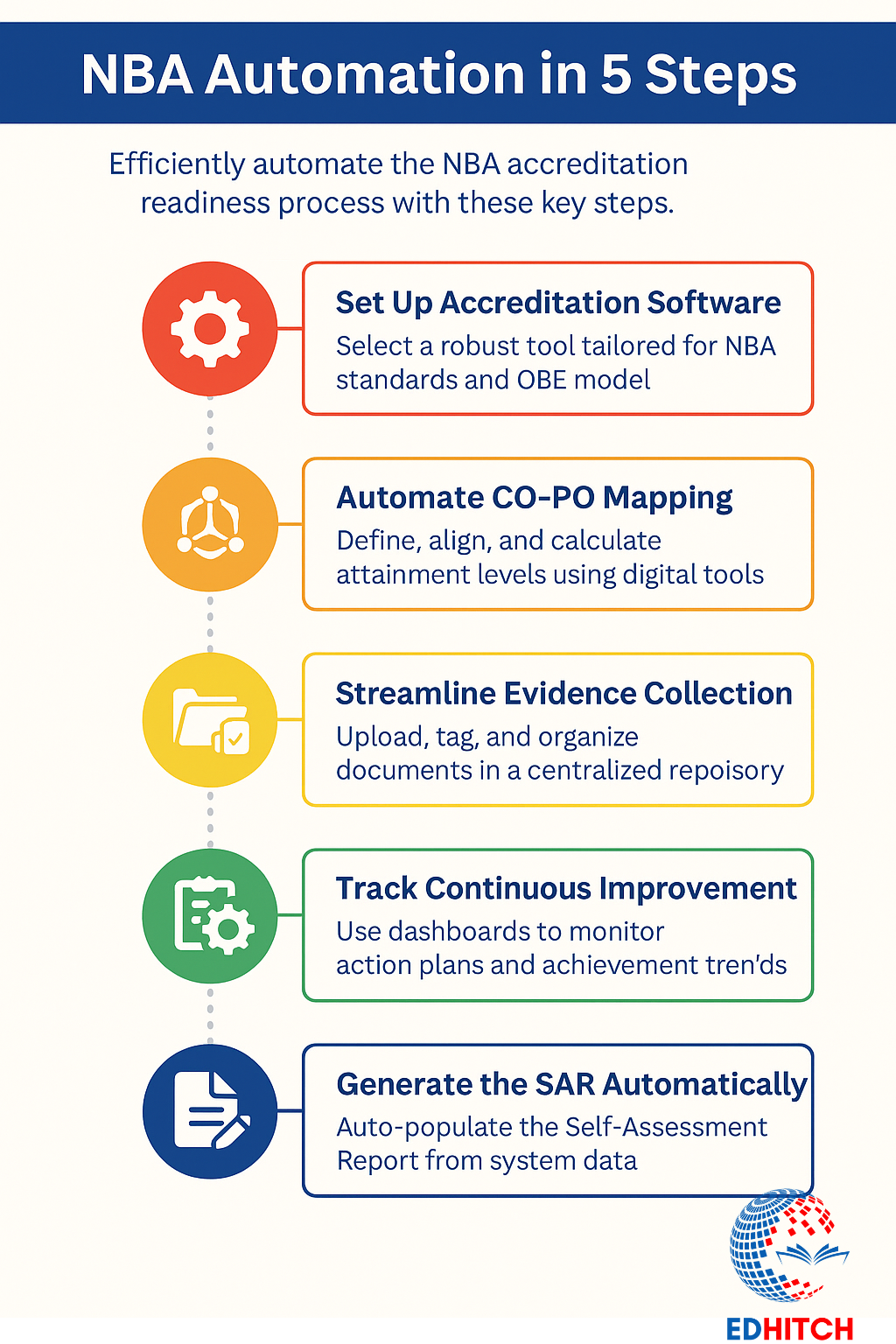
4. The 5-Step SAR Automation Workflow
- Upload 3 years of historical data — faculty, students, exams, and results
- Define COs, map them to POs/PSOs, and tag each question in your assessments
- Auto-calculate direct and indirect attainments (with normalisation)
- Upload and align your evidence to SAR sections using smart tagging
- Auto-generate the SAR in NBA-prescribed format — Word or PDF
Think of this like building with LEGO — but with clear instructions.
5. Start with a free CO-PO attainment tool
You don’t need to buy anything to run the attainment loop properly for one course. Two free tools cover the calculation and the mapping, and both are built to the 11-PO GAPC v4.0 structure.
Free CO-PO Attainment Calculator
- Excel template with the NBA 80/20 formula built in
- Up to 6 Course Outcomes per course, rolled up to all 11 POs
- Web calculator for a single CO if you just want a quick number
- Bloom’s Taxonomy CO verb reference included
Free Online CO-PO Mapping Matrix Builder
- Build the CO-PO-PSO correlation matrix in your browser
- Bloom’s level guidance for deciding 1, 2 or 3 mapping strength
- Export to CSV and paste straight into your SAR
- No login, no download
FAQs
Q1: What is the best way to automate NBA SAR generation?
Use software that combines CO-PO mapping, evidence tagging, and SAR formatting with built-in data logic and visual dashboards. The key requirement is that question-level assessment data flows through to PO attainment automatically, so recalculation after any correction takes seconds rather than days.
Q2: How is CO-PO attainment calculated correctly?
Each assessment question is tagged to a CO. COs are linked to POs via a weighted correlation matrix scored 1 to 3. Direct attainment comes from student performance against a threshold, indirect from course-end surveys, and the two combine using NBA’s standard 80/20 weighting. PO attainment is the weighted aggregate across the mapping matrix. Worked examples in the CO-PO attainment calculation guide.
Q3: Which documents are required for NBA accreditation?
Vision and mission, PEOs, course outcomes, CO-PO matrix, course files, assessments, feedback, mentoring logs, FDP records, and continuous improvement plans with Action Taken Reports. Under Revised SAR 2025, three years of attainment data with documented resulting actions is expected — not attainment figures alone.
Q4: What tools help with NBA evidence tracking?
Digital systems that allow file tagging by criterion, live readiness dashboards, and auto-linked SAR exports. The practical test: can you answer “which criterion is missing evidence right now” in under a minute?
Q5: Does CO-PO mapping apply to NAAC Binary as well as NBA?
Yes. The NAAC Binary framework expects outcome-based practice backed by measurable attainment across all disciplines, not only engineering. The underlying CO-PO discipline is the same. The difference is presentation: NBA uses the SAR format with programme-level POs, NAAC Binary assesses institution-level attributes. Institutions running both benefit from one CO-PO data source feeding each submission.
Conclusion: Accreditation is a System, Not a Sprint
Here’s the hard truth: NBA and NAAC Binary aren’t difficult — they’re just data-heavy. Those who panic at the last minute are missing the bigger opportunity. With the right systems in place, your SAR or SSR can write itself, and your faculty can spend time teaching, not firefighting.
Related tools & resources on Edhitch
- CO-PO Pro — ₹2,499/year (1 course) or ₹4,999/year (up to 6 courses) for individual faculty (works for both NBA SAR and NAAC Binary SSR)
- The 11 Programme Outcomes of NBA — GAPC v4.0 Explained
- CO-PO Attainment Calculation for NBA — Full Guide
- Free CO-PO Attainment Calculator (Excel + Web)
- Free Online CO-PO Mapping Matrix Builder
- NBA Accreditation Manuals 2025 — Tier-I & Tier-II
- Enterprise CO-PO Mapping Software (institutional)
- OBE Software — Full Lifecycle (GAPC v4.0)
Stop building this in Excel.
You’ve just read a guide on automation. The honest truth: faculty who actually adopt automation start small. Pick one course, run the attainment loop properly for one semester, prove it to your committee, then scale. Here are two ways to start.
Most faculty start with CO-PO Pro for one course, prove the workflow, then their HOD calls us for the institutional version. That’s the right order.